Prediction markets foresaw Democratic dominance in midterm elections
A dominant performance by Democrats in this week’s midterm elections created a political earthquake, shifting the balance of power in Washington, D.C., and offering a clear view of voter frustration with President Trump and his party. But most of Tuesday’s results were foretold in the hours before polls closed. Online prediction market platforms, such as Kalshi and Polymarket, have proven capable in recent…
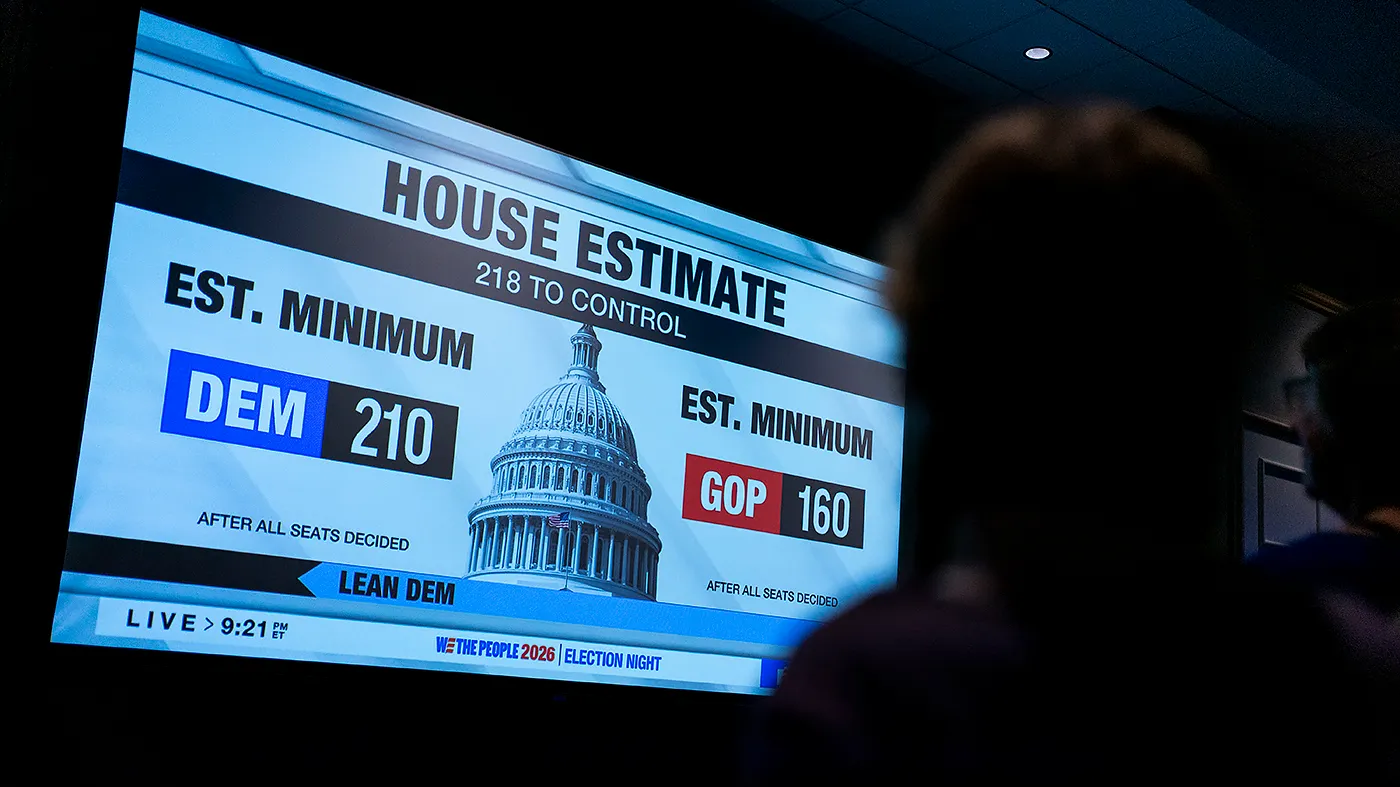
A dominant performance by Democrats in this week’s midterm elections created a political earthquake, shifting the balance of power in Washington, D.C., and offering a clear view of voter frustration with President Trump and his party.
But most of Tuesday’s results were foretold in the hours before polls closed.
Online prediction market platforms, such as Kalshi and Polymarket, have proven capable in recent election cycles of providing an increasingly accurate view of the public’s perception of likely political outcomes and current events.
Prediction market platforms performed with impressive accuracy again on Tuesday, as traders poured billions of dollars into election markets at a time when the platforms face growing scrutiny from lawmakers about the dangers of insider trading and gambling addiction.
“There’s no way around it, the prediction markets seem to be highly accurate,” said Ross Dahlke, an expert in computational social sciences and a professor at the University of Wisconsin-Madison.
“The markets just react so quickly to new information in a way that a lot of traditional media isn’t set up to do, particularly with their concern over accuracy, fact-checking — for better or for worse,” he added.
Democrats were expected to perform well on Tuesday, given widespread voter concern about the economy and the war with Iran. But the volume of trading on prediction markets this election cycle and the speed with which the platforms were able to correctly predict races were notable.
Many of Tuesday’s key race results were being projected accurately on prediction market platforms hours before major TV networks, which use decision desk data and voter analysis to make race calls, declared winners.
Kalshi, one of the nation’s most widely used prediction market platforms, said Wednesday its markets had correctly predicted 98 percent of House, Senate, governor, attorney general, lieutenant governor and secretary of state races.
The company said it compared market favorites at 5 p.m. EST shortly before the first polls closed in Indiana and Kentucky to races that have been called so far.
Race results were still coming in on Wednesday, but Kalshi touted 95 percent accuracy on House races and 94 percent accuracy on Senate races, including highly competitive seats in Texas, Maine and Kansas that all went to Democrats.
Dahlke underscored that the initial numbers only include resolved markets, which may be easier to predict than those that remain unresolved, and that many races were fairly certain going into Election Day.
Polymarket said Wednesday its midterm markets were accurate in 98.4 percent of resolved races, when compared with the day before the election. It touted about 97 percent accuracy in Senate and governor races and 98.6 percent accuracy in House races.
“It’s now routinely hours between when prediction markets call it versus the TV networks,” Polymarket CEO Shayne Coplan wrote in a post on the social platform X.
“The networks hold out until absolute certainty, and the suspense keeps it entertaining all night. No knock to them, but now there’s Polymarket, and many people are realizing they want to know what’s happening in real time.”
Prediction markets exploded in popularity following the 2024 election, a race where traders on both Kalshi and Polymarket correctly picked Trump to defeat former Vice President Kamala Harris.
Prediction markets have served as a venue for users to wager on the outcome of specific real-time events, from major business transactions and natural disasters to military actions, in addition to live sports events.
Lawmakers in Congress have voiced heightened concern about the ability of people with access to pertinent information on current events to profit from that knowledge using prediction markets.
Trading volume on Kalshi election markets nearly doubled over the past two years, rising from $1.3 billion in the 2024 cycle to $2.5 billion this cycle, the company said Wednesday.
A recent Washington Post analysis estimated nearly $2 billion was wagered on Tuesday’s midterm elections on platforms such as Kalshi and Polymarket.
Despite recent successes, prediction markets have had some high-profile misses in other elections.
Polymarket showed Brazilian presidential candidate Flávio Bolsonaro with a greater than 80 percent chance of winning late last month, before he lost to incumbent President Luiz Inácio Lula da Silva.
In the primary race for Los Angeles mayor, Kalshi traders were pricing in a 78 percent chance that Republican Spencer Pratt would advance to the general election. Instead, sitting Mayor Karen Bass (D) and progressive Nithya Raman faced off in the final contest.
And progressive Francesca Hong appeared steeply favored to win the Democratic primary for Wisconsin governor in August, with a 95 percent chance on Kalshi, but David Crowley ultimately won the nomination instead.
Some observers saw Tuesday’s midterms as a key moment for the prediction market industry, both in terms of growing its customer base and its effort to fend off increasing scrutiny.
“This creates a powerful incentive to participate again, potentially converting casual observers into active traders. For platforms like Kalshi and Polymarket, this election may have introduced an entirely new customer base that now believes it has an informational advantage,” said Matthew Bakowicz, a professor of business at American University.
“As these platforms attract more participants and larger amounts of money, lawmakers will likely focus increasingly on market integrity. Interestingly, the more successful these platforms become, the more scrutiny they may attract.”
Topics in this story
Gathered from external sources. Rights to this text belong to whoever originally published it.