Americans don’t agree on much. Backlash to Big Tech might be the outlier
Big Tech is facing some of its fiercest resistance yet from Americans finding common ground, a rarity in today’s politically polarized environment, over the technology industry’s growing footprint across the country. From protests over data centers and AI-powered surveillance cameras to landmark verdicts against social media platforms, backlash against Big Tech is reaching a fever…
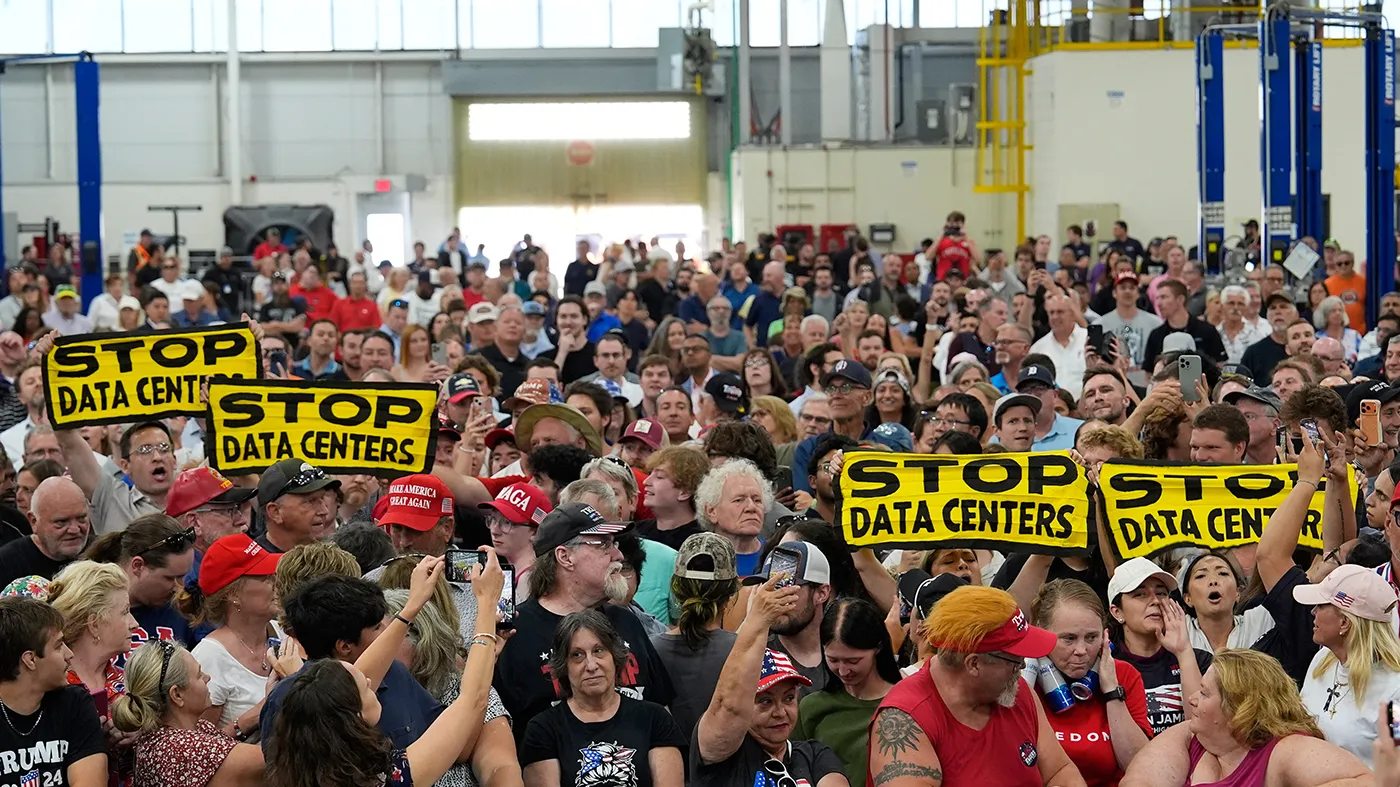
Big Tech is facing some of its fiercest resistance yet from Americans finding common ground, a rarity in today’s politically polarized environment, over the technology industry’s growing footprint across the country.
From protests over data centers and AI-powered surveillance cameras to landmark verdicts against social media platforms, backlash against Big Tech is reaching a fever pitch in both political parties.
Political scientists say the scrutiny on the different issues is colliding and is rooted in the same sentiment: “Don’t tread on me.”
“You couldn’t think of a better Bond villain than Big Tech, who are promising to put you out of a job, to make your children ignorant and completely captured by their algorithms, to make you completely surveyed so that the government or companies can track virtually every one of your movements, and take your land for its data centers,” Valerie Hudson, a distinguished professor with the Texas A&M University Bush School of Government and Public Service, told The Hill.
The technology industry had a busy six months, fielding mounting questions over the cybersecurity risks of new, advanced AI models and the data centers and actual data used to train and maintain the technology.
In the midst of President Trump’s inauguration and unreserved support for technology firms, Democrats treated AI and surveillance technology with far more skepticism than their Republican counterparts, often using the industry’s monetary support of the president as ammunition.
Progressives like Sen. Bernie Sanders (I-Vt.) or Rep. Alexandria Ocasio-Cortez (D-N.Y.) seized on concerns over AI’s impact on jobs and the environment, calling for bans on data centers or further AI development.
These concerns were mostly only expressed among Democrats, but the tides started to shift this summer when a growing number of GOP leaders abruptly broke with their typical support for innovation over strict regulation.
As data centers and AI development tanked in popularity, Republicans, like Texas Gov. Greg Abbott, found themselves aligned with figures on the left such as Pennsylvania Gov. Josh Shapiro (D).
Both governors rolled out new initiatives this summer to more carefully approve data center projects and reduce any financial or environmental burden of the massive facilities on residents.
Candidates like Texas Attorney General Ken Paxton (R) and former Rep. Mike Rogers (R-Mich.) have also called for tighter guardrails on the projects, while members in Congress have introduced legislation to ensure data centers and AI firms bear the costs of the facilities and that they benefit communities.
While Trump has remained all in on data centers, the White House did soften its policy on AI regulation earlier this year, floating ways for the government to oversee private model rollouts.
Hudson, a political scientist, described the growing bipartisan alliance as an example of “transformative repolarization,” which occurs when issues unite voters on the left and right “in ways that are highly unusual for the typical polarized environment” present in the U.S.
The movement, described by some as a populist push against Big Tech, is showing in the polls. A Gallup poll released in July found public confidence in large technology companies was at a record-low, dropping from 32 percent in 2020 to 20 percent in 2026.
The same poll showed Republicans’ support for large technology companies dropped slightly last year to 20 percent, while Democrats’ support dropped from 18 percent to 13 percent this year.
In Kentucky, a farmland owner made headlines last month after telling an AI firm representative to “kick rocks and don’t come back” after being offered more than $26 million for their property to build a data center.
“There is a limit to what Americans will put up with,” Hudson said.
The same dynamics are unfolding around surveillance technology and the idea of government or technology corporations infringing on Americans privacy, political scientists noted.
The national backlash against Flock Safety resurfaced this summer, catching the attention of GOP policymakers despite their longtime support of law enforcement.
Flock offers a system of automated license plate readers, video cameras and audio detection devices that not only record license plate numbers, but specific details about a car to create what the company calls a “vehicle signature.”
These details include the make, model and color of the car along with unique features like bumper stickers, decals and accessories. Flock argues a license plate is “just a start” in law enforcement investigations, and the additional information can be crucial for missing persons or criminal searches.
While communities acknowledge the technology’s use in emergencies, many feel the information collection amounts to a massive database and unwarranted mass surveillance of drivers on the road.
An increasing number of Republicans this summer suggested the cameras, despite their use to law enforcement, run up against the values of privacy-minded conservatives .
The push from the GOP is akin to Democrats, who have taken a more hard-line approach to AI-powered surveillance systems, arguing they risk abuse by law and immigration enforcement and intelligence agencies.
Over the past week, both Abbott and Shapiro ordered restrictions on Flock or funding for the technology, joining the likes of Rhode Island Gov. Dan McKee (D), Florida Gov. Ron DeSantis (R) and Utah Gov. Spencer Cox (R).
“In our intensely divided moment, there’s one thing that the right and left seem to agree on: they hate Flock cameras,” Rikki Schlott, a media fellow with the libertarian think tank Cato Institute, wrote in a column last month for the New York Post .
Flock updated its privacy policies last month amid the backlash, but civil liberties groups told The Hill it was not enough to quell the fears.
Political strategist Basil Smikle said the scrutiny is rooted in a “long existing, but still growing rejection of a large surveillance state,” an idea that has resonated in both parties in the past.
“We’ve certainly seen over the last few years the connection between technology and crime fighting, but there are real concerns about the impact on people’s liberties,” Smikle said.
Privacy concerns have also long existed in both parties for kids online safety on social media platforms. Bipartisan groups of lawmakers have teamed up for years on legislation to hold social media firms accountable for alleged harms to kids, but little has made it across the finish line.
While firms have avoided new requirements through Congress, two landmark verdicts against Meta and a major settlement to change its platforms demonstrated the backlash may play out in court instead.
Even as Meta agreed to significant changes to its platforms, some are still skeptical much will change since the platform itself wrote the rules.
Should companies — social media or AI firms — be open to new regulation, Hudson suggested, “the trust is way too far gone.”
“They [the public] would assume that the tech companies had written the regulations in their own self-interest,” Hudson said, adding she does not see how firms could “come back” from the backlash.
Topics in this story
Gathered from external sources. Rights to this text belong to whoever originally published it.