Ancient ‘Vegan Dracula’ Fish Found Lurking Over 900 Miles from Natural Habitat, Stunning Scientists
Scientists expected the creature only lived in cold water, before recently discovering the fanged fish in warm tropical streams
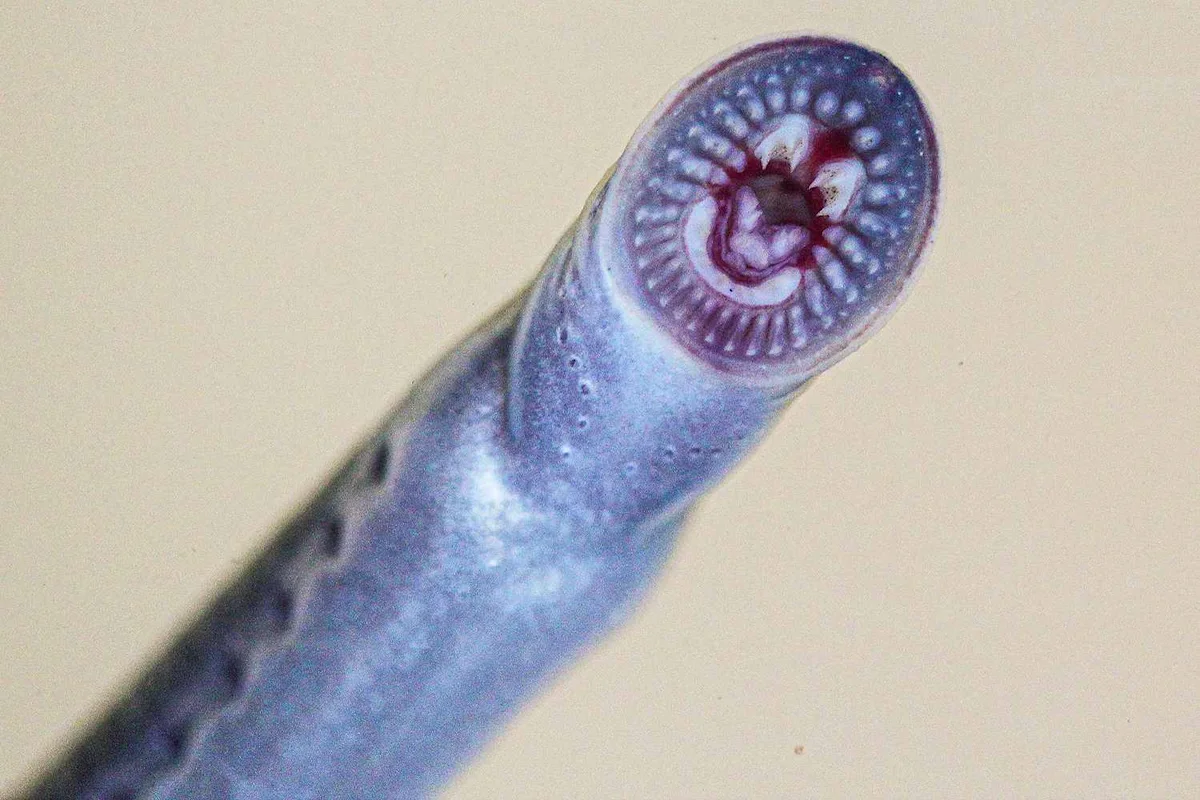
The Australian brook lamprey, nicknamed "vegan Dracula," is a non-parasitic, ancient fish predating the dinosaurs
Researchers discovered the species in Queensland, challenging assumptions that lampreys only survive in cold climates
Scientists believe the lampreys could aid genetic research and help advance human medicine through their unique biology
An eel-like fish with rows of sharp, circular teeth has been nicknamed "vegan Dracula," despite being a harmless sea creature.
The nickname belongs to the Australian brook lamprey (Mordacia praecox), an ancient, jawless creature that scientists in Queensland, Australia, are now working to understand. According to IFLScience , despite its fearsome-looking mouth, the species is non-parasitic, meaning it doesn't feed on the blood or flesh of other animals the way many of its relatives do.
"Lampreys, across the world, are generally parasitic," Griffith University aquatic ecologist Dr. Luke Carpenter-Bundhoo told the outlet. "These [Australian brook] lampreys forego that parasitic feeding phase — they're the vegan Dracula of lampreys."
Carpenter-Bundhoo added that lampreys are ancient, predating the dinosaurs, and have changed remarkably little over time. "They are older than, say, the Australian lungfish, which everybody likes to tout as the dinosaur fish," he said in a statement for Griffith University. "Lampreys actually existed before and after dinosaurs. What we see 150 million years ago is effectively what we see as a lamprey today."
Carpenter-Bundhoo first discovered the species on K'gari — the World Heritage-listed island formerly known as Fraser Island — in 2022, while studying the effects of the Black Summer bushfires on the island's ecosystem.
He was startled to find an eel-like creature with seven gills in one of the island's creeks, roughly 1,500 kilometers (about 930 miles) north of the species' previously documented range near the New South Wales–Victoria border, where it is now believed to be locally extinct.
The discovery also upends the long-held assumption that lampreys can only survive in cold climates. "It was always thought they couldn't exist in warmer waters, but they've been here and as far north as Rockhampton for more than a decade," Carpenter-Bundhoo said. "Technically, Queensland is home to the world's first tropical lamprey."
Because the fish were thought to break down in temperatures above about 28 degrees Celsius (82 degrees Fahrenheit), their tropical survival abilities have raised hopes that the species could resist climate change.
Today, new funding could reveal the scope of the lamprey's spread. Carpenter-Bundhoo was awarded $90,116 through the Queensland government's Protecting Queensland's Threatened Species Applied Research Grant Program, delivered by the Department of the Environment, Tourism, Science and Innovation (DETSI). Working with DETSI principal scientist David Moffatt, he plans to sample remote and hard-to-reach habitats across the state to pinpoint where the lampreys live.
The team believes Queensland may be home to three "vegan Dracula" species. Alongside the Australian brook lamprey, researchers have identified two smaller, as-yet-undescribed lampreys they're confident are new to science — a finding that, if confirmed, would bring Australia's total to five lamprey species, three of them in Queensland.
Beyond their novelty, the fish could hold real scientific value. Carpenter-Bundhoo has described lampreys as a "model organism" for genetic research, calling them an essential blueprint for understanding how a vertebrate is built, and scientists hope the creatures could eventually help advance human medicine.
Never miss a story — sign up for PEOPLE's free daily newsletter to stay up-to-date on the best of what PEOPLE has to offer, from celebrity news to compelling human interest stories.
"Knowing their locations will help us create awareness and increase opportunities for their protection," Carpenter-Bundhoo said, cementing Queensland's place as a "hotspot for these incredibly cryptic and fascinating non-parasitic creatures."
Topics in this story
Gathered from external sources. Rights to this text belong to whoever originally published it.