MIT scientists break a 20-year materials science rule; flexible nanoparticle links replace rigid connectors to create never-before-seen crystal structures
For years, scientists designing nanoparticle structures have preferred molecules that hold their shape.
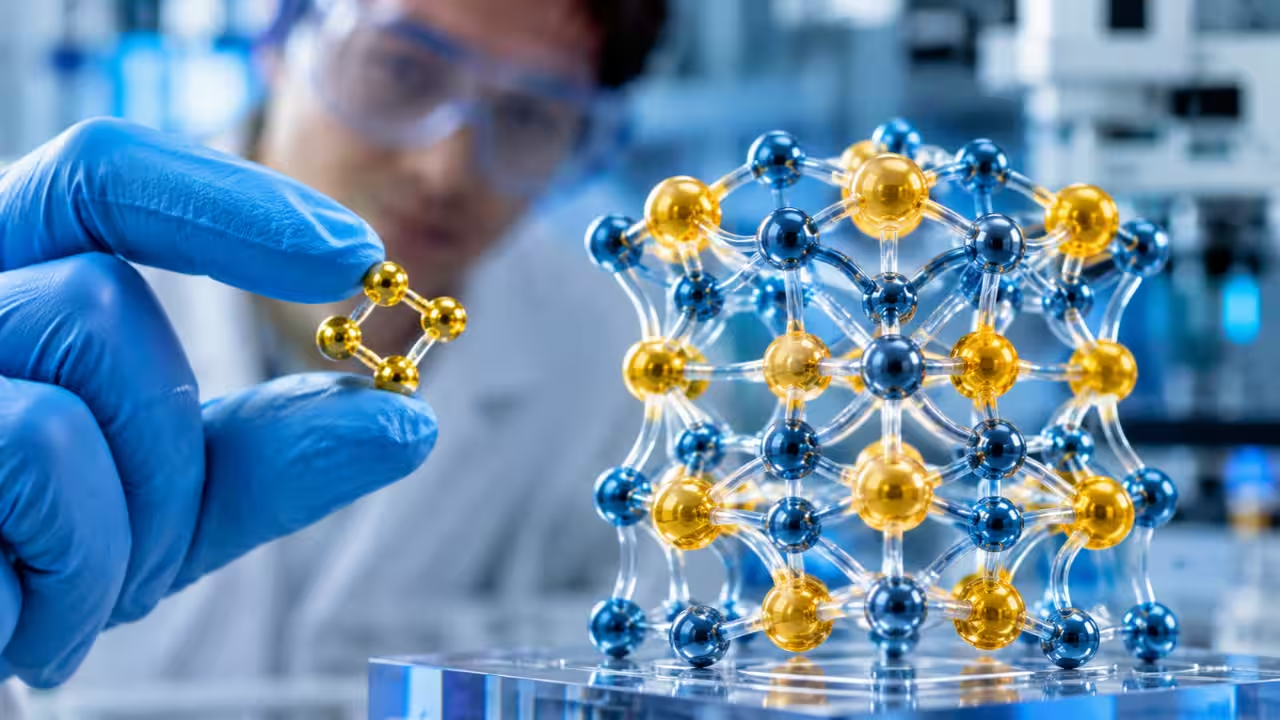
For years, scientists designing nanoparticle structures have preferred molecules that hold their shape. The thinking was that rigid connectors would keep the tiny particles in place, while flexible ones could bend and disrupt the arrangement. An MIT research team has now shown that this need not be the case. In experiments with gold nanoparticles, the scientists used flexible molecular chains to build ordered crystal structures that had not been produced before. The finding puts a long-standing materials science assumption to the test and gives researchers another way to control how nanoparticles come together.Science behind the 20-year rule for nanoparticle connectionsNanoparticles may be extremely small, but the way they are arranged determines how they behave when brought together to form a material. Scientists can assemble them into repeating patterns called superlattices, where the connections between individual particles help shape the final structure.One challenge is stopping the particles from simply clumping together. To get them into a specific arrangement, researchers use molecules known as ligands, which act as links between neighbouring nanoparticles.For about 20 years, scientists favoured rigid ligands for this job. The reasoning was straightforward: molecules that hold their shape should keep the particles in place. Flexible connectors, which can bend and shift, were considered less suitable because they might disturb the arrangement.How scientists used molecular flexibility to limit nanoparticle bondsAccording to the research published in Nature, titled ‘Breaking symmetry in nanoparticle superlattices via spontaneous valency’, the team chose gold nanoparticles for the experiments and used polyethylene glycol (PEG) to make the connecting chains. PEG is a widely used polymer, but its behaviour is quite different from that of the rigid ligands traditionally used to assemble nanoparticles. Its chains can bend and rearrange rather than hold a fixed shape.To help the particles connect, the researchers modified the ends of the PEG chains with positive or negative electrical charges. The charged ends encouraged interactions between neighbouring particles as they came together.The team did not try to dictate the precise position of every connector. Instead, they allowed the polymer chains to move around during the assembly process. Computer simulations helped the researchers track this behaviour alongside their laboratory experiments.The discovery that challenged two decades of materials science thinkingThe results questioned an assumption that had shaped nanoparticle assembly for around 20 years. Rob Macfarlane, the MIT materials scientist who led the research, described the team's approach as the opposite of the established principle. Rather than fixing every connection before assembly began, the researchers used the behaviour of flexible polymers to regulate how many links formed between particles. The chains effectively helped determine the final arrangement as the nanoparticles came together.The size of the particles also made a difference. By changing the dimensions of the gold nanoparticles and varying the length of the polymer chains, the researchers could alter the number of connections formed. Smaller particles, for example, developed fewer links in the experiments. The length of the connecting chains mattered too, as did their ability to move and rearrange around the contact points.Experiments produce previously unseen crystal arrangementsUsing the method, the researchers produced ordered crystal arrangements that had not previously been observed in nanoparticle assembly. The experiments showed that flexible connectors could do more than simply hold particles together. Their movement and clustering could help determine the pattern in which the particles settled. That finding opens up a different way of thinking about how these materials are designed. The number of links between particles can influence the architecture of a superlattice, and that architecture can, in turn, affect the properties of the material.Macfarlane's team demonstrated that polymer flexibility could be used to control how many bonds an individual particle forms. Researchers may therefore be able to produce lattices with fewer connections without changing the shape of the nanoparticles or having to specify the position of every bond.Potential applications in medicine, agriculture and photonicsThe researchers see possible applications in fields where the arrangement of materials at the nanoscale can influence their behaviour. Photonics is one area worth exploring. It involves the generation and control of light, and carefully arranged nanoparticles could offer new possibilities for materials designed to interact with it.Chemical catalysis is another field where the approach may prove useful. Catalysts help speed up chemical reactions, and their performance can depend on the structure of the material and the availability of active surface sites. Greater control over nanoparticle connections could give scientists another way to design these materials.Medicine and agriculture have also been identified as areas that could benefit from advances in nanoparticle-based materials. At this stage, however, these are potential directions rather than demonstrated applications of the new structures.Fearless legend or grounded realist? Rate yourself on 11 categories in the Great Indian Confidence Survey – find out in 3–6 min
Topics in this story
Gathered from external sources. Rights to this text belong to whoever originally published it.