‘Dracarys’: New ‘dragon’ species named after House of the Dragon’s Syrax discovered in Thailand
Science News: A newly described mountain horned dragon from western Thailand has given the world a species name with a fantasy-inspired twist. Researchers have name.
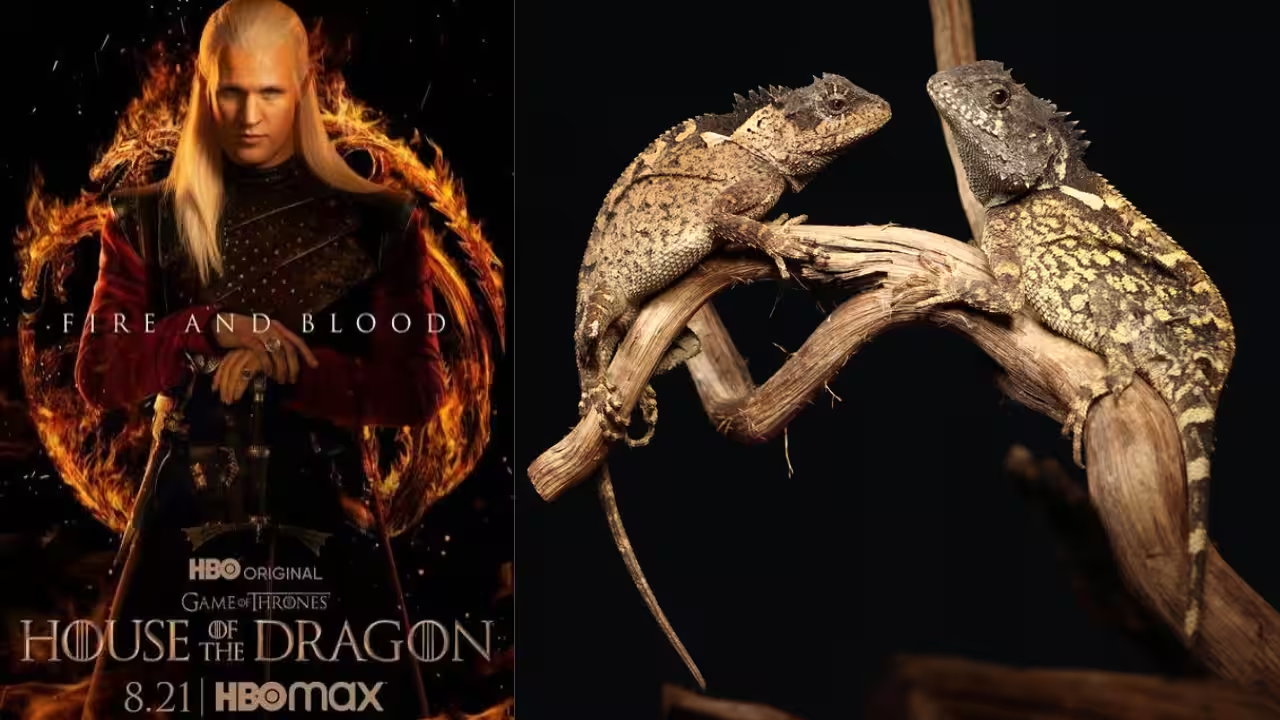
A newly described mountain horned dragon from western Thailand has given the world a species name with a fantasy-inspired twist. Researchers have named the small, spiny lizard Acanthosaura syrax, after Syrax, the dragon ridden by Queen Rhaenyra Targaryen in HBO’s House of the Dragon. The animal was found in the high-elevation evergreen forests of Mae Wong National Park, where it appears to occupy a restricted mountain habitat above 1,300 metres. Its name is not the only thing that makes the species remarkable. The lizard is among the smallest members of its genus and has the tiniest neck and back crest scales recorded in Acanthosaura. In the study published in ZooKeys, researchers combined characteristics with DNA evidence to establish that A. syrax is genetically distinct from its closest relatives, adding another species to Thailand’s remarkable reptile diversity. The findings underline why continued field surveys matter in poorly documented mountain ecosystems in Southeast Asia. It expands knowledge of Thailand’s mountain biodiversity.New lizard species discovered in Thailand’s high-elevation forestsThe new species was formally described as Acanthosaura syrax in the ZooKeys paper, ‘A new species of mountain horned dragon from high-elevation habitats of western Thailand (Squamata, Agamidae)’. The study was authored by Poramad Trivalairat, Krittiya Trivalairat, Nawee Moungkhaek, Simon Caponov and Benchapol Lorsunyaluck. The research involved scientists associated with Chulabhorn Royal Academy, Kasetsart University and Mahidol University in Thailand. According to the researchers, the lizard was identified from Mae Wong National Park in Tak-Kamphaeng Phet, where specimens were recorded in evergreen forest above 1,300 metres. The discovery brings the recognised number of Acanthosaura species to 23, highlighting how much biodiversity can remain hidden in mountain environments and the hidden species.Why was the mountain horned dragon named after Syrax?The name Syrax was chosen because several traits of the real lizard echo the fictional dragon from House of the Dragon. Acanthosaura syrax has yellowish-green colouring and a relatively small body compared with other mountain horned dragons. The species also produces comparatively large egg clutches for its body size, adding another distinctive feature to its profile. Its physical characteristics help separate it from closely related species as well. Researchers found that it has the smallest nuchal and dorsal scales recorded within the genus Acanthosaura, while its overall body size is notably small. Unlike several related species, it lacks a black patch surrounding the eye and instead has a distinctive dark collar marking. DNA analysis further supported its status as a separate species, with sequences from the ND2 and COI genetic markers showing that A. syrax is genetically distinct from its closest relative, A. lepidogaster, as well as other members of the genus.Why could Acanthosaura syrax be important for conservation?Beyond its memorable name, Acanthosaura syrax could become important for conservation efforts in western Thailand. The researchers indicate that the species appears to be restricted to high-elevation evergreen forests within Mae Wong National Park, with its known habitat occurring at elevations above 1,300 metres. The rugged mountain landscape may also contribute to isolated populations, although the species’ full distribution and population size are not yet known. Further surveys will therefore be necessary to establish whether the lizard occurs in other suitable habitats. The researchers have highlighted the importance of protecting the park’s high-altitude forests and suggested that the newly described species could serve as a flagship for conservation in the area. Mae Wong National Park is also home to other threatened wildlife, including the Asian forest tortoise, Oldham’s leaf turtle and the Indochinese tiger, meaning protection of its habitat could benefit a much wider range of species.
Topics in this story
Gathered from external sources. Rights to this text belong to whoever originally published it.