Trump moves to build his space legacy with NASA’s help
President Trump is about to do JFK one better.
Lost in the glare of the recent midterms and their startling results, President Trump released a proclamation entitled The American Declaration of Freedom in Space . The document states that American policy will be to open up the solar system “forging an interplanetary civilization founded on the enduring and inalienable rights of freedom and individual liberty.”
Summoning the legacy of the Apollo moon landings and the ongoing Artemis program, Trump’s proclamation set an ultimate goal for America’s space effort that goes beyond just returning to the moon and going on to Mars.
It states that “the solar system and all of outer space beyond Earth are the province of all humans and are open to exploration, development, use, and the establishment of a permanent presence by American citizens consistent with United States law and the international obligations of the United States.”
As noted, the proclamation does not set aside the Outer Space Treaty by claiming the solar system for the U.S. as sovereign territory. But it is firm in the principle that the U.S. will lead the winning of the high frontier of space.
A few short years ago, Trump’s proclamation and the vision contained within it would have seemed to be more a scenario of a science fiction story than government policy. Now, the document has been barely remarked on, even by critics. The wide acceptance of the Artemis program and the rise of the commercial space sector, as exemplified by SpaceX and Blue Origin, have made dreams of an interplanetary civilization into a likely future.
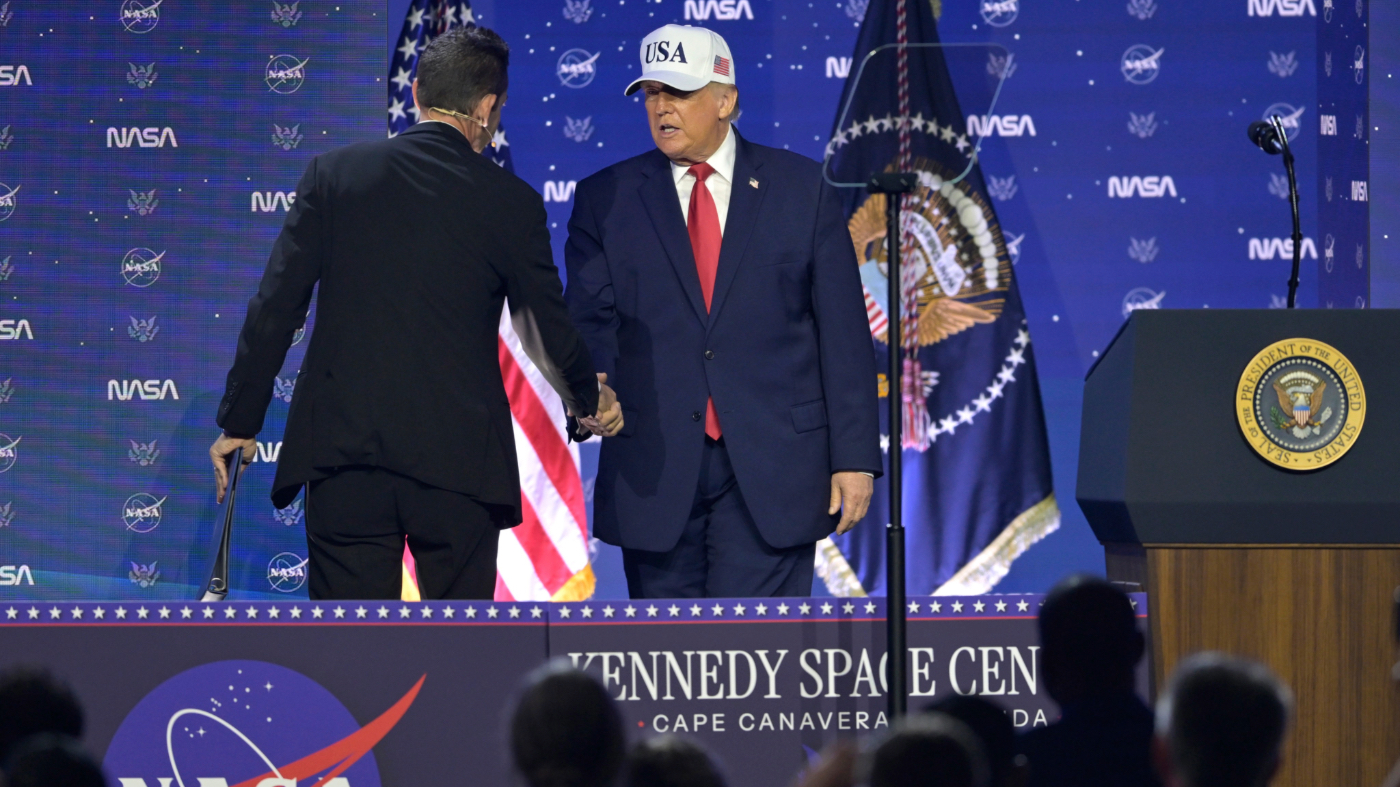
Three days after the midterms, President Trump traveled to the Kennedy Space Center in Florida to deliver remarks at Max Power , a technology exhibition and air show. Some of his speech covered the midterms and more Earthly issues. But the heart of what the president had to say celebrated the space program, as well as technological advances such as nuclear power and the Human Genome Project. He noted the upcoming Artemis IV moon landing, with missions scheduled to begin in 2028, the final year of his current and last term in office.
The very next day, NASA announced contracts issued under the next phase of the Commercial Lunar Payload Services program.
“The investments will advance commercial robotic deliveries, a nuclear-powered rover named PROMISE, launch and orbital transfer services, and surface infrastructure as the agency works with American industry to establish a sustained presence on the Moon’s South Pole.”
No matter what happens, Donald Trump will not be president of the United States after Jan. 20, 2029. After the thumping that the Republicans received in the recent midterms, Trump has two things to do. He has to hold the line against emboldened congressional Democrats, and he has to build a lasting legacy.
The first task should be straightforward. Like President Obama after his midterm defeat in 2014, Trump has a veto pen and a phone. He will have to fend off attacks on Elon Musk, the entrepreneur crucial to the spread of human civilization across the solar system.
For the second task, Trump should look to the example of President Reagan after the 1986 midterm elections. Reagan was the subject of endless investigations and threats of impeachment surrounding the Iran-Contra scandal, just as Trump is likely to be because of a multitude of real and perceived sins.
Despite all that, Reagan left office with a 63 percent approval rating . Then, when the Berlin Wall fell, followed by the Soviet Union, he became a world historic figure, mentioned in the same breath as Washington and Lincoln. Incidentally, Reagan’s legacy also includes the orbiting laboratory that eventually became known as the International Space Station.
If all goes as planned, in the midst of the tiresome veto fights and endless investigations, in 2028, American astronauts will walk on the moon. America and the world will stop and watch in wonder at the sight, not seen since Richard Nixon was in office.
No matter what one feels about Trump, hate him or love him, the unalterable fact will be that he set that next moonwalk in motion. The Artemis program has survived changes of administrations and congresses. It is one thing that most Americans, on both sides of the political divide, agree is glorious and good.
Think of President John F. Kennedy. Two things are remembered of him. He was assassinated and he threw down the gauntlet for the race to the moon.
President Trump is about to do Kennedy one better. The Apollo program ended. The Artemis program and what will follow will never end. Not a bad legacy.
Mark R. Whittington, who writes frequently about space policy, has published a political study of space exploration entitled “ Why is It So Hard to Go Back to the Moon? ” as well as “ The Moon, Mars and Beyond ” and, most recently, “ Why is America Going Back to the Moon? ” He blogs at Curmudgeons Corner.
Topics in this story
Gathered from external sources. Rights to this text belong to whoever originally published it.