How Trump learned to stop worrying and love space science
He recognizes a cool thing when he sees it.
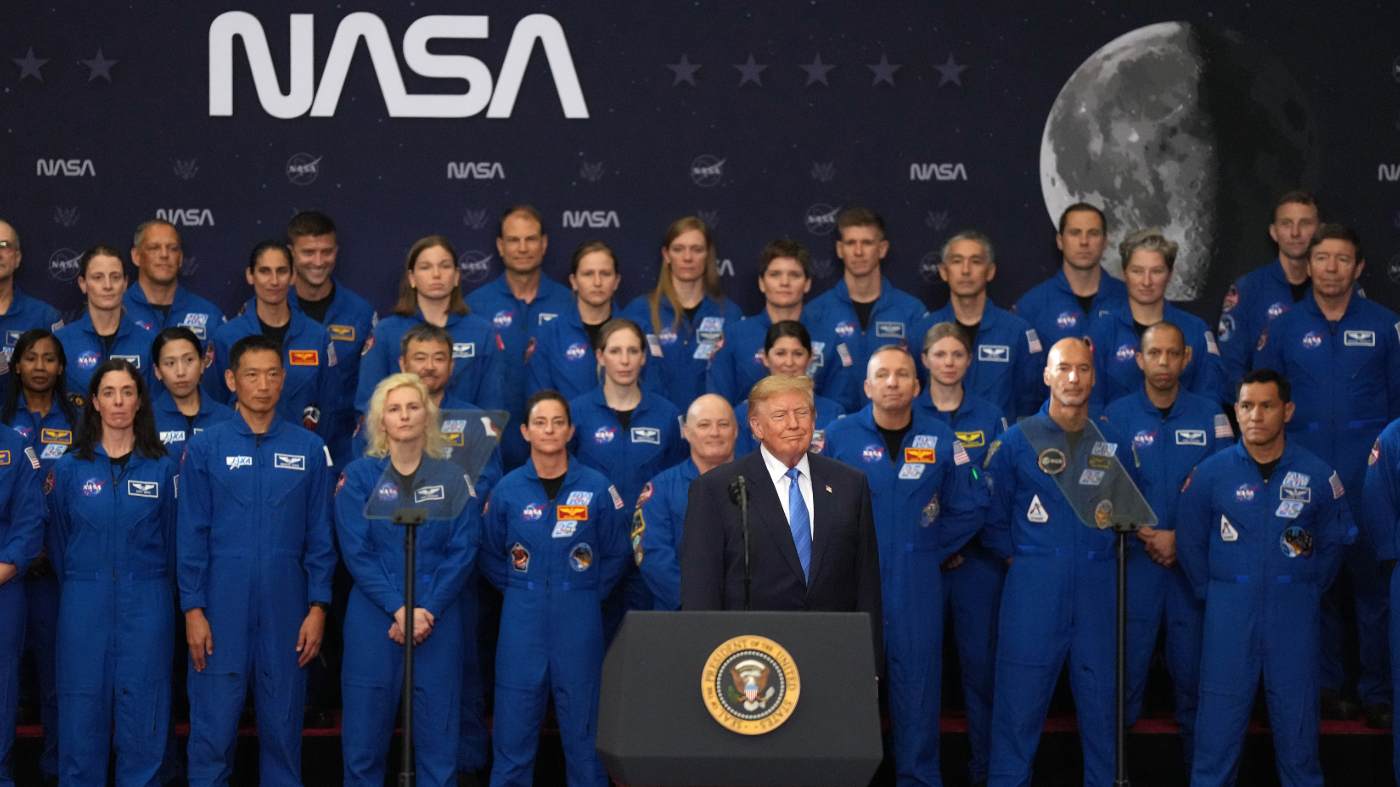
Ars Technica has reported that two NASA Venus probes have escaped the Trump White House budget axe. The development represents a subtle and welcome development concerning the administration’s attitude toward science missions that are not directly related to the Artemis return to the moon program.
The Deep Atmosphere Venus Investigation of Noble gases, Chemistry, and Imaging, or DAVINCI, mission will take off a year earlier than previously scheduled in December 2030. It will launch “a parachute-assisted descent probe through Venus’ atmosphere, returning the first direct images of the planet’s surface since 1982.”
The Venus Emissivity, Radio science, InSAR, Topography, And Spectroscopy, or VERITAS, mission “will follow with a launch in November 2032 to map the Venusian surface by radar from orbit.”
The greenlighting of two Venus missions is remarkable. As recently as April, the Trump administration proposed cutting NASA science , which includes the Venus probes, by roughly half. Everything outside Artemis was in jeopardy of the chopping block to help address the massive budget deficits the United States government is facing
Part of the reason that DAVINCI and VERITAS are going forward is that Congress, just as in 2025, is balking at the proposed cuts to NASA science missions. Another part is that some of the cuts were found by cancelling the Mars Sample Return mission , which was suffering from cost overruns and schedule delays.
The situation NASA finds itself in is nothing new. The historical record suggests that during the early days of the Apollo race to the moon, President John F. Kennedy was entirely uninterested in space exploration in and of itself. He saw the Apollo program as an instrument of the Cold War, a way to demonstrate the superiority of the United States over the Soviet Union.
Kennedy’s attitude was a source of endless frustration to his NASA administrator , James Webb, who wanted to fund missions outside of Apollo, such as the Mariner probes to Venus and Mars.
However, some evidence exists that President Trump is beginning to appreciate NASA science missions that are not part of Artemis. In August, when NASA launched the Nancy Grace Roman Space Telescope from the Kennedy Launch Center on top of a SpaceX Falcon Heavy, President Trump praised the mission with a post on Truth Social.
“Congratulations to NASA Administrator Jared Isaacman, and the Great Patriots at NASA, on a successful launch. This is THE GOLDEN AGE OF AMERICA!”
Trump also called into the post-launch press conference to offer more fulsome praise for NASA on the successful launch.
Ironically, the Nancy Grace Roman Space Telescope had been in danger of cancellation because of the proposed White House budget cuts. So, why the sudden change of heart?
The Nancy Grace Roman Space Telescope is an impressive undertaking, like the James Webb and the Hubble space telescopes. It will hunt for exoplanets, delve into the mysteries of dark energy and perform a great deal of other infrared astronomy. President Trump is quite right to celebrate its launch, as it will expand the frontiers of our knowledge of the universe. He recognizes a cool thing when he sees it.
On the other hand, Trump is a practical politician who knows how to make the best out of a policy reverse. The president, seeing what the political zeitgeist is, has become a champion of space science as well as the Artemis program.
Even so, the $2 trillion a year budget deficit and the over $40 trillion national debt is still out there and needs to be fixed. But it looks like the federal government will have to look elsewhere than NASA to find some savings.
Space exploration has entered a unique period of history. The hugely expensive and ambitious undertaking of sending astronauts beyond low Earth orbit to the moon, Mars and beyond has gained popularity on both sides of the political divide. But so have other missions, including probes to Venus and space telescopes.
Historians will figure out why this new space age has come to be. Factors like the threat of China, the rise of space barons like Elon Musk, and charismatic and politically savvy NASA leaders such as Jared Isaacman and Jim Bridenstine all have come into play.
The world can be a frightful place, as anyone who has turned on a television or seen social media can attest. But, beyond the Earth something glorious and good is taking shape. There is hope for humanity yet.
Mark R. Whittington, who writes frequently about space policy, has published a political study of space exploration entitled “ Why is It So Hard to Go Back to the Moon? ” as well as “ The Moon, Mars and Beyond ” and, most recently, “ Why is America Going Back to the Moon? ” He blogs at Curmudgeons Corner.
Topics in this story
Gathered from external sources. Rights to this text belong to whoever originally published it.