Meet Ramya Manjunath Anche, the Bengaluru-born astronomer leading NASA's $20 million PUFFINS telescope mission to study tiny dust particles between stars
This is the story of Ramya Manjunath Anche, a Bengaluru-born astronomer preparing to study something that has remained difficult for scientists to
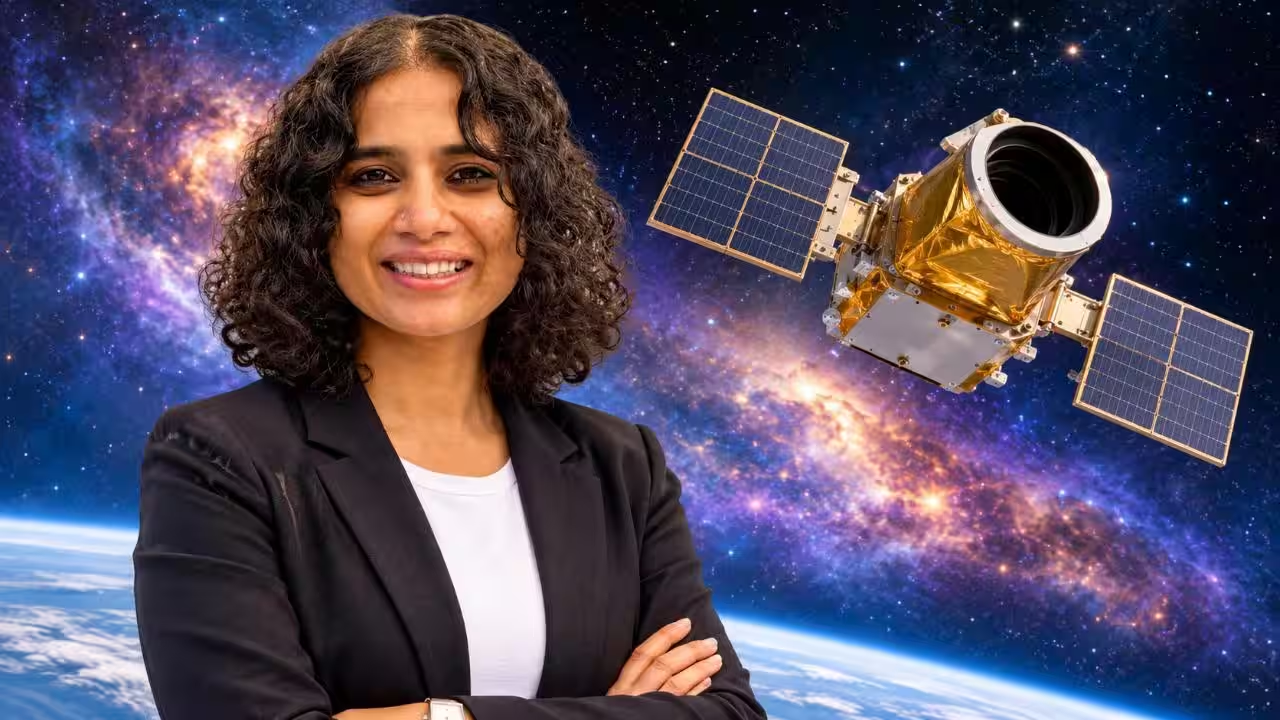
This is the story of Ramya Manjunath Anche, a Bengaluru-born astronomer preparing to study something that has remained difficult for scientists to understand for decades. The subject is of the tiny particles of dust floating between stars. As a teenager fascinated by the 2003 Space Shuttle Columbia disaster, she has now grown up to lead a NASA-funded space telescope mission worth $20 million.Anche is now working as an assistant research professor at the University of Arizona’s Steward Observatory as the principal investigator of NASA’s PUFFINS mission. The aim of the mission is to investigate interstellar dust using a specialised ultraviolet telescope. The mission, selected under NASA’s Astrophysics Pioneers programme, received $20 million in funding in October 2026 and is targeted for launch in 2030.What makes her achievement interesting is that the scientist leading this ambitious international project began her journey in Devanahalli, a town near Bengaluru, India. She then went on to pursue engineering and astrophysics in India before taking her research career to the United States.Journey from a curious schoolgirl to an astronomerRamya Anche comes from a family where science was a regular subject of conversation. Her father, A Manjunath, is a microbiologist retired from the University of Agricultural Sciences in Bengaluru. His work in soil research at home helped nurture her curiosity from an early age.She attended Oxford English School in Devanahalli before studying at MES Vidyasagar Prof. MPL Sastry PU College in Bengaluru. She subsequently pursued a Bachelor of Engineering degree in electrical and electronics engineering from Sir M Visvesvaraya Institute of Technology.In an interview with The Indian Express, Anche said that she was always interested in research and that her family never pressured her to take up a conventional job.Space Shuttle Columbia disasterIt was the Space Shuttle Columbia disaster on February 1, 2003 that influenced her decision. The accident claimed the lives of seven astronauts and left a deep impression on her as a teenager and prompted her to wonder why the tragedy had happened. She went so deep that she wanted to understand whether it could have been prevented.The journey from electrical engineering to astrophysicsIn 2012, Anche joined the Indian Institute of Astrophysics (IIA), Bengaluru for an integrated MTech-PhD programme in astronomical instrumentation. Her academic journey subsequently took her to Pune, where she completed a postdoctoral fellowship at the Inter-University Centre for Astronomy and Astrophysics (IUCAA) during 2020–21.In 2021, she moved to the United States. She was admitted to the University of Arizona's Steward Observatory and her work focuses on astronomical polarimetry, optical design, high-contrast imaging and the development of space telescopes.But one of the biggest milestones in her career came when she led a proposal for a NASA mission while still working as a postdoctoral researcher. The proposal eventually secured funding under NASA's Astrophysics Pioneers programme.What exactly is PUFFINS, the $20-million mission study?PUFFINS stands for Polarimetry in the Ultraviolet to Find Features in INterStellar Dust.These particles, known as interstellar dust grains, are incredibly small. As per the University of Arizona, PUFFINS will investigate grains smaller than approximately 50 nanometres, roughly the size of a common cold virus.Interstellar dust influences how light travels through space and is also connected to the formation of new stars and planets. Studying its composition, formation and behaviour can therefore help scientists understand how galaxies evolve and how the building blocks of planetary systems come together.To achieve this, PUFFINS will carry a specialised telescope measuring just 10 inches across, approximately the size of a large dinner plate. The mission will use a technique called ultraviolet spectropolarimetry.A team of 40 researchers and a 2030 launch targetAlthough Anche is leading the mission, PUFFINS is a collaboration of scientific efforts involving the University of Arizona, McDonald Observatory at the University of Texas at Austin and researchers from several institutions around the world.Around 40 scientists, engineers, graduate students and postdoctoral researchers are involved in the project. The team is currently in the early design phase, with the next four years expected to involve designing and building the telescope before its planned launch in 2030.
Topics in this story
Gathered from external sources. Rights to this text belong to whoever originally published it.