Meet Alaina Zhang, the 17-year-old testing whether native seaweed can cut Rhode Island’s coastal nitrogen pollution by 30%
Nature & Environment News: At 17, Rhode Island student Alaina Zhang is investigating whether a native seaweed could help tackle one of the state’s coastal pollution problems. Th.
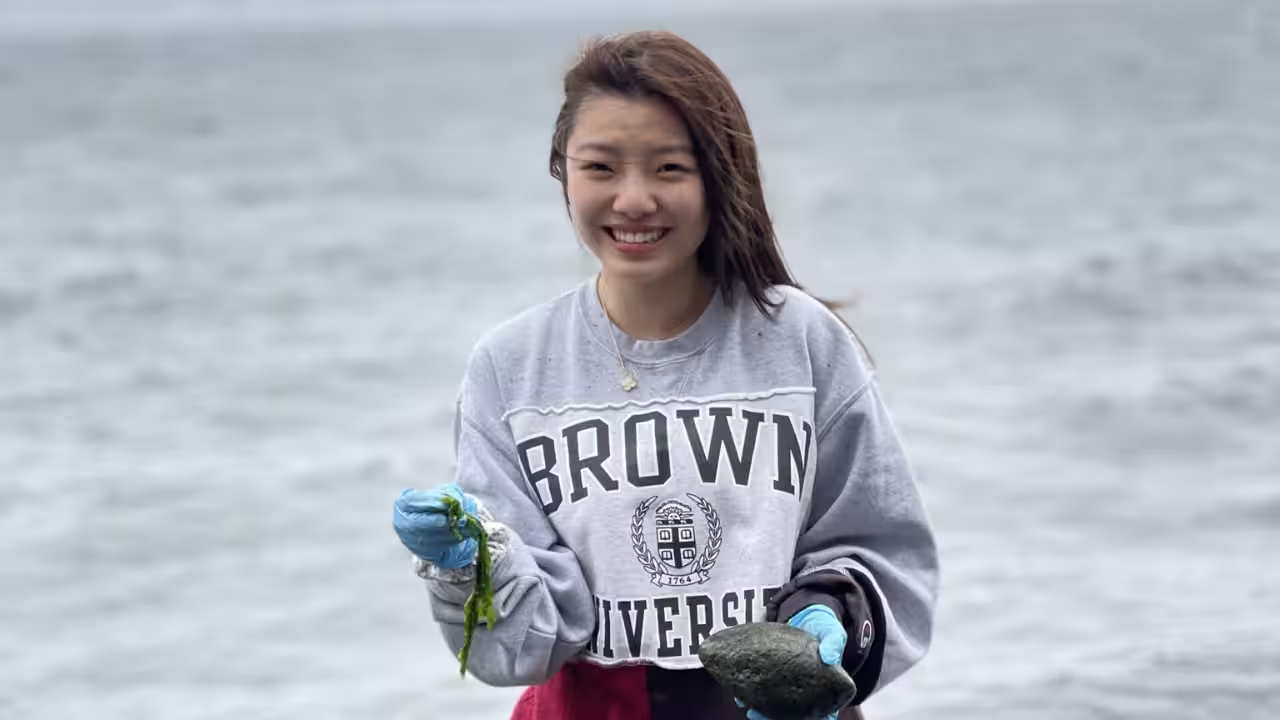
At 17, Rhode Island student Alaina Zhang is investigating whether a native seaweed could help tackle one of the state’s coastal pollution problems. Through her project, Harvesting Change, Zhang is studying sugar kelp and its potential to absorb excess nitrogen from coastal waters, where nutrient overload can fuel algal blooms and reduce oxygen available to marine life. Her interest in the issue grew from seeing polluted waterways during her childhood in China and later recognising similar concerns along Rhode Island’s coast. The project has since developed into student-led field research, scientific presentations and environmental advocacy, earning Zhang recognition as a 2025 Gloria Barron Prize winner.How polluted waters in China led Zhang to a Rhode Island research questionZhang’s interest in coastal pollution did not begin in a Rhode Island laboratory. She spent part of her childhood in China, where she saw algae-covered waters and the effects that pollution could have on the communities living beside them. When she later encountered similar concerns along Rhode Island’s coast, the connection stayed with her. Nitrogen enters coastal waters through sources including agricultural runoff and urban sewage. Once concentrations become too high, the resulting algal growth can consume oxygen as it breaks down, leaving less available for fish and other marine organisms.Zhang began looking for a way to address the problem that did not depend solely on removing pollution after it had reached the water. Seaweed offered a different possibility.How native sugar kelp could be used to tackle excess nitrogenSugar kelp is native to the waters around Rhode Island and, like other seaweeds, absorbs nutrients as it grows. Zhang’s Harvesting Change project explores whether that natural process could be put to practical use through kelp farming.According to the Gloria Barron Prize for Young Heroes, her research model suggests that growing sugar kelp could remove 30% or more of excess nitrogen under the conditions she examined. The attraction of the approach is partly its simplicity: rather than building an entirely new system to capture nutrients, kelp could use the surrounding seawater as part of the process while producing biomass.That does not make kelp a standalone answer to coastal pollution. Nitrogen still enters waterways from land-based sources, and the amount that seaweed can remove depends on factors such as location, growing conditions and the scale of cultivation. Zhang’s work is instead examining whether kelp can become one component of a wider strategy for improving coastal water quality.How a 17-year-old turned research into a field projectZhang did not begin with an established research programme waiting for her. She contacted researchers herself, including scientists at Brown University and the University of Rhode Island, after reaching out by email. She then worked through the practical side of establishing a field project, including obtaining permits from Rhode Island’s Coastal Resources Management Council and raising money for the work. The result was the first student-run sugar kelp farm in her area.Field research also meant working beyond school and laboratory settings. Marine researchers and field technicians have been involved, while local fishermen have provided experience and knowledge connected to the waters where the project is being carried out. That mix has shaped the project into something larger than a school experiment. Zhang has been testing a scientific idea while also learning how marine research operates in the real world, where permits, equipment, weather, local knowledge and public acceptance all matter.From measurements to a wider coastal questionThe research has developed into two projects examining sugar kelp, nutrient removal and coastal resilience. Zhang is lead author on both, with one manuscript under review by Frontiers in Marine Science, as reported by National Society of High School Scholars (NSHSS). She has also taken the work beyond Rhode Island. At the American Geophysical Union Annual Meeting, she presented her findings as one of its youngest oral presenters.Her kelp biofiltration model has received awards from organisations including the Environmental Protection Agency, NASA, NOAA, the US Air Force and the Rhode Island Clean Water Association. The recognition has given the research a wider audience, but Zhang has continued to spend time explaining the basic problem to people outside scientific settings. She has presented her work at workshops and lectures attended by more than 500 Rhode Islanders. For a project rooted in coastal chemistry and marine biology, communication has become part of the research itself, according to the Gloria Barron Prize for Young Heroes.How Zhang is connecting marine science with environmental policyZhang’s work has also moved into environmental policy. She helped start the Narragansett Bay Resilience Collaborative, which supports policy efforts connected with the health of the bay. She has testified in support of five environmental bills. Among them was the Coastal Habitat Conservation Act of 2023, which was signed into law in 2024.Her involvement has extended beyond state-level policy as well. As a UN Ocean Decade Youth Representative, she has advocated for ocean restoration measures on Capitol Hill. She has also worked with the Rhode Island Department of Environmental Management and contributed to an IOC-UNESCO Challenge 10 white paper.There is a practical thread running through those activities. The kelp project asks whether a biological process can help deal with a measurable environmental problem; the policy work looks at the systems and decisions that determine how environmental solutions can be used.How a Rhode Island kelp project became an environmental lessonZhang has spent considerable time bringing environmental science into classrooms and community settings. She serves as a NOAA Ocean Guardian Ambassador and is co-president of her school’s Environmental Science Club. She is also a co-leader of Ecotopia, an NGO supporting youth-led sustainability projects, and has taught elementary school pupils about her experiences in environmental research.That outreach has given her a second audience for the kelp work. A technical finding about nitrogen removal means little to someone who has never encountered the underlying problem. Explaining where the nitrogen comes from, what happens to oxygen in polluted water and how kelp might fit into the picture makes the research easier to connect with everyday coastal concerns. For Zhang, education and research have developed alongside one another rather than as separate activities.“This journey has taught me that leadership doesn’t begin with confidence — it begins with conviction,” she says. “I’ve learned that initiative isn’t about having all the answers — it’s about being willing to try.”
Topics in this story
Gathered from external sources. Rights to this text belong to whoever originally published it.