In 2018, scientists seeded clouds over China's Muz Taw Glacier to make snow; the brighter surface was followed by 14% to 17% less ice loss in a preliminary experiment
Earth & Climate News: Researchers in China have tried to make artificial snow over China’s Muz Taw Glacier to slow its melting. The experiment conducted in 2018 involved se.
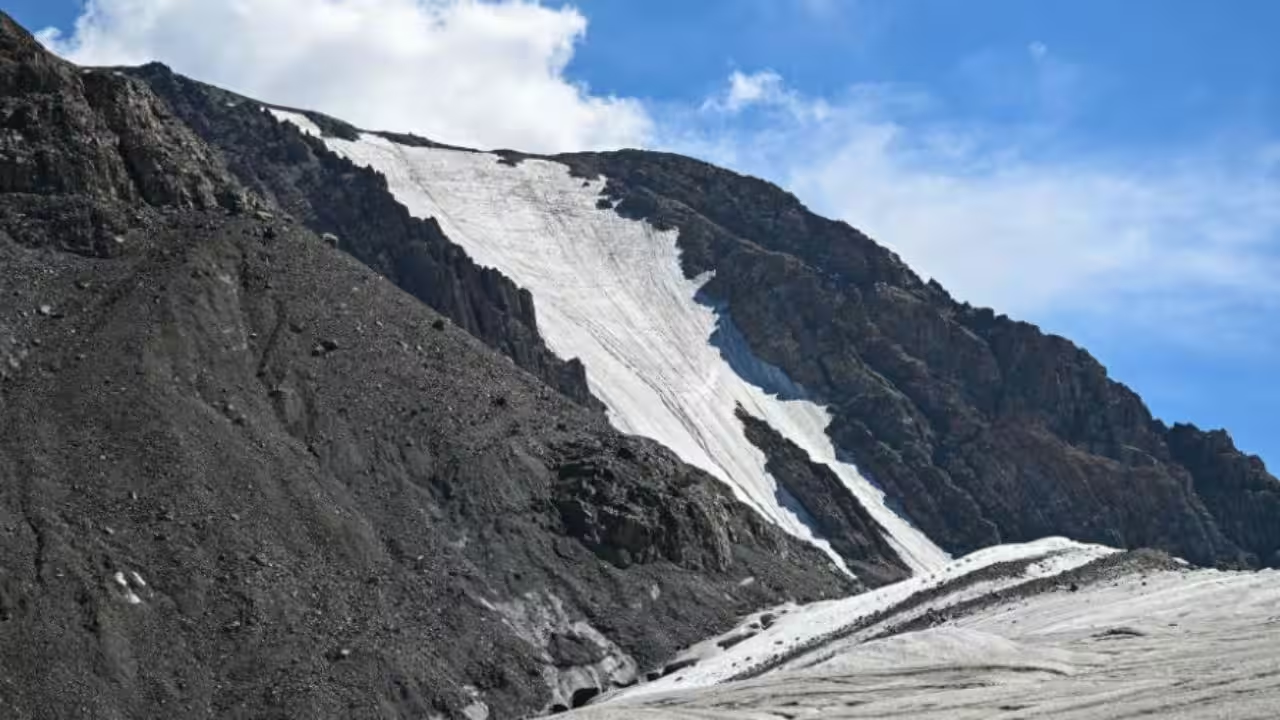
Researchers in China have tried to make artificial snow over China’s Muz Taw Glacier to slow its melting. The experiment conducted in 2018 involved seeding clouds with silver iodide, which helped trigger snowfall over the glacier. The fresh snow made the surface brighter and was linked to lower mass loss during the short study period.The experiment was carried out on the Muz Taw Glacier in the Sawir Mountains, which lie along the border between China and Kazakhstan, European Geosciences Union reported. The glacier has been shrinking for decades, with its retreat accelerating in recent years. Scientists wanted to test whether adding snow to its surface could reduce the amount of ice lost during the summer melting period.They used silver iodide (AgI) smoke generators to seed clouds. Silver iodide can act as an ice nucleus, helping water vapour in clouds form ice particles that can eventually fall as snow. Researchers used 14 remotely controlled generators powered by solar energy, which had already been installed along rivers near the glacier by the local meteorological service.The study, published in The Cryosphere in August 2020, compared conditions before and after the artificial snowfall experiments. The scientists measured snowfall, surface albedo and the glacier’s mass balance to understand whether the additional snow had any effect on melting.How the cloud seeding was carried outThe Muz Taw Glacier is a 3.2-kilometre-long valley glacier with an area of 3.13 square kilometres, based on 2016 measurements. Its elevation ranges from 3,137 to 3,818 metres above sea level. The glacier has been in constant recession since 1959.The researchers used a weather radar at the Jimunai Meteorological Station to identify clouds around the Sawir Mountains. The radar helped them track the direction, height, distance and movement of clouds approaching the glacier.When conditions appeared suitable, the scientists activated the AgI smoke generators. The particles were carried upwards by valley winds towards the glacier. The researchers did not add extra water to create the precipitation. Instead, the method was intended to help water already present in the atmosphere form precipitation.Artificial precipitation experiments were carried out during the glacier’s melting season in August 2018. The researchers then compared measurements from the glacier with observations from a control site in the forefield, which was not exposed to the AgI smoke.Snow made the glacier surface brighterOne important measurement was albedo. In simple terms, albedo describes how much sunlight a surface reflects. A bright, snow-covered surface reflects more sunlight, while darker ice absorbs more solar energy.Fresh snowfall quickly made parts of the glacier whiter and increased its surface albedo. The researchers measured albedo at 14 locations across the glacier before and after the experiments.The changes were particularly noticeable around the glacier’s equilibrium line, where the amount of snow gained and ice lost is roughly balanced over time. At some higher sites, the albedo rose to about 0.8, showing that snow remained on the surface after the snowfall events.A brighter glacier surface absorbs less solar radiation. That can reduce the energy available for melting, allowing more of the glacier’s mass to remain.Ice loss fell after the snowfallThe researchers also measured the glacier’s mass balance, which shows the difference between the mass gained and lost by a glacier.They compared two periods of the same length: 12–18 August, before the artificial snowfall, and 18–24 August, after it. The estimated mass balance for the whole glacier was −61.4 millimetres water equivalent during the first period and −37.2 millimetres water equivalent during the second.That meant mass loss was about 40% lower during the second period, even though the positively accumulated temperature was higher than during the first period. The researchers linked the lower mass loss to increased snowfall and higher surface albedo after the artificial precipitation.Measurements from stakes placed across the glacier showed that the difference in mass balance between the two periods was between 32 and 41 millimetres water equivalent after accounting for possible natural precipitation. The artificial snowfall reduced the mass loss by 14% to 17% compared with the period before the experiments.The study also estimated that artificial snowfall accounted for a significant share of the melt saved during the second period. Depending on how much natural precipitation was included, the snowfall was estimated to have buffered 42% to 54% of the total melting during that period.Result is preliminaryThe scientists stressed that the experiment was only an early trial and that the results cannot yet establish whether artificial snowfall can provide a long-term solution for melting glaciers.Some of the precipitation recorded during the experiments may have been natural rather than artificially produced. The researchers estimated that natural precipitation could have accounted for up to 21% of the snowfall received by the glacier during the experiments.They also said more controlled experiments are needed to separate natural and artificial precipitation more accurately. Longer studies are needed to understand how long the increased albedo remains after artificial snowfall and how the snow behaves as it melts.The researchers proposed a feedback process in which artificial snowfall adds mass to the glacier and increases its albedo. The brighter surface then reflects more solar radiation and absorbs less energy, which can reduce melting and help preserve the snow cover.However, they noted that the method requires suitable atmospheric conditions. It cannot be used when the weather is dry and sunny and there are no suitable clouds for precipitation.The study concluded that the approach may have potential for glaciers in Central Asia, particularly during summer when melting is strong. But the researchers made clear that broader and longer-term experiments are needed before its effectiveness can be properly assessed.
Topics in this story
Gathered from external sources. Rights to this text belong to whoever originally published it.