In 2019, researchers shifted the blades of an eggbeater-shaped vertical turbine; wind-tunnel tests found its peak power coefficient rose about 10%
In 2019, researchers enhanced the power coefficient of an eggbeater-shaped vertical-axis wind turbine by shifting blade positions, resulting in a significant efficiency improvement during wind-tunnel tests.
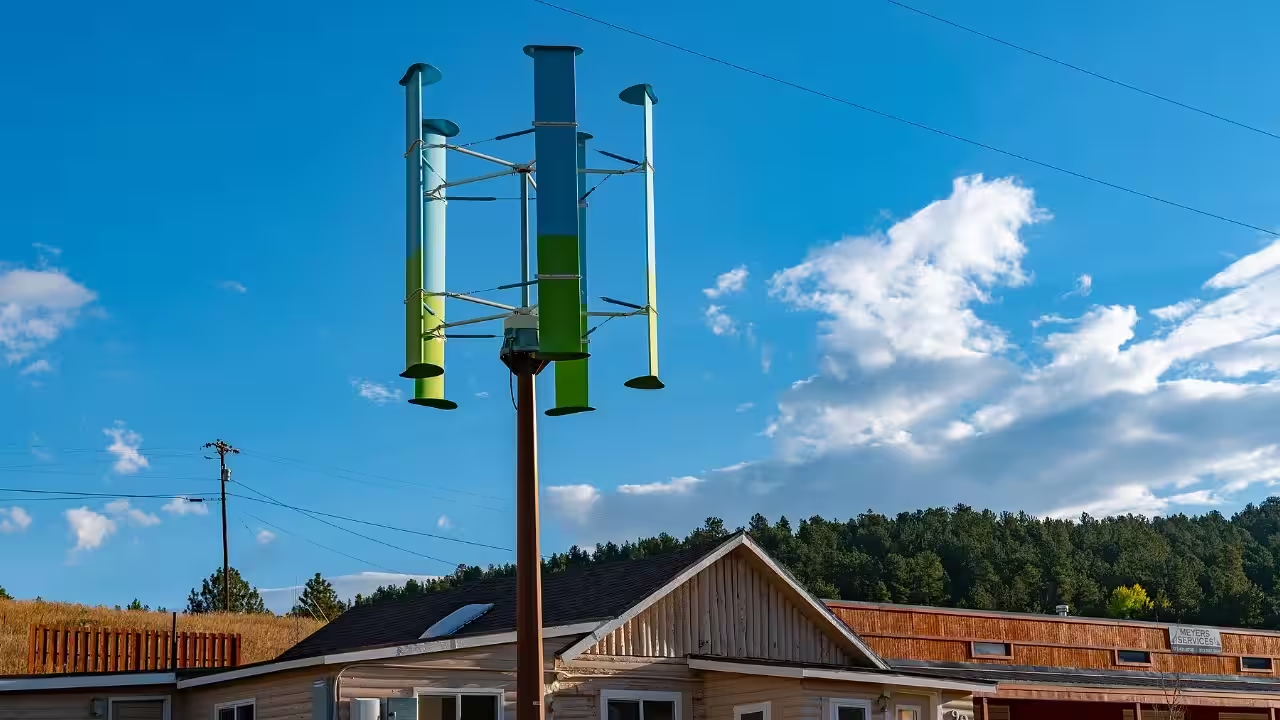
Wind turbine designers often look for ways to generate more electricity without increasing the size of a machine or adding more material. Sometimes, improving performance depends on changing how the blades are arranged rather than building a larger rotor. In 2019, scientists tested the performance of an eggbeater-type vertical-axis wind turbine by adjusting the position of the blades of the turbine. In wind tunnel experiments, the modified turbine reached a peak power coefficient about 10% higher than the unmodified version of the same turbine, under the conditions tested.Researchers compared three Darrieus turbine configurationsHilewit and colleagues published Power Coefficient Measurements of a Novel Vertical Axis Wind Turbine in Energy Science & Engineering in 2019, studying how changing the positions of the blades influenced the efficiency of a Darrieus vertical axis wind turbine. In a Darrieus turbine, the blades are curved and rotate around a vertical axis, which gives the turbine the look of an egg beater. This type of turbine has an advantage over traditional designs because there is no need to turn it towards the wind.The researchers compared a conventional turbine with two modified configurations called the 50% shifted troposkien-shape vertical-axis wind turbine (50% STS-VAWT) and the 100% shifted version (100% STS-VAWT). Wind-tunnel tests used three 2-bladed models built with the same height, swept area, chord, and NACA0015 airfoil, run at 600 and 700 rpm with tip-speed ratios of about 2 to 6, as described in the National Research Council Canada’s copy of the study. The research team sought to find out how blade position affected aerodynamic performance, in particular blade-vortex interaction. Whenever a blade moves through air, it leaves a wake of disturbed air, and a following blade can pass through that disturbance, which affects how the blades move.The 50% shifted design achieved a higher peak power coefficientBased on the wind tunnel tests, it was established that the 50% shifted design outperformed the conventional turbine under the given testing conditions. At 600 rpm, and correcting for wind tunnel blockage, the 50% shifted turbine reached a maximum power coefficient of 0.23, while the conventional design reached 0.21. That is a relative increase of about 10%, or 0.02 in absolute terms. The authors link the improvement to a reduction in blade-vortex interaction. At 700 rpm the 50% shifted design also showed a higher peak power coefficient than both other designs, and the study reports this held with or without the blockage correction. The results indicate that blade position can affect how effectively a vertical-axis turbine captures wind energy.Shifting the blades further did not improve performanceThis experiment shows that blade displacement alone does not guarantee better results. The design engineers have to take into account the interactions between blade shape, rotor dimensions, and speed of operation. First, the conclusions were based on tests performed on small turbines in a wind tunnel.Additionally, the study reports an uncertainty of about 5.4% for the corrected peak power coefficient of the 50% shifted turbine at 600 rpm and about 3.7% for the tip-speed ratio, at a 95% confidence level. The 100% shift setup did not yield the same benefit as the 50% shift setup. At 600 rpm, the study found it had similar efficiency to the conventional turbine at lower and higher tip-speed ratios and lower efficiency around the peak power.Further testing is needed before commercial applicationThe 2019 experiment found that a 50% blade shift could raise the peak power coefficient without enlarging the rotor’s swept area. That does not mean every turbine using this arrangement will produce 10% more power outdoors, since wind conditions and structural requirements also affect performance. Physical tests on larger machines would be needed to show whether the design delivers consistently better results in real conditions. For turbine manufacturers, the key conclusion is that blade position matters to turbine performance.
Topics in this story
Gathered from external sources. Rights to this text belong to whoever originally published it.