How the Crown-of-Thorns Starfish Liquefies Living Coral
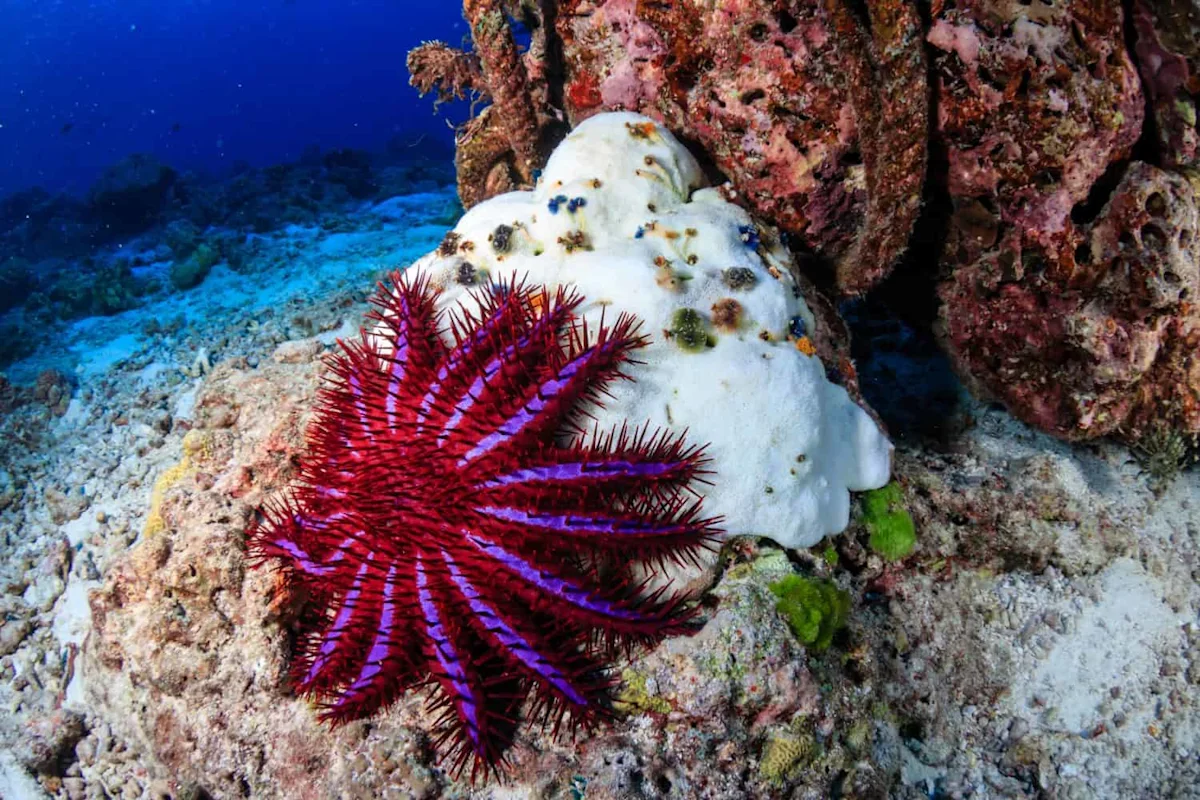
When a crown-of-thorns starfish settles onto a coral reef, it turns its own stomach inside out and gets to work dissolving living coral from the inside. Unde...
The post How the Crown-of-Thorns Starfish Liquefies Living Coral appeared first on A-Z Animals .
Crown-of-thorns starfish are predatory starfish. They do not feed on sea urchins , barnacles , or even snails like similar species do. Instead, the crown-of-thorns starfish melts living coral for nutrition, often leaving a wave of destruction in its path.
Starfish are carnivores . Many are opportunistic feeders, yet the crown-of-thorns starfish is very specific about what it eats. Their food of choice is coral.
Crown-of-thorns starfish do not simply graze . Instead, they eat coral to the point of the organism's death. To accomplish this, a starfish locates a healthy coral reef to target. Once attached to the reef, the starfish begins to feed.
To feed, the crown-of-thorns starfish pushes its cardiac stomach—the upper part of the stomach where the esophagus connects—out through its mouth, which is located on its underside.
According to the Australian Institute of Marine Science, the stomach spreads out to completely cover the coral polyps . As it does so, it releases enzymes that break down the polyps into a liquid. Once this process is complete, the crown-of-thorns starfish draws the fluid into its body as it retracts its stomach. The only thing left behind is the coral's white skeleton.
Crown-of-Thorns Starfish Can Decimate Coral Reefs
Coral reefs in tropical locales are no stranger to crown-of-thorns starfish. In fact, when populations are under control, crown-of-thorns starfish help prevent fast-growing corals from outcompeting slower-growing corals. This balance helps create a strong and resilient coral reef.
According to a 2022 study , the problem arises when too many crown-of-thorns starfish populate a region. In favorable conditions, there can be up to 1,000 individuals per two acres of marine habitat. Since each adult starfish can consume over 100 square feet of coral per year, large populations can quickly devastate coral reefs.
Because of how quickly the starfish can decimate a coral reef, specific vulnerable reefs are now monitored. This helps ensure that action is taken at the first sign of a crown-of-thorns starfish outbreak, allowing for the removal of the starfish and rehabilitation of the reef before it is permanently destroyed.
Is Human Activity Responsible for Crown-of-Thorns Overpopulation?
Crown-of-thorns starfish are not an invasive species . They are native to the Indo-Pacific. However, their populations can easily grow out of control, and human activity is often to blame.
There are many predators that target crown-of-thorns starfish . However, these same fish are often a favorite among anglers. Consequently, as triggerfish , large wrasse , and even giant snails are depleted from their habitats, crown-of-thorns starfish thrive. The larger their population grows, the more destruction they cause to coral reefs.
Pollution is another cause of starfish population booms . Fertilizer or sewage runoff into the ocean can cause large algal blooms . These blooms provide nutrition to crown-of-thorns larvae, allowing more to survive compared to regions without blooms.
Perhaps one of the ongoing human-caused issues is climate change . While most marine creatures struggle as ocean temperatures increase , crown-of-thorns starfish—and especially their larvae—thrive in these conditions. When temperatures get too warm and coral bleaching occurs, this is an added benefit for the starfish. Dead and dying coral provide an ideal habitat for the starfish to live and create nurseries for their young.
Crown-of-thorns starfish are beneficial to their habitat when their populations can be kept under control. But as the oceans continue to change for the worse, the starfish face fewer obstacles. When their populations become too large, they ruin coral reefs, which are essential for marine biodiversity , coastline protection, and the economic well-being of coastal communities.
Topics in this story
Gathered from external sources. Rights to this text belong to whoever originally published it.