Meet Bailey Quinn Frank, 15, from Fort Lauderdale, who built an air sampler with a small fan and filter paper to collect bacterial DNA; she has now won a $25,000 science prize among nearly 2,000 applicants
A 15-year-old student from Fort Lauderdale, Florida, has won a $25,000 science award for developing an affordable device that collects airborne bacterial
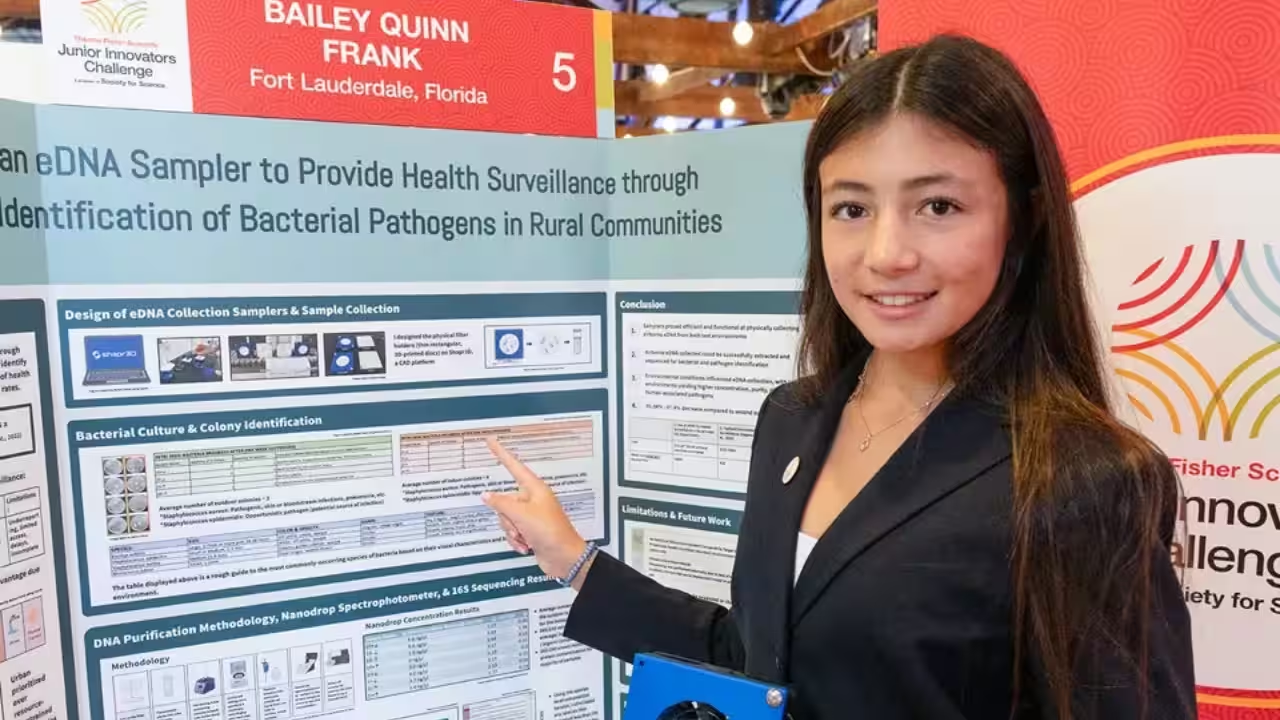
A 15-year-old student from Fort Lauderdale, Florida, has won a $25,000 science award for developing an affordable device that collects airborne bacterial DNA, with the potential to help communities monitor environmental health risks. Bailey Quinn Frank received the top prize at the 2026 Thermo Fisher Scientific Junior Innovators Challenge, announced on October 27. According to the official announcement by Society for Science, Bailey designed a low-cost environmental DNA sampler using a small fan and filter paper to collect airborne bacteria. She was selected as the winner from a group of 30 finalists chosen from nearly 2,000 applicants across 47 states and five US territories.How Bailey developed an affordable air samplerBailey’s project focused on environmental DNA, commonly known as eDNA, which allows researchers to study genetic material collected from the environment and identify organisms present in a particular location. She explored whether an inexpensive device could capture airborne genetic material and support the detection of bacterial pathogens.According to her finalist profile published by Society for Science, Bailey built her sampler by attaching filter paper to small fans. When switched on, the fans drew air through the device, allowing environmental material, including bacterial DNA, to collect on the paper. She collected two indoor air samples and one outdoor sample. After collecting the material, she purified DNA from the filter papers and transferred part of the collected sample to petri dishes to grow the bacteria. She recorded the bacterial colonies after one week and attempted to identify them.Bailey also sent her best samples for 16S ribosomal RNA sequencing, a technique commonly used to help identify and classify bacteria. Her project examined whether the device could provide useful information about the microorganisms present in different environments.What her research revealed about indoor and outdoor airBailey’s preliminary findings showed differences between the bacterial communities in indoor and outdoor air samples. The indoor samples contained more bacterial genera associated with people, while the outdoor sample included bacteria associated with soil, water, air and plants. These findings helped demonstrate how an inexpensive sampler could collect material for further investigation of the microorganisms present in an environment. The work also showed how students can apply scientific methods to questions involving public health and environmental monitoring.The device was designed around readily available materials rather than specialised, expensive equipment. This approach is important because the cost of collecting and analysing environmental samples can be a barrier for communities and institutions with limited resources. However, the project represents an early investigation rather than a validated disease-monitoring system. More testing would be needed to establish how reliably the sampler detects specific pathogens, how its performance compares with established equipment and whether it can support routine health surveillance.Why the device could matter for rural communitiesBailey was particularly interested in the challenges faced by rural communities, where access to resources for disease surveillance may be limited. Monitoring environmental samples could potentially help researchers identify microorganisms in an area and investigate possible health risks. Her idea was to explore whether a simple, low-cost sampler could make environmental DNA collection more accessible. If further research establishes its reliability, such a device could offer a practical starting point for collecting samples in locations where sophisticated monitoring equipment is difficult to obtain.Bailey’s interest in the subject was also shaped by her personal experience with coeliac disease, according to her Society for Science profile. She said that the experience helped her develop empathy for other children and adults whose health conditions make them feel different from their peers. Outside research, she enjoys making art, including digital art, watercolour, fabric and clay projects. She is also involved in the Technology Student Association, where she has developed technical and leadership skills through activities related to medical technology, community service and career preparation.$25,000 award recognises research and teamworkBailey received the $25,000 Thermo Fisher Scientific ASCEND Award, the highest prize at the 2026 Thermo Fisher Scientific Junior Innovators Challenge. The award recognised her environmental DNA project as well as her performance in the competition’s team challenges. The competition brought together 30 finalists selected from nearly 2,000 applicants representing 47 states and five territories. The finalists collectively received more than $100,000 in awards, while each finalist’s school received a $1,000 grant to support science, technology, engineering and mathematics education.Alongside evaluating individual research projects, the competition tested participants’ critical thinking, creativity, communication and collaboration. Challenges included designing sustainable cities, prioritising patients during a simulated outbreak, exploring the use of artificial intelligence to identify turtle species and building protective enclosures for diamondback terrapin eggs. Other leading award recipients included Henry Grover and his twin brother Jack Grover, who investigated whether a water-absorbing gel could help prevent wildfires from reigniting. Myreen Ahsan used machine learning to identify molecules that could potentially target a protein associated with frontotemporal dementia, while Wileidy Enid Feliciano-Rivera developed biodegradable mulch from plantain peels.Bailey’s award highlights how an accessible scientific question can lead to a project combining practical engineering with environmental research. Although her sampler requires further evaluation before it can be used for routine health surveillance, her work demonstrates the potential of young researchers to explore affordable approaches to real-world challenges.
Topics in this story
Gathered from external sources. Rights to this text belong to whoever originally published it.