Astronomers find ‘reborn’ planet around a dead star
BENGALURU: Astronomers have identified what could be the first second-generation planet found around a white dwarf, a dead star that has exhausted its
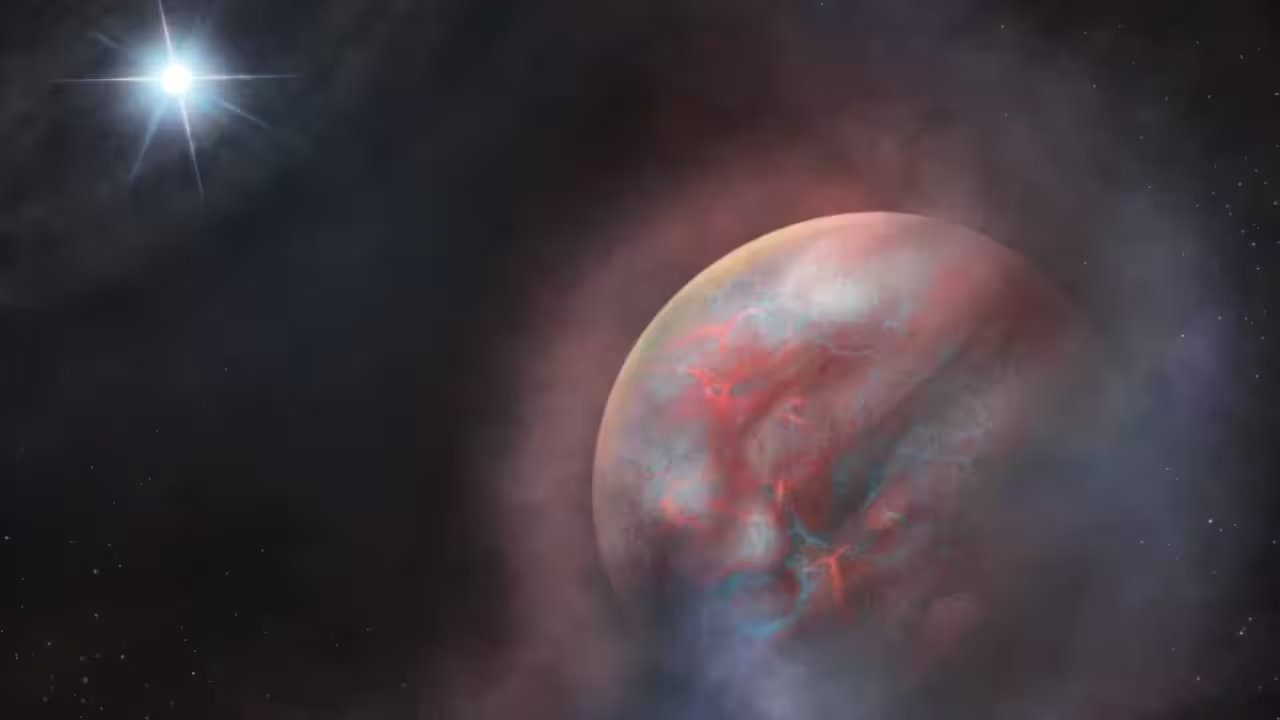
BENGALURU: Astronomers have identified what could be the first second-generation planet found around a white dwarf, a dead star that has exhausted its fuel. The planet appears to have formed from material the star itself threw into space as it died.The discovery was made by a team led by the University of Warwick and centres on a white dwarf called “HS 0209+0832”. Its atmosphere contains unusually high levels of heavy elements including zinc, copper and, most notably, niobium, which was found at levels more than 1,000 times higher than in the Sun.These are all elements created during the death of a star, as per a statement shared with TOI. Niobium has not previously been detected in a white dwarf. The unusual chemical mix provided the key clue. Nicholas Stone, of the University of Wisconsin-Madison, said the pattern was a signature of the “s-process”, a nuclear reaction that builds heavy elements inside dying stars.“It’s a chemical signature no ordinary, ‘first-generation’ planet should carry, which told us that this new planet was something different,” he said. Researchers believe the white dwarf is feeding on a newly formed giant planet.As the star died, it expelled material that may have gathered into a disc around it. A planet could then have formed from this disc, making it a second-generation world. Such planet formation is not straightforward. Material expelled by a dying star would normally escape rather than settle into orbit.Jamie Williams, a PhD student at the University of Warwick and the study’s first author, said the star probably needed a companion that pulled some of the expelled material back into orbit.“Second-generation planets are worlds that form out of the material a star casts off as it dies. They’re incredibly rare, and finding one around a white dwarf was completely unexpected. It’s a bit like finding a planet that has risen from the ashes of the very star it once orbited,” Williams said.Further evidence came from Nasa’s TESS satellite, which detected a faint change in brightness repeating every 4.4 days. This is consistent with a Jupiter-sized gas giant in a close orbit around the white dwarf.The planet is so close to the white dwarf that its outer atmosphere is expected to be boiling away under the intense radiation. Some of this escaping material could be falling on to the white dwarf, producing the unusual chemical signature observed by astronomers.If confirmed, “HS 0209+0832” would be the first white dwarf known to host a second-generation planet. The discovery could also help astronomers search for more such “reborn” worlds around other dead stars.The findings of the astronomers, funded by the European Research Council (ERC), have been published in the journal Nature Astronomy.
Topics in this story
Gathered from external sources. Rights to this text belong to whoever originally published it.