Map shows where measles cases spiking in Pennsylvania as 2 deaths reported
They are the first measles-related deaths recorded in Pennsylvania in 35 years.
Two measles -associated deaths have been reported in Pennsylvania as the state grapples with a growing outbreak that has sickened hundreds of people this year, according to health officials.
The Pennsylvania Department of Health on Tuesday confirmed the deaths, which involved two unvaccinated Lancaster County residents, marking the first measles-related deaths recorded in the commonwealth in 35 years.
The deaths come as measles cases continue to rise across Pennsylvania and the country. The Pennsylvania Department of Health, which did not say when the deaths occurred, has confirmed 393 cases across 28 counties in the state this year, while the Centers for Disease Control and Prevention (CDC) has recorded 2,777 cases nationwide, the highest annual total reported in more than 35 years.
It is unclear if the two people who died were children.
Newsweek reached out to the Pennsylvania Department of Health, the CDC and the Department of Health and Human Services (HHS) via email for comment on Tuesday.
The fatalities reported amid federal health officials and political leaders sending mixed messages about the MMR (measles-mumps-rubella) vaccine. While President Donald Trump said last week that the combined vaccine could be "quite lethal," Centers for Medicare and Medicaid Services administrator Dr. Mehmet Oz said Sunday that the MMR vaccine is not lethal when asked about the president's comments. Trump recently signed an executive order seeking to reshape federal vaccine guidance by promoting separate measles, mumps and rubella vaccinations instead of the combined MMR shot.
Public health authorities continue to recommend the two-dose MMR vaccine as the most effective way to prevent measles, which is highly contagious and can lead to pneumonia, brain swelling and death in rare cases. On Tuesday afternoon, the CDC said on X that the MMR vaccine is the most effective protection against measles.
"HHS and CDC extend their condolences to the families and communities affected by two measles-associated deaths in Lancaster County, Pennsylvania," the post said.
"CDC is working closely with state and local health departments to strengthen response efforts, rapidly support affected communities across the state, and communicate the steps people can take to slow the spread of measles. The MMR vaccine provides the most effective protection against measles and helps prevent its spread. CDC will continue to follow Pennsylvania's lead and provide resources to support the state's response."
Data from the Pennsylvania Department of Health shows infections spread across multiple regions, highlighting the scale of an outbreak that mirrors a broader national resurgence of the highly contagious virus.
Measles cases have been reported across much of the state, with outbreaks affecting numerous counties. According to state officials, 393 cases have been confirmed in 2026, with Lancaster County among the areas most heavily affected, with 185 recorded cases.
Public health officials closely monitor case totals because measles is one of the most contagious viruses. A single infected person can spread the disease to multiple others in communities where vaccination rates have fallen below levels needed for herd immunity. The outbreak has prompted renewed efforts to encourage vaccination and educate residents about the risks associated with measles infection.
"Because measles was largely eliminated in the Commonwealth for more than three decades, people are not familiar with this disease and don't fully understand the potential severity of the illness," Pennsylvania Secretary of Health Dr. Debra Bogen said in a press release. "We want to ensure every Pennsylvanian has the information they need to protect themselves, their loved ones and their communities. As a physician, I want to make sure that people understand that the MMR vaccine is safe and provides the best protection we have against measles."
The announcement of two measles-related deaths in Lancaster County has drawn renewed attention to comments HHS Secretary Robert F. Kennedy Jr. made in the county before taking office. On July 31, 2021, Kennedy spoke to a crowd in Lancaster County and argued that vaccines had not been properly tested for safety, according to local reporting. Public health experts have disputed those claims.
Measles typically begins with symptoms that resemble a common respiratory infection. Early signs include a high fever, cough, runny nose and red, watery eyes, also known as conjunctivitis. Symptoms may appear seven to 21 days after exposure to the virus.
Because early symptoms can resemble other illnesses, health officials advise people who believe they may have been exposed to measles to contact a healthcare provider promptly. Early evaluation can help reduce the risk of further transmission and ensure appropriate medical care if symptoms worsen.
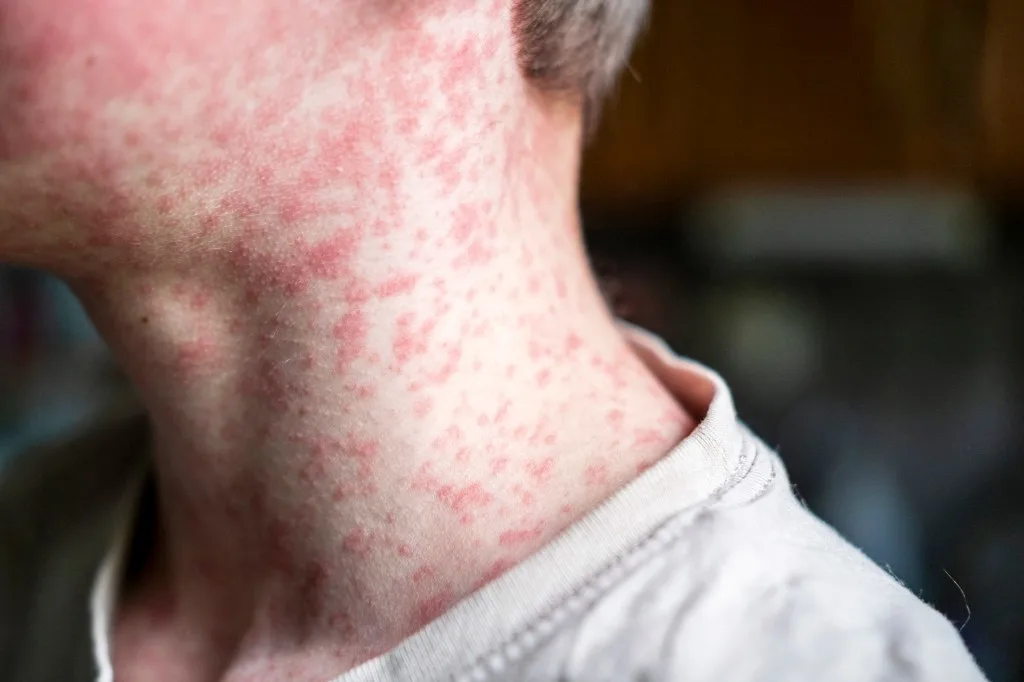
One of the hallmark signs of measles is a distinctive rash that develops several days after the initial symptoms begin. The Pennsylvania Department of Health says the rash usually starts on the head or face before spreading downward.
The rash is often accompanied by fever and other respiratory symptoms. While most people recover, health experts caution that measles can lead to serious complications, particularly among infants, pregnant women and people with weakened immune systems.
The CDC recommends that children receive two doses of the MMR vaccine. The first dose is typically administered between 12 and 15 months of age, while the second is given between ages 4 and 6.
Health officials say two doses provide about 97 percent protection against measles. The Pennsylvania Department of Health has repeatedly stressed that vaccination remains the best way to prevent infection and limit the spread of the virus during outbreaks.
Adults who are unsure of their vaccination status are encouraged to speak with a healthcare provider about whether they need additional protection.
Measles is often thought of as a childhood illness, but health experts warn that it can be severe and, in some cases, fatal. According to the Pennsylvania Department of Health, nearly 20 percent of people who contract measles require hospitalization. The virus can cause complications including pneumonia and brain swelling.
State officials note that measles-related deaths occur in roughly one to three patients per 1,000 cases. While fatalities are uncommon, the two deaths reported in Pennsylvania this week highlight the dangers posed by the disease, particularly for unvaccinated people.
The virus spreads through coughing, sneezing and even lingering airborne particles. Health officials say measles can remain infectious in the air and on surfaces for up to two hours after an infected person leaves an area, making it especially difficult to contain once outbreaks begin.
There is no specific cure for measles once a person becomes infected. Instead, treatment focuses on relieving symptoms and preventing complications while the body's immune system clears the virus. Supportive care typically includes rest, fluids and medications to reduce fever. If complications such as pneumonia or ear infections develop, additional treatment may be needed. Most people recover fully within a few weeks.
Because no antiviral drug is approved specifically to cure measles, health officials continue to emphasize the MMR vaccine as the most effective way to prevent infection and reduce the risk of severe disease.
Contact Newsweek editors on this story: Gabe Whisnant , Dave Siminoff , Sam Wilson .
Zohran Mamdani Angers Leftists With Hakeem Jeffries Support
List of Companies Laying off Employees in September
How Lake Mead Water Levels Stand as Nevada Sues Over Colorado River Cuts
Topics in this story
Gathered from external sources. Rights to this text belong to whoever originally published it.