150,000 Tons of Radioactive Waste Were Dumped in The Atlantic. Decades Later, It's Visibly Oozing.
Well, well, well. If it isn't consequences.
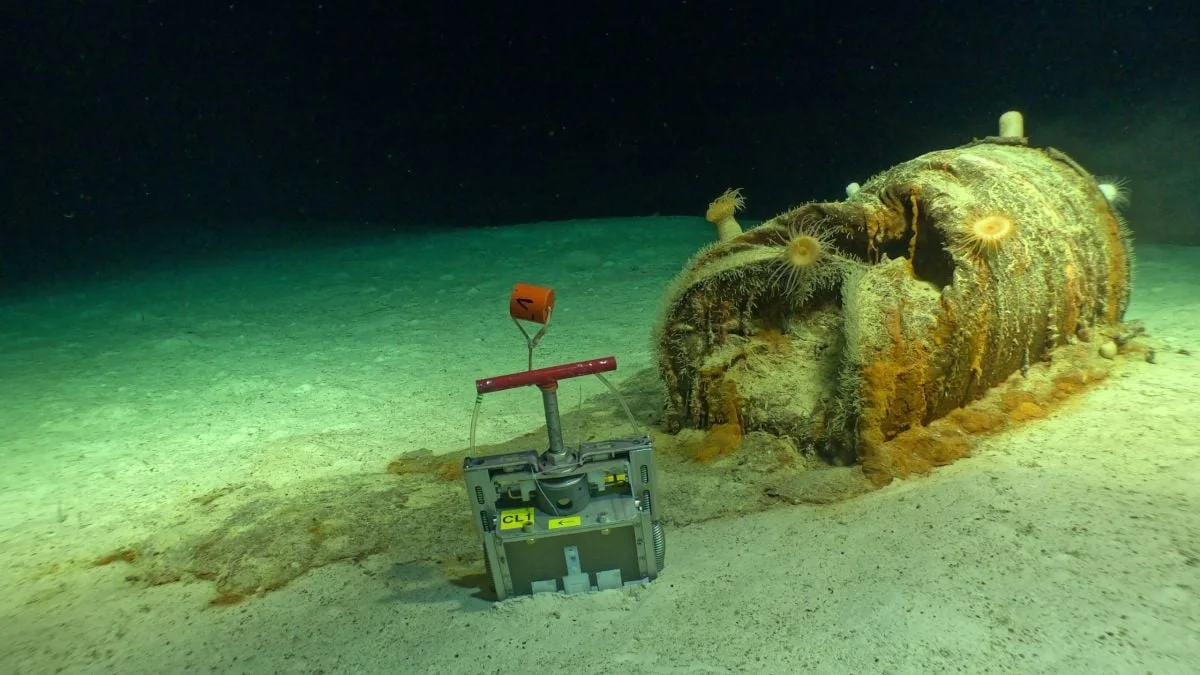
Between 1949 and 1982, over 200,000 barrels of low-level radioactive waste were dumped at the bottom of the Atlantic Ocean, with many barrels now corroded and degraded, spilling their contents across the seafloor.
The dumped waste, containing radioactive materials like cesium-137 and plutonium isotopes, has become part of the ecosystem, with anemones, sponges, fish, and crustaceans living around the barrels, raising concerns about potential radioactive contamination in marine life.
Despite significant radioactive signals around the barrels, activity levels weren't high enough to pose major radiation-protection problems for the scientists handling the samples, suggesting that the radioactive material may not be spreading far beyond the immediate vicinity of the barrels.
The second half of the 20th century was something of a golden age for nuclear technology.
Following the atomic devastation of WWII, the world found new, more benign uses for radioactive decay. Power plants, medical treatments, scientific research, and industry all blossomed under a benevolent nuclear glow.
But with the nuclear revolution came a significant problem – what to do with all the thousands of tons of radioactive waste generated in the excitement.
For Europe, the solution was relatively simple.
There was a perfectly good seafloor at the bottom of the Atlantic Ocean that, as far as the authorities were concerned, no one important was using.
So, between 1949 and 1982, that's where it went – more than 200,000 barrels of low-level radioactive waste, totaling more than 150,000 tons, mostly dumped at depths between 3,000 and 5,000 meters (9,840 and 16,400 feet).
For decades, no one really knew what had become of them.
Now, scientists have descended to the wreckage in a crewed submersible to investigate – and found many of the barrels corroded and degraded, their contents spilling across the seafloor.
Surprisingly, this isn't necessarily a subversion of the original plan.
Radioactive waste categorized as low-level, or LLW, doesn't mean that it's not hazardous. It comes from sources such as medical and industrial use and typically contains lower levels of long-lived radionuclides.
The International Atomic Energy Agency recommends that LLW be disposed of in robust containment in isolation for at least a few hundred years – but back in the mid-20th century, the recommendations were a little different.
The contemporaneous guidelines recommended that containers needed to reach the seafloor intact and remain sealed only long enough for the short-lived radionuclides to decay.
After that, the remaining waste was expected to slowly escape and disperse through the surrounding ocean.
Not everything in the barrels would conveniently decay away, however. They contained a radioactive hodgepodge, including cesium-137, plutonium isotopes, and tritium, some of which can persist for thousands of years.
When the dumping stopped in the 1980s, everyone pretty much just dusted off their hands and walked away. The precise locations and conditions of the barrels remained poorly known for decades.
But then, a few years ago, nuclear engineer Patrick Chardon and marine geologist Javier Escartín of the French National Center for Scientific Research started to wonder what had become of the dumped waste.
That question eventually became NODSSUM – Nuclear Ocean Dump Site Survey Monitoring – an interdisciplinary project bringing together nuclear physics, geology, oceanography, biology, and marine chemistry to find the barrels and investigate what, if anything, they were doing to the surrounding environment.
The first expedition set sail in June 2025 aboard the research vessel L'Atalante . In this first foray, the team sent an autonomous underwater vehicle called UlyX sweeping across the seafloor to map and photograph the barrels, while collecting water, sediment, fish, and crustaceans from the surrounding area.
In just a month, they located and mapped 3,355 barrels.
That first expedition was reconnaissance, giving the researchers something they hadn't had before – targets.
This time, aboard the Pourquoi Pas? , the team brought Nautile , a three-person submersible capable of descending 6,000 meters. Over 20 dives, it carried scientists more than 4,700 meters down to inspect the barrels directly and collect samples from their immediate surroundings.
At first glance, the condition of some of the barrels was alarming.
They were heavily corroded and degraded, with material visibly oozing out onto the surrounding sand.
But here's where the expedition became puzzling – because the barrels also appeared to function as tiny oases on the otherwise sparsely populated sandy seafloor.
Anemones had attached themselves to the barrels. Sponges, sea cucumbers, fish, and crustaceans lived around them, with crabs apparently particularly fond of the artificial shelters.
This presented the researchers with an unexpected problem. The barrels weren't simply containers slowly releasing radioactive material into an empty abyss. They had become part of the ecosystem.
Which raised a much more complicated question: Was any of that radioactive material making its way into the animals themselves?
There was no question that radioactive material had escaped containment. Instruments aboard the ship detected significant signals of cobalt-60 and niobium-94, which the researchers could specifically link to the dumped waste.
Cesium-137 and americium-241 were also present at levels well above the background expected from atmospheric nuclear testing and accidents.
Whether that radioactivity is accumulating in the animals living on and around the barrels is another matter.
At five sites, Nautile collected sediment, water, organisms and microbial communities from immediately around – and even in contact with – the barrels. The researchers also sampled nearby rocky habitats to give them something to compare the barrel communities against.
Those samples are now being analyzed to determine what effect – if any – these strange habitats are having on the creatures that now call them home.
There is precedent, however, to suggest that even striking levels of radioactivity around a source don't necessarily spread very far.
A recent study of the sunken Soviet submarine Komsomolets found radionuclide levels hundreds of thousands of times above background immediately around the leaking reactor – but those levels dropped sharply within just a few meters as the material dispersed through the seawater.
The NODSSUM team similarly found that, despite the significant radioactive signals around the barrels, activity levels weren't high enough to pose major radiation-protection problems for the scientists handling the samples.
Nautile and the instruments it carried showed no signs of contamination.
None of this means the waste is harmless – nor does it mean we're about to be overrun by radioactive crabs.
But for the first time, researchers have a detailed map of thousands of barrels and samples that can reveal what is happening around them.
Topics in this story
Gathered from external sources. Rights to this text belong to whoever originally published it.