The rocket problem India cannot launch away
Science News: India has never had more rockets to talk about. The PSLV remains the backbone of the country's launch programme, notwithstanding its recent failures. .
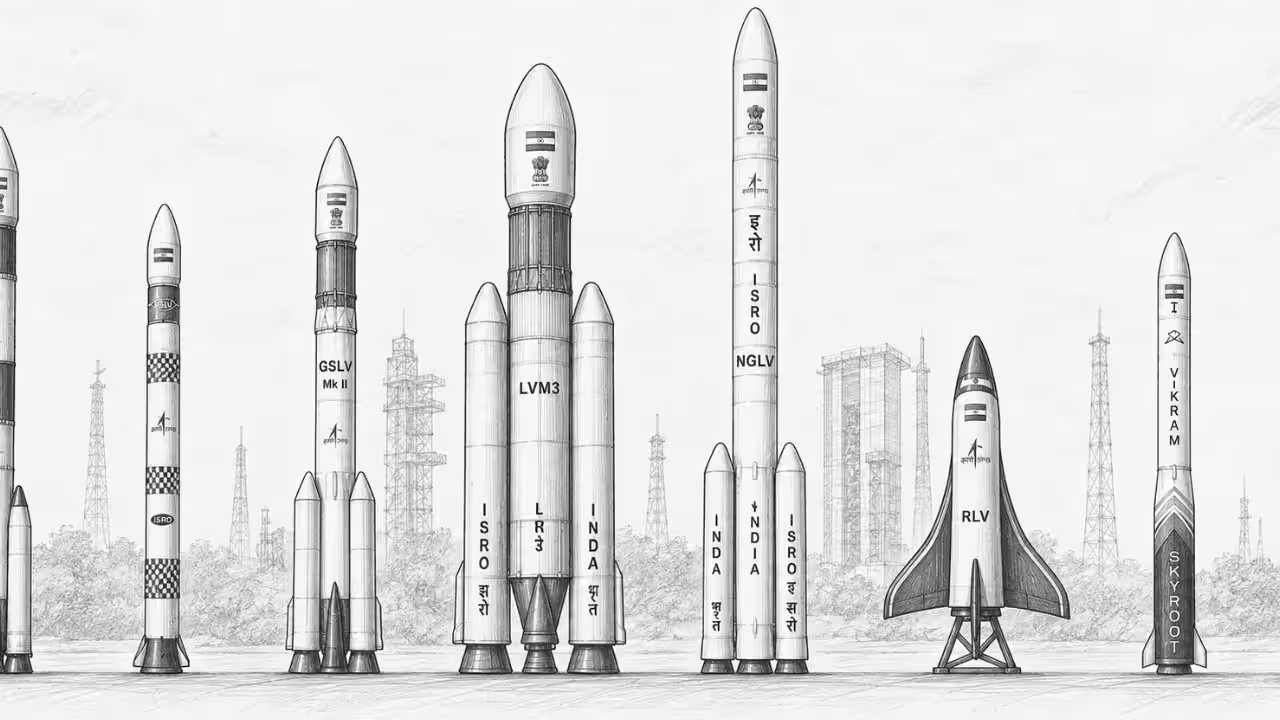
India has never had more rockets to talk about. The PSLV remains the backbone of the country's launch programme, notwithstanding its recent failures. GSLV-Mk2, like the one that launched Friday, gave India the ability to put heavier satellites into geostationary transfer orbit. LVM-3 has expanded India’s reach further and will carry some of the country’s most demanding missions. SSLV is being positioned as a quicker route to orbit for smaller satellites. Beyond them lie upgrades, reusable launch technologies and the Next Generation Launch Vehicle, or NGLV, on which India is betting for the next phase of its space programme.The private sector has begun adding to that picture too. Skyroot Aerospace has now put Vikram-1 into orbit, becoming the first Indian private company to achieve an orbital launch. Agnikul is pursuing its own orbital vehicle and a different propulsion architecture. More companies are entering the wider launch ecosystem.On the surface, then, India does not appear to have a rocket problem. But the question facing the country is no longer whether it can build rockets. It clearly can. The question is whether it can build enough access to space for everything it now wants to do there.Those are not the same thing. A capable rocket programme can still fall short if it cannot launch often enough. New vehicles do not automatically solve a capacity problem if they carry different classes of payload. More rockets on the drawing board do not necessarily translate into more launches if production, launchpads and associated infrastructure do not expand with them. And a failure that temporarily affects one vehicle can become a larger problem when too much of the system depends on the same facilities, technologies or people.That is the distinction India needs to confront as its space ambitions grow. The country is no longer planning only occasional planetary missions and satellite launches. The manifest ahead includes Chandrayaan-4, human spaceflight, the Bharatiya Antariksh Station, large Earth-observation and communication satellites, navigation systems and strategic spacecraft. These are not all missions that can be squeezed onto a small rocket when one becomes available. Many require medium- or heavy-lift capability, and some have to fly on Indian launch vehicles.The challenge, therefore, is not merely one of launch frequency. It is also one of mass. India has, over the past decade, averaged about five orbital launches a year. Even under optimistic assumptions about planned upgrades, production improvements and additional private launchers, the available analysis suggests the country could struggle to generate the cadence required by its declared programme through 2030.Commercial ambitions face the same constraint. The PSLV built India a reputation as a reliable and affordable launch provider, but commercial customers look at access too, not just heritage. In an increasingly competitive market, India needs enough launch opportunities, across enough payload classes, for customers to plan around its schedule rather than wait for a slot.Cadence and capability, therefore, are commercial questions too. Small launchers may open new opportunities, but they cannot by themselves sustain India’s larger launch ambitions or replace medium- and heavy-lift capacity. If India wants launch services to become a meaningful part of its space economy, it will need to launch frequently and competitively across classes, not treat commercial launches as occasional additions to its national programme.The issue becomes clearer when measured against payload mass: a growing number of India's planned missions require capabilities that small launch vehicles simply cannot replace. This is why Skyroot’s success, important as it is, needs to be viewed at the right scale.Vikram-1 will one day be able to carry roughly 300-350 kg to low-Earth orbit — it is yet to demonstrate that payload capacity. Once that capacity is achieved, it’ll broadly be in the same small-lift class as Isro’s SSLV (tech transfer deal with HAL has been finalised). It creates an additional Indian route to orbit, particularly for smaller payloads, and its successful first flight is an achievement that should not be diminished.But India’s launch requirement is increasingly heavier than that. A PSLV can carry several times Vikram-1’s payload, while LVM-3 operates in an altogether different class. Chandrayaan-4, large satellite systems, human spaceflight and the infrastructure required for a future space station cannot be made easier simply by adding more small rockets to the fleet.This is not an argument against private launch vehicles. It is an argument against expecting one category of vehicle to solve another category’s problem.In fact, the emergence of Skyroot and other companies makes this moment an opportunity as much as a warning. India could, for the first time, begin building a genuinely broader launch ecosystem, in which private companies add capacity rather than merely compete for the same small segment of the market or depend indefinitely on Isro's infrastructure.That will require more than access to technology and launch facilities. India needs additional launch infrastructure, independent of the facilities on which its existing programme depends. The planned small-launch complex at Kulasekarapattinam is important in that context, but it will not, by itself, resolve the medium- and heavy-lift challenge.Production capacity must rise with demand. Propulsion research has to extend beyond the traditional institutions. And private companies will need customers capable of sustaining them through the long period between proving that a rocket can fly and proving that it can become a repeatable business.The govt, in other words, cannot simply announce that the private sector has arrived and then retreat from the launch business. That brings us to the intervention this week by nine employee bodies representing Isro and Department of Space staff.Their representation, seeking written clarity on the future role of Isro in launch-vehicle design, realisation, integration, testing and launch, is not merely a labour question. It has raised a larger institutional issue that India should address with considerably more clarity than it has so far.What exactly is the launch architecture the country wants? There is nothing contradictory about a strong public space agency and an expanding private industry. Indeed, India will need both. But there is a difference between transferring technology, expanding industrial production and creating new private capability on the one hand, and progressively hollowing out the institution that developed and still sustains the country’s most complex launch capabilities on the other.The distinction matters especially now because no Indian private company is yet building a PSLV-class vehicle, let alone something comparable to LVM-3 or NGLV. If Isro is expected to move away from manufacturing and operations, the transition cannot be treated as a matter of ideology or aspiration. It needs a credible answer to a practical question: who will guarantee that India has the launch capacity it needs while the private sector develops the capability to add its own?That answer should not be “wait and see”. The recent problems with PSLV illustrate why. The failures are not, by themselves, evidence of a broken programme. Rocket failures happen, including in mature launch systems. The more revealing issue is the extent to which a disruption in one part of India’s launch architecture can affect the wider programme. A resilient spacefaring nation needs not only reliable rockets, but enough production capacity, launch infrastructure and alternatives to absorb setbacks without allowing its entire schedule to drift.That is where India's current crisis and opportunity meet. The country should not respond by protecting Isro from competition. Nor should it respond by assuming that private competition makes Isro less necessary. It needs to increase the total amount of launch capacity available to the country, while creating greater redundancy between vehicles and infrastructure.Isro should remain capable of developing and flying the launch vehicles on which India’s scientific, strategic and human spaceflight programmes depend. Industry should be enabled to manufacture more, develop independently and eventually compete where it is capable of doing so. Private launch companies should have incentives to build vehicles and infrastructure that add new capacity rather than simply occupy a corner of an existing public system.The direction of travel matters because the rest of the world is not standing still. The global launch business is moving towards higher cadence, larger constellations, greater reusability and lower costs. China and the US are expanding both state-backed and commercial capacity, albeit through very different systems. India does not have to reproduce either model. But it does need to recognise that occasional demonstrations of capability are no longer enough.Access to space is becoming an industrial capability in its own right. India has spent decades learning to build rockets and, in the process, built an enviable launch heritage. The task ahead is different. It is to turn that heritage into a system capable of carrying an expanding national programme while also creating room for a private industry that can stand on its own.That will require more than one successful startup launch, more than one new rocket and more than another policy announcement. It will require capacity.--PostscriptFor decades, India’s space programme has taught us to look at a rocket and ask a simple question: how much can it carry? Perhaps the Parallax India now needs in its space story is the more important question: how often India can rely on it to carry the country where it says it wants to go.
Topics in this story
Gathered from external sources. Rights to this text belong to whoever originally published it.