Nurseries discarded unwanted plants; Pearl Fryar rescued them and spent decades turning them into a three-acre sculpture garden
A cleared cornfield in Bishopville, South Carolina, became the setting for one of America's most distinctive topiary gardens.
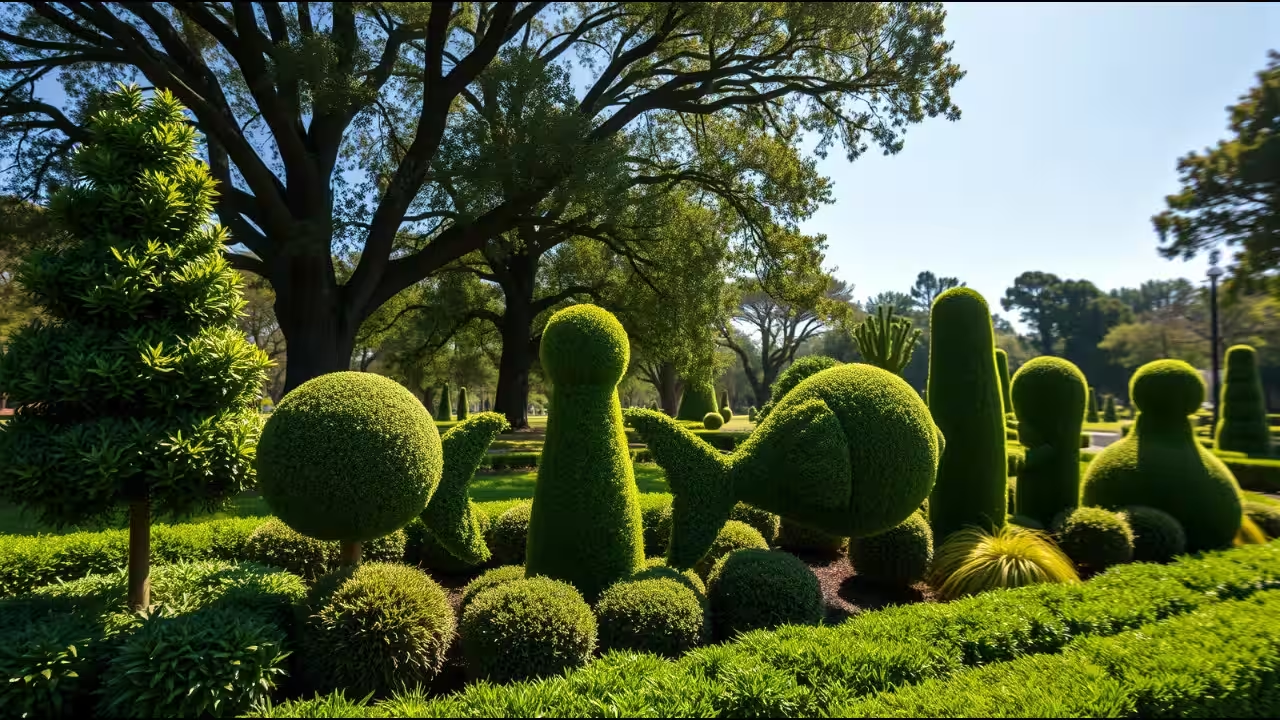
A cleared cornfield in Bishopville, South Carolina, became the setting for one of America's most distinctive topiary gardens. In the early 1980s, Pearl Fryar began transforming the land around his home without any formal horticultural experience. Many of the plants he used had been rescued from nursery compost piles, where discarded trees and shrubs had been left behind. Fryar instead transformed them into living plant sculptures, eventually creating a three-acre topiary garden containing more than 400 expertly trimmed plants. Fryar's work was shaped by an interest in pruning that began long before the garden took form. According to his official biography, he had developed a childhood habit of trimming the shrubs around his family's home into interesting patterns. Decades later, while working full time and living in Bishopville, he began pruning trees and shrubs on his own property. What developed from that work became a large-scale garden that attracted visitors by the thousands.The garden's official website describes Fryar's driving focus as positive thinking, hard work and perseverance. He also wanted the garden to remain free to the public, describing its message as one of "Love, Peace, and Goodwill." Today, the nonprofit Pearl Fryar Topiary Garden, Inc. maintains the property as a living memorial to its creator.Pearl Fryar Topiary Garden in Bishopville: how discarded nursery plants became living sculpturesFryar had no formal horticultural background when he began creating his topiary garden. He had, however, been interested in shaping plants since childhood. His official biography says his habit of trimming the shrubs around his childhood home into unusual patterns had once been frowned upon. About four decades later, he began pruning trees and shrubs freely on his own property in Bishopville. The transformation began with hundreds of plants, many of them excavated from nursery compost piles. Fryar used these discarded trees and shrubs as the material for an evolving landscape of living sculptures. His work eventually included geometric forms, abstract shapes and trees resembling familiar objects.One of the garden's best-known creations is the fishbone tree, made from a Leyland cypress. The official garden website describes it as Fryar's signature tree and says it appears in his logo. Creating the tree was a seven-year project. Other distinctive forms include the square tree, birdhouse tree and mushroom-shaped trees, all of which were created from live oaks. Along the southern hedgerow, enormous Hollywood junipers have been shaped into sailing ships. Together, these plants form the central collection of the three-acre garden. The official website says the property contains more than 400 expertly trimmed plants, while Fryar's biography describes the garden as the result of his work with hundreds of plants rescued from nursery compost piles.Inside the garden: the fishbone tree, junk art and more than 400 plantsThe garden extends beyond its living sculptures. Fryar also created fountains and sculptures from scrap metal, a collection he called his "junk art." The official garden website identifies prominent words incorporated into the pieces, including "Hate Hurts," "Peace" and "Love." The message appears elsewhere in the landscape as well. Visitors enter through a hand-built concrete driveway framed by hedgerows, while shrubs on the driveway island have been trimmed into the letters L-O-V-E.Fryar described his work simply, referring to himself as "a man who cuts up bushes." He also explained what he wanted visitors to experience when they entered the garden: "I wanted to create a feeling so that you experience something different when you come to my garden. Every individual can make a difference." That idea is reflected in the garden's stated message of Love, Peace and Goodwill. The official website says Fryar wanted the garden to remain free to all, and the garden continues to operate on that basis. Scheduled tours are available in 2026. The combination of living plants, scrap-metal sculptures and fountains gives the property a character distinct from a conventional landscaped garden. Its individual trees are shaped into recognisable forms, while the surrounding landscape preserves the larger artistic environment Fryar developed over decades.Pearl Fryar's legacy: recognition, preservation and the garden after his death in 2026Pearl Fryar died peacefully at home on the evening of April 4, 2026, according to the current official Pearl Fryar Topiary Garden website. The site says he was surrounded by his garden and that his wife, Metra, who had been his wife for nearly 60 years, was by his side. The garden now describes itself as a living memorial to Fryar. Its nonprofit organisation, Pearl Fryar Topiary Garden, Inc., continues to maintain the property and preserve his artistic and horticultural legacy. Fryar's work received institutional recognition during his lifetime. North Carolina Central University, his alma mater, established a yearly Pearl Fryar Service Award for students. The official garden website also records that Fryar was celebrated at the 2025 African American Horticultural Symposium in Durham, North Carolina.On March 29, 2025, the Durham Board of Commissioners proclaimed Pearl Fryar Gardening Appreciation Day. The garden's website says the recognition honoured his horticultural artistry and his adherence to positive thinking, hard work and perseverance. Preservation work has continued following his death. The garden says its nonprofit management is overseeing new plantings and general upkeep, as well as structural and electrical repairs and work on a cedar footbridge. A Children's Garden space behind the Garden with a Message is also underway.The garden has received financial support from several sources. According to its official website, the Ruth Foundation for the Arts provided a three-year grant, while the Andy Warhol Foundation for the Visual Arts also provided a grant. The University of South Carolina has contributed funds collected on behalf of the garden, while private donors provide additional support for maintenance and preservation. Today, the Pearl Fryar Topiary Garden remains open and free to all, with scheduled tours available. What began with a cleared cornfield and plants rescued from nursery compost piles became a three-acre landscape containing more than 400 trimmed plants, alongside fountains and sculptures made from scrap metal. After decades of pruning, shaping and creating, Fryar left behind a garden that can still be experienced as a physical record of his work and his stated message: Love, Peace and Goodwill.
Topics in this story
Gathered from external sources. Rights to this text belong to whoever originally published it.