Can ‘sunscreen’ for lakes, dams shield water from evaporation?
A physicist from Ghana has an unusual solution for a serious problem: apply a ‘sunscreen’ to the surface of lakes and reservoirs to conserve water.
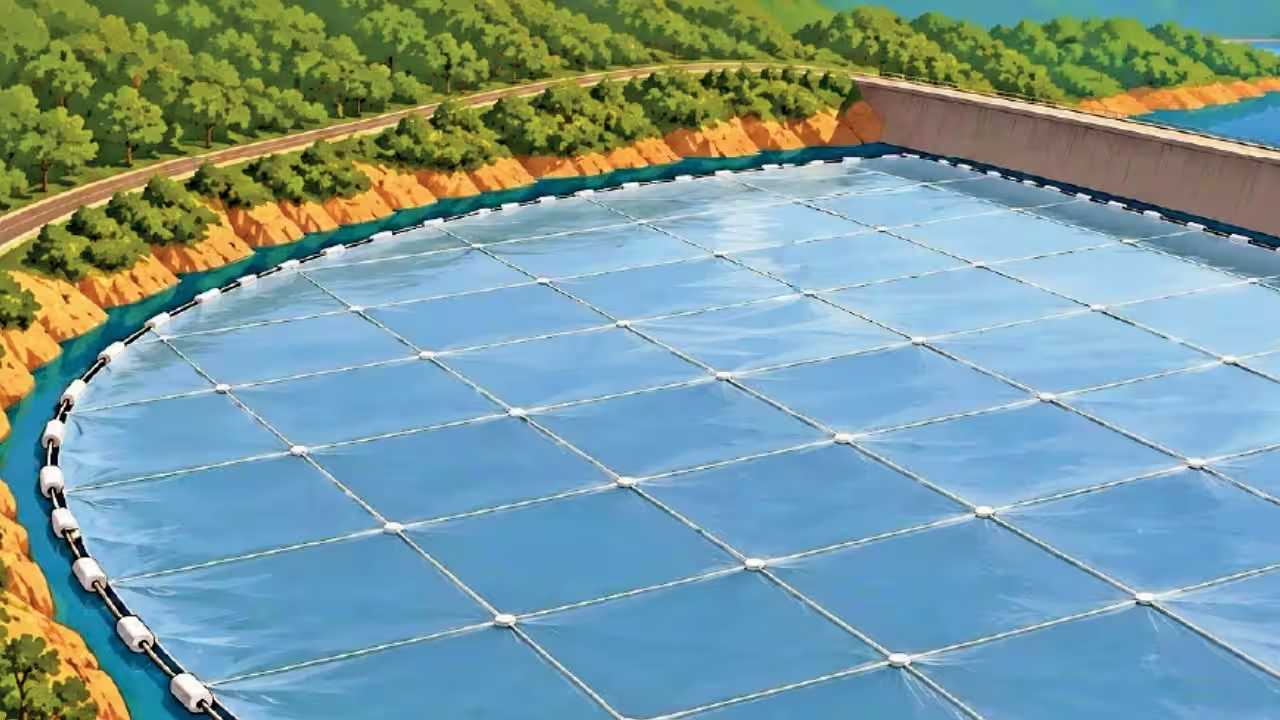
A physicist from Ghana has an unusual solution for a serious problem: apply a ‘sunscreen’ to the surface of lakes and reservoirs to conserve water.Daniel Kwasi Kpeglo (PhD from University of South Africa), and his team investigated whether a thin, nanomaterial-coated sheet could reduce evaporation while allowing enough light through to sustain aquatic life.They used a commercially available transparent conducting oxide (TCO) and applied it to a standard PET sheet. The researchers published their findings in ‘Nature’.“The most important resource we use is water and much of that is lost to evaporation,” Kpeglo tells TOI. “So we said, ‘Let’s come up with a thin material that will act as a barrier and minimise evaporation’.”Kpeglo says the research began in 2022-23. In the lab, researchers used a 29.8x21.1x11 cm reservoir and a halogen lamp set to 1.5 times the intensity of sunlight, testing at distances of 10, 20 and 30cm. They compared an uncovered reservoir with PET-covered and TCO-coated versions, measuring temperature changes and water loss.In the uncovered reservoir, water levels fell at rates ranging from 0.45mm to 0.78mm per hour, depending on the lamp’s distance. Ordinary PET slowed the loss but did not prevent it. With the coated sheet, the level remained virtually constant during the observation period, within the margin of experimental error. Evaporation was also considerably higher under infrared-rich illumination.The hydrophobic coating could limit biological build-up, although its ability to resist algae and bacteria over time remains untested. Kpeglo says the thin film is not placed directly on the surface of the water. “The sheet is secured above the water, leaving a gap of about one centimetre.”That flexibility could prove useful in India, where monsoon rainfall makes permanent reservoir coverings impractical. “When the rainfall is coming, you can remove it from the reservoir,” Kpeglo says. “You bring it back during the dry season,” he says.The material is far from field ready, however. Wind and moving water could displace the sheets, requiring secure support (see box), and the film’s UV resistance needs to be studied, Kpeglo says. The next step is field trials.The ‘sunscreen’ solution remains a concept, for now, but Kpeglo says it's one with potential. “This thing has opened a door when it comes to using nanosciences to minimise water evaporation.”Your child uses AI every day. But do they understand it? Find out in the TOI AI Masterclass.
Topics in this story
Gathered from external sources. Rights to this text belong to whoever originally published it.