Eating only 15-ml olive oil before having carbs can have a positive impact on blood sugar spike, in an experiment on mice scientists are tracing the effect to a combination of digestive hormones and nerve signals
A planetarium designed by American architect Frank Lloyd Wright has reopened to the public in Florida, more than two decades after its projection system
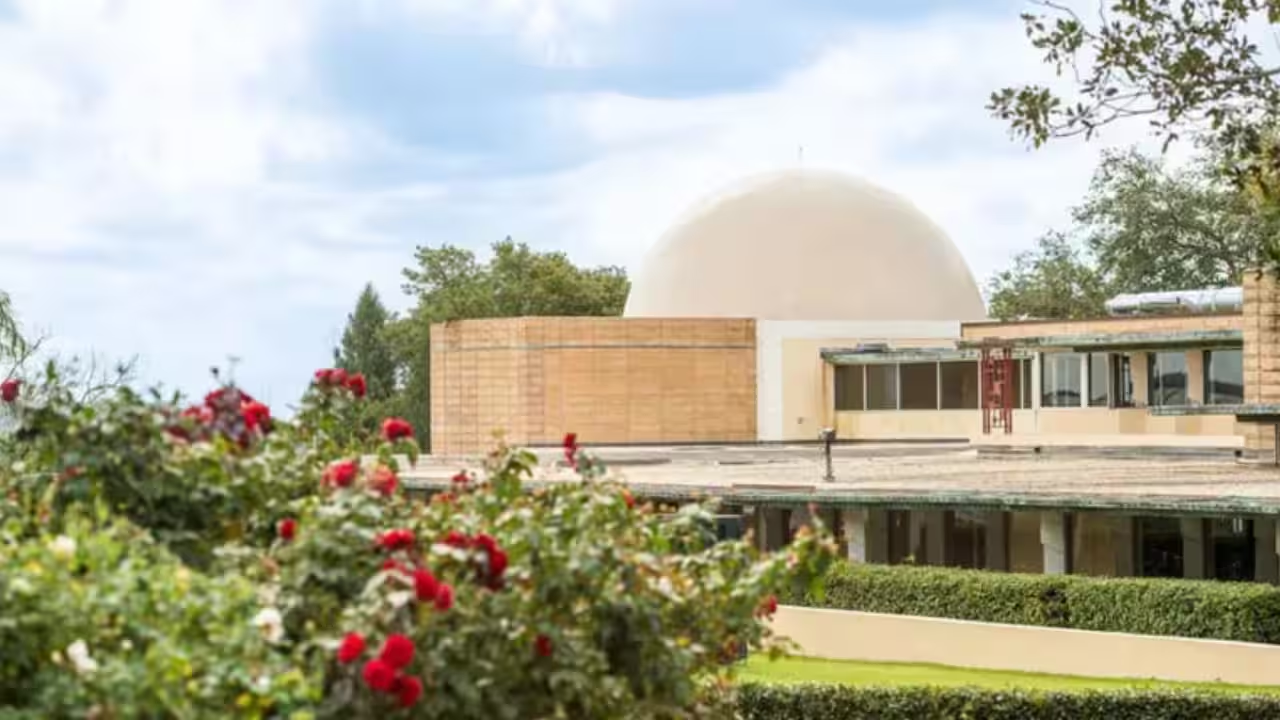
A planetarium designed by American architect Frank Lloyd Wright has reopened to the public in Florida, more than two decades after its projection system stopped working. Located at Florida Southern College in Lakeland, the restored planetarium is now offering public shows, school visits and educational programmes with new projection and sound technology.The planetarium is located inside the college's Polk Science Building and is the only planetarium ever constructed from a design by Wright, according to West Orlando News. It is also part of a collection of 13 Wright-designed structures at Florida Southern College, which the institution describes as the world's largest collection of his architecture at a single site.The reopening follows a restoration project involving work on both the exterior and interior of the building. The latest phase included installing modern equipment to allow the planetarium to operate again. The space had been used only occasionally since 2004, when its original projection system stopped functioning.“Florida Southern has long been entrusted with preserving Frank Lloyd Wright’s extraordinary vision for this campus, and reopening the Planetarium allows us to bring an important piece of that vision back to life,” said Dr. Jeremy P. Martin, president of Florida Southern College. “This restoration honors the history of this remarkable space while creating new opportunities for our students, visitors and the broader community to experience it in a meaningful way,” he added.Public shows four days a weekWith the restoration complete, the college has introduced a regular schedule of public shows. Visitors can attend programmes on Tuesdays, Thursdays, Saturdays and Sundays at 3.30 pm.Six programmes will be offered on a monthly rotation. These include Cosmic Adventure, Destination Mars: The New Frontier, From Earth to the Universe, God, Science, and Our Search for Meaning, Oasis in Spaceand Undiscovered Worlds: The Search Beyond Our Sun.The shows cover different areas of astronomy, including the solar system, exploration of Mars, exoplanets and the wider universe. Exoplanets are planets that orbit stars outside our solar system.Each programme lasts approximately 20 to 32 minutes. However, the complete visit will take around 60 to 90 minutes because it also includes an introduction to the planetarium's history and architectural importance.Tickets cost $20 per person. Families and groups of four or more can purchase tickets at $15 per person. Admission to the planetarium is separate from the college's Frank Lloyd Wright architectural tours.The facility will also be used by Florida Southern students and faculty members. Schools, community organisations and other groups will be able to arrange visits and participate in educational activities.The restorationThe reopening follows several phases of restoration supported by government funding and private contributions. According to the college, work on the exterior was funded by the State of Florida and private donors. The interior restoration received support through the federal Save America's Treasures programme, along with private donations.The most recent phase, also supported by State of Florida funding, involved installing a COSM projection system and a Bowen sound system. These additions have made it possible to resume planetarium shows using modern technology while retaining the restored historic space.“Reopening the Planetarium allows us to bring an important part of Florida Southern’s history back to life while creating new opportunities for our students and the community,” said Tory King, director of Tourism Operations & Visitor Experience at Florida Southern College. “The architectural restoration brought the space back, and the new technology now allows us to return it to active educational and public use,” she added.History dating back to the 1950sThe planetarium was included in Wright's original plans for the Polk Science Building, which was constructed between 1954 and 1958. Its first show was held on April 7, 1960.For several decades, it served as an educational facility for the college's astronomy programme. Professors used planetarium shows to explain important astronomical concepts to students, while schools and members of the public could also visit.Traditionally, the facility offered four public shows each year. However, its use became limited after the projection equipment stopped working in 2004.Wright had been interested in designing a planetarium for several decades before including one in his plans for Florida Southern College. His design for the Science Building included spaces intended for public education, reflecting his belief that colleges should provide learning opportunities for surrounding communities as well as enrolled students.
Topics in this story
Gathered from external sources. Rights to this text belong to whoever originally published it.