Cornell researchers tested sheep grazing under New York solar panels for three years; at two sheep per hectare, beneficial insects rose 38% versus mowing, while honey bees increased 83%
Solar farms could offer more than clean energy.
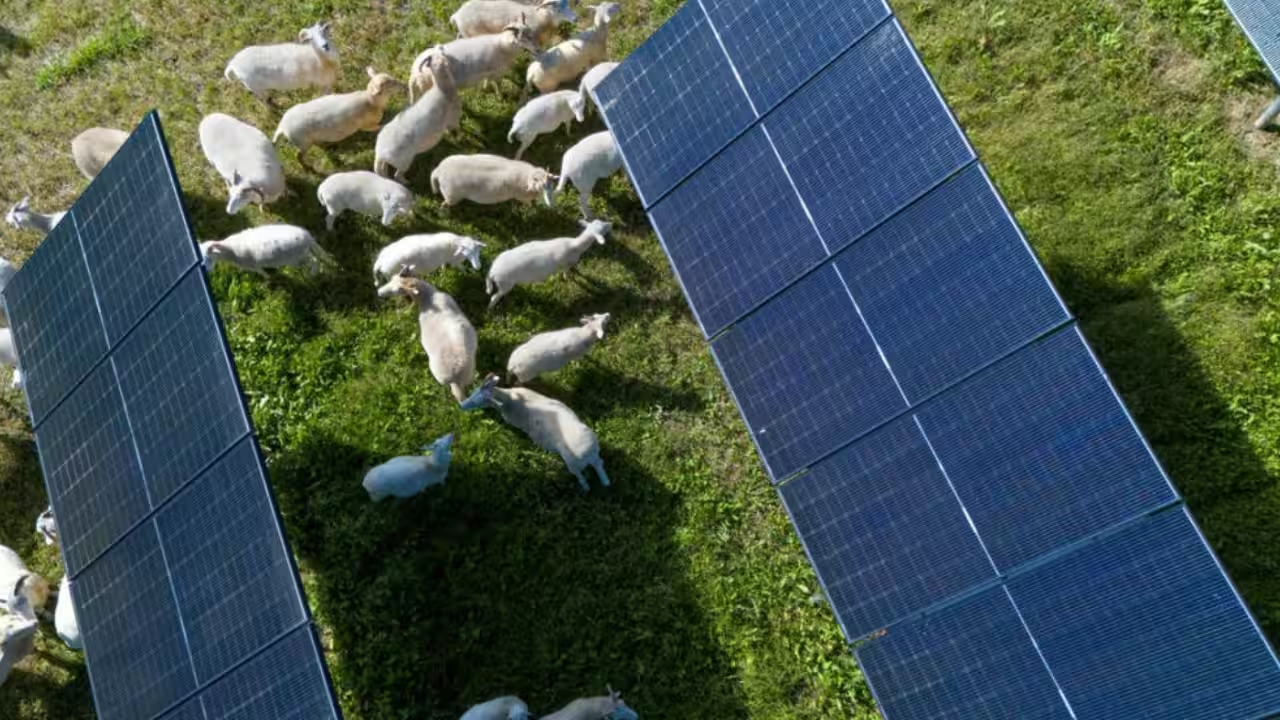
Solar farms could offer more than clean energy. A three-year study by Cornell University researchers in New York has found that allowing sheep to graze beneath solar panels may also benefit insects, including bees and lady beetles, when the animals are kept at the right density. The findings, published in Environmental Research Letters on October 7, 2026, suggest that using sheep to manage vegetation can deliver ecological benefits alongside renewable power generation. Cornell Chronicle and science news outlet Phys.org reported the findings on October 14. At a grazing density of two sheep per hectare, researchers recorded 38% more beneficial insects than in plots where vegetation was controlled by mowing. Honey bees accounted for much of the increase, with their abundance rising by 83%. However, the study also found that increasing the number of sheep did not necessarily produce better results for insect populations, highlighting the importance of balancing vegetation management with biodiversity.How sheep grazing can benefit solar farmsThe research was conducted at Cornell University's Cascadilla Community Solar Farm in Dryden, New York. Over three years, researchers examined how different sheep stocking rates affected insect populations and vegetation around solar panels.Solar farms need regular vegetation management because tall grass and other plants can shade panels or interfere with their operation. Mowing is one way to control growth, but grazing sheep offers an alternative that allows land to serve two purposes at once: generating electricity and supporting agricultural activity.This approach, known as solar grazing, is part of a broader practice called agrivoltaics, which combines solar energy production with agriculture on the same land. Cornell's earlier research into solar grazing has explored how the approach can help farmers maintain productive livestock operations while reducing the need for conventional vegetation management.The latest findings add another dimension to the practice by examining how grazing intensity affects beneficial insects. Rather than treating sheep management and pollinator conservation as separate concerns, the researchers assessed how both could be accommodated within the same solar installation.Why the number of sheep mattersThe researchers found that the ecological benefits depended on how many sheep grazed in a given area. At four sheep per hectare, beneficial insect numbers were similar to those recorded in the mowed control plots, although vegetation management was more effective than at the lower stocking rate. At eight sheep per hectare, the sheep were most effective at controlling vegetation, and flock health remained high. However, honey bee abundance fell by 45%, illustrating a potential trade-off between maintaining grass and supporting insect populations.These findings suggest that there is no single grazing density that maximises every benefit. A smaller flock may be better for beneficial insects, while a larger flock can provide more effective vegetation control. The appropriate stocking rate will depend on the priorities of farmers and solar farm operators, as well as local environmental conditions.The economic opportunity for sheep farmersThe ecological research was accompanied by a separate Cornell study examining how solar grazing can become a more viable business for sheep farmers. Published in Manufacturing & Service Operations Management on September 28, 2026, the research introduced a spreadsheet-based decision-support tool designed to help farmers manage flock sizes, costs, sales and expected vegetation at individual solar sites.The model can help farmers determine how many sheep they need to meet a solar operator's vegetation-management requirements while accounting for the costs of acquiring and maintaining their flock. It can also help solar developers structure contracts that better reflect farmers' operational needs. For sheep farmers, these arrangements can provide a source of income beyond selling meat and wool. Solar grazing contracts may also give them access to land and animal feed, helping them expand their businesses without having to purchase additional grazing property. The model has already been incorporated into the onboarding process of United Agrivoltaics, a company working with sheep farmers and solar installations.A different way to think about renewable energyThe findings come as solar development continues to raise questions about how land can be shared between energy production, agriculture and conservation. Solar grazing offers one possible solution, allowing sheep to control vegetation while keeping land in agricultural use. However, the Cornell study does not suggest that grazing alone will automatically increase biodiversity at every solar farm. Its results demonstrate that management decisions, particularly stocking density, can influence the balance between vegetation control and insect habitat.The research provides a practical starting point for farmers, developers and local authorities considering how to make solar installations more environmentally beneficial. By choosing grazing rates carefully, they may be able to combine renewable electricity generation with viable farming operations and improved conditions for beneficial insects. As the use of solar energy expands, the challenge will be to ensure that these installations deliver more than electricity. Cornell's findings suggest that, with thoughtful management, the land beneath solar panels can also support farming and contribute to healthier ecosystems.
Topics in this story
Gathered from external sources. Rights to this text belong to whoever originally published it.