A tiny change in temperature could now produce a big electrical signal; scientists surpass century-old limit
Science News: BENGALURU: A small rise in temperature can be hard to detect. Scientists measure such changes using increasingly sophisticated sensors, but a discover.
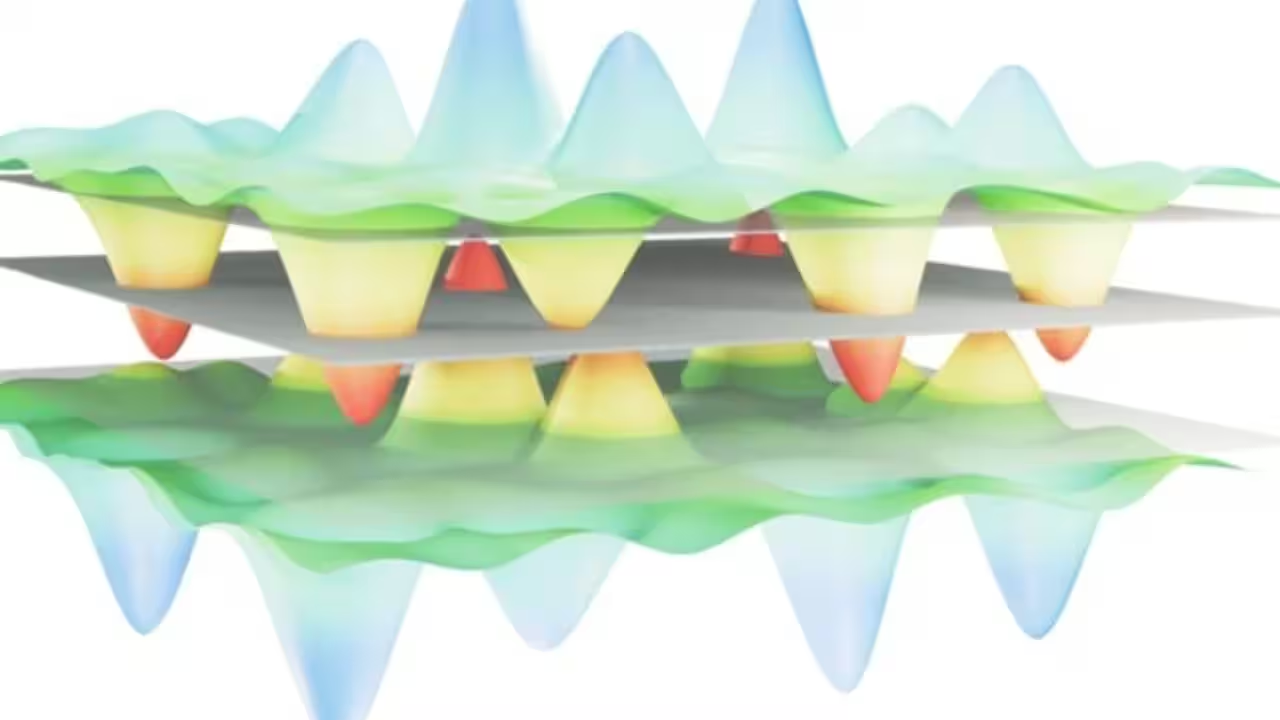
BENGALURU: A small rise in temperature can be hard to detect. Scientists measure such changes using increasingly sophisticated sensors, but a discovery involving researchers from the Jawaharlal Nehru Centre for Advanced Scientific Research (JNCASR), IISc and the University of Sydney, could make the task considerably easier.In doing so, researchers may have overturned a limit that scientists had accepted for more than a century on how much electricity a solid material can generate from a difference in temperature.The team has found a crystalline material that can generate an electrical signal from a temperature difference at levels far beyond what scientists had thought possible for a solid. The finding could eventually lead to highly sensitive temperature sensors, better thermal imaging and devices capable of detecting extremely small amounts of heat or light.The discovery concerns a phenomenon called the “Seebeck effect”. Put simply, when one side of a material is hotter than the other, electrically charged particles can move and create a voltage. This principle is already used in temperature sensors and in devices designed to convert waste heat into electricity.For decades, scientists believed there was a practical upper limit to how large this electrical response could become in a crystalline solid. The largest effects were generally seen in liquids and other materials in which ions carry charge.The researchers, however, found that a specially engineered form of scandium nitride, a semiconductor, could produce an electrical response several hundred to more than a thousand times larger than that normally seen in inorganic semiconductors. In one thin film, the measured response exceeded –124.6 millivolts per Kelvin of temperature difference.The key, researchers said, was introducing a carefully controlled form of disorder into the crystal. The team added magnesium to scandium nitride to balance the electrical charges already present in the material, creating what they call a heavily doped, highly compensated semiconductor.“What we found instead is that a fully crystalline, epitaxial, single-phase semiconductor can behave thermoelectrically like a liquid electrolyte,” said Prof Bivas Saha, who led the study.His team comprised of Renuka Karanje, Dheemahi Rao, Diksha Dadhich and Sourav Rudra from JNCASR, Ashalatha Indiradevi Kamalasanan Pillai and Magnus Garbrecht from the University of Sydney and Prof Subroto Mukerjee from IISc.The team has already built an early photon sensor using the material. When one of its contacts was illuminated with a laser, the tiny local rise in temperature produced a measurable voltage (–102.4 millivolts per Kelvin). Researchers believe that, with further work, such materials could potentially be used to detect extremely weak light signals.Beyond temperature sensing, the findings could have applications in thermal imaging, heat detection and emerging quantum technologies. An Indian patent application has also been filed for thermoelectric thin-film materials and sensors based on the work.The study, published in the journal Science, doesn’t mean everyday devices will immediately become dramatically more sensitive. But it opens up a new way of thinking about materials that turn heat differences into electrical signals, challenging a limit that researchers had long assumed was difficult, if not impossible, to cross.
Topics in this story
Gathered from external sources. Rights to this text belong to whoever originally published it.