Scientists surveying Bolivia's Madidi National Park have confirmed 99 bat species, including seven never before recorded in the country and one potentially new to science, revealing unexpected diversity across forests
While people adore animals, few are not very famous among humans.
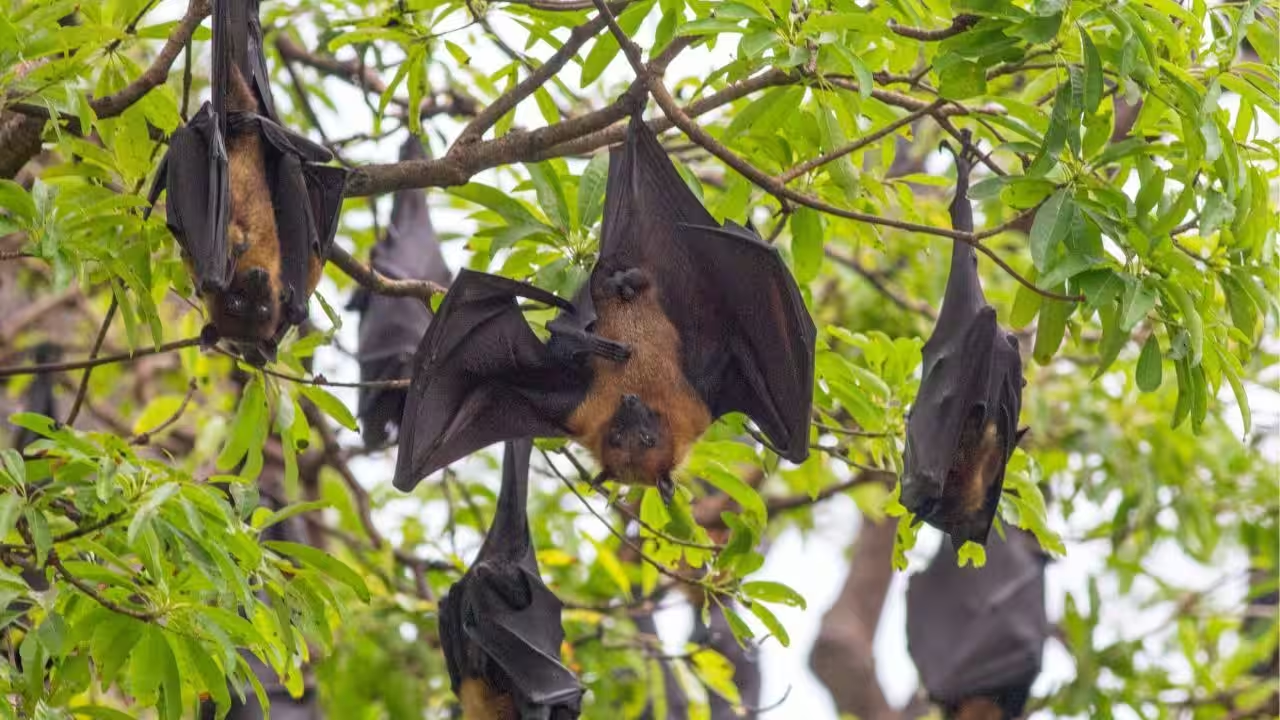
While people adore animals, few are not very famous among humans. It might be because of their hideous appearance, strange behaviours, being stinky, or maybe they just haven’t gained popularity in the human world. But bats are creatures that are not unknown but infamous, especially after the Covid-19 pandemic. However, their contribution to nature cannot be ignored, which is why detailed studies are conducted to study them extensively.In Bolivia's Madidi National Park, scientists have been listening, watching and looking a little closer. And they have discovered something remarkable. The latest research has documented 99 bat species in a single protected area of Bolivia. Out of these, seven have been recorded in Bolivia for the first time, while one additional bat could represent a species never described by science. The findings, announced by the Wildlife Conservation Society (WCS) on November 16, 2026, place Madidi among the world's richest protected areas for bat diversity.A forest hiding an extraordinary number of batsMadidi National Park and Natural Area of Integrated Management is located in Bolivia and covers nearly 19,000 square kilometres. The nature sanctuary spreads from Amazonian rainforests and tropical foothills to high-altitude regions of the Andes. This distinguishes Madidi, as it contains different climates, vegetation and elevations under one protected area. Thus, the wildlife in the region is extremely varied, with the availability of different habitats in which they can feed, shelter and reproduce.The latest research confirms that the park supports more than two-thirds of Bolivia's known bat fauna. The research found 25 new bat species records that had not been documented in Madidi before. Among them, there were seven that had never previously been recorded anywhere in Bolivia as well. The study also recorded a potentially undescribed species belonging to the genus Histiotus. If further investigation confirms its identity as a new species, Madidi's tally could reach 100 bat taxa.The study, titled ‘Bats (Chiroptera) from Madidi National Park: An Integrative Assessment from Field Surveys, Museum Collections, and Historical Records’, was published in the scientific journal ZooKeys.Listening to the forest after darkBats are nocturnal, often small, and some are particularly difficult to observe using conventional wildlife-survey methods. The research was conducted under the Wildlife Conservation Society's (WCS) Identidad Madidi initiative, which combined several techniques to track these bat species.Field surveys were conducted between 2015 and 2017 across 12 locations, covering elevations ranging from 198 metres to an astonishing 4,814 metres above sea level. Scientists also used nets to capture bats, searched potential roosting sites and employed acoustic detectors to record their ultrasonic calls. These detectors were particularly useful because bats navigate using echolocation, producing sounds generally beyond the range of human hearing.The team captured 820 bats belonging to 69 species. Acoustic recordings revealed another 28 species, including 14 that were detected exclusively through their calls. Combining the field observations with historical records and museum collections eventually produced the confirmed count of 99 species.Bats spread their wings across different forestsMadidi being an extremely biodiverse landscape, the bat diversity was also unevenly distributed throughout the park. While 77 species were documented in the Sub-Andean Amazon Forests, 66 were found in the Pre-Andean Amazon Forests and 49 in the Yungas. The numbers reflect how variation in habitat has an effect on the kind of bat communities present in the region.The researchers also found considerable differences in the composition of bat communities between these ecological regions. This matters because protecting a forest does not simply mean protecting its trees. It means preserving the different environments that allow its wildlife to survive. As Robert Wallace, WCS Bolivia's senior conservation scientist and a co-author of the study, explained, conserving Madidi's biodiversity requires protecting the entire landscape, from the Amazonian lowlands to the high Andes.The potentially new Histiotus species still requires further investigation before scientists can formally establish whether it is new to science. Researchers have also cautioned that differences in sampling effort mean additional surveys are needed to understand the distribution of bat species more completely.Fearless legend or grounded realist? Rate yourself on 11 categories in the Great Indian Confidence Survey – find out in 3–6 min
Topics in this story
Gathered from external sources. Rights to this text belong to whoever originally published it.