Forget rockets — Longshot wants to fire cargo into space from a gun. See it at TechCrunch Disrupt 2026 | TechCrunch
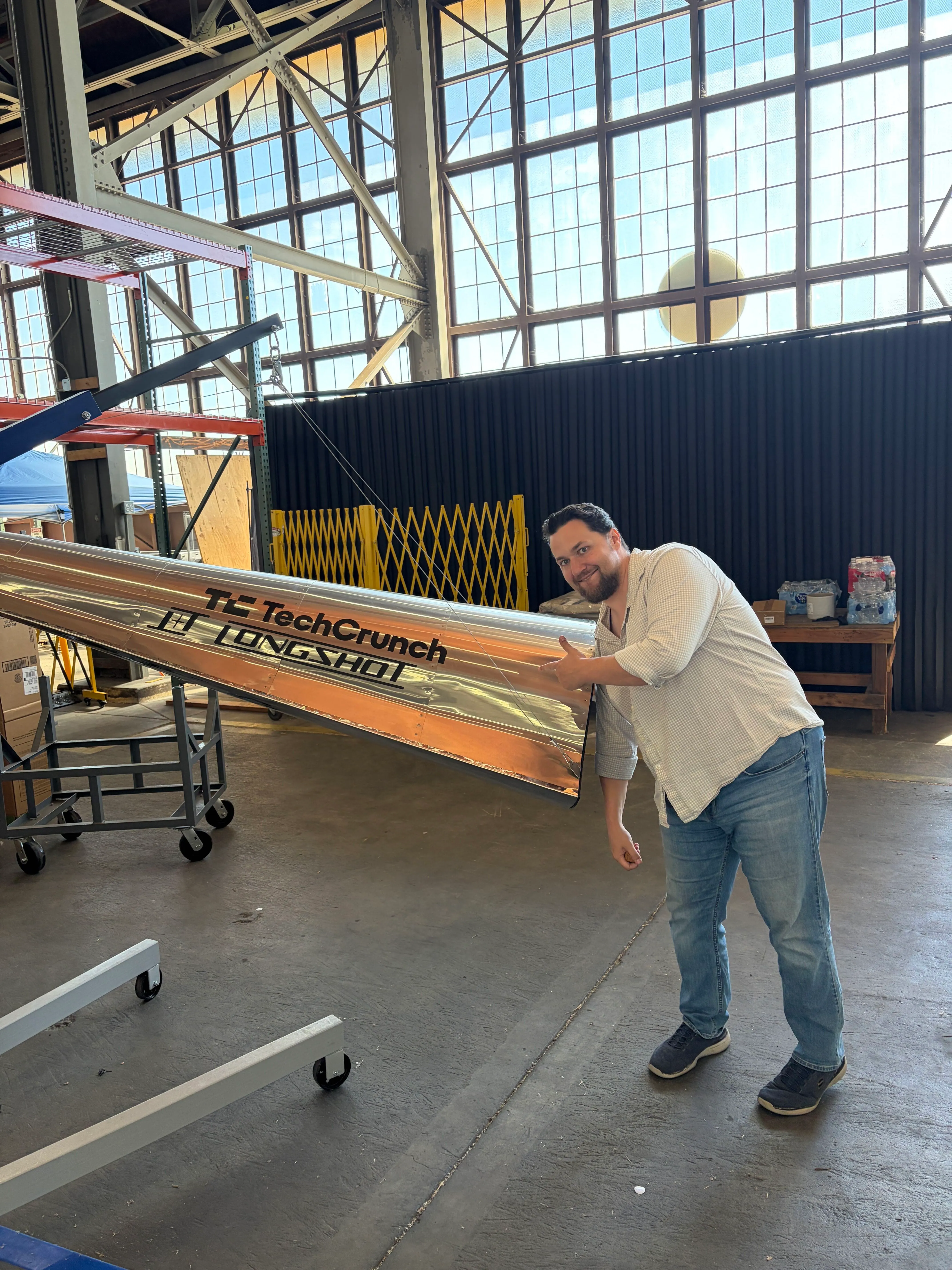
Longshot is trying to build a gun big enough to make space data centers a reality.
Rockets are, infamously, a real pain in the butt. Our old friend physics forces rockets to be built with almost no room for error, and even then only a small fraction of their weight makes it to orbit.
There are, at least in theory, other ways to do the job — space elevators, centrifuges, or a big chain hanging from a satellite in space and scooping up cargo from Earth. (Blue Origin spent some time thinking about that one before the idea wound up in a Neal Stephenson novel .)
And then there’s an idea dating all the way back to Jules Verne: Use a big gun to shoot a projectile into space.
Longshot Space Technology , a startup based in Alameda, California, is working on exactly that. The co-founders, CEO Mike Grace and CTO Nato Saichek, see an opportunity to take a technology that has already proven its worth and apply it to the pressing need for space launch. The startup has raised about $20 million from venture investors in service of its mission.
When it comes to frontier technology, Grace says, “you can build something that has a lot of novelty, or you can do something really hard. You don’t get to do both.” He points to SpaceX as an example of a company that has “taken classically de-risked technology and scaled it aggressively.” What SpaceX did with NASA rocket research, he says, Longshot will do with multi-injection guns — designs that give a projectile extra boosts as it moves down the barrel — built for World War II and during 1960s research programs.
The idea is to take all the work done by the first stage of a launch vehicle and collapse that into a reusable accelerator on the ground. Picture a steel pipe mounted horizontally over the ground, with tanks of high-pressure gas attached at ports spread across its length. When a projectile is fired and moves down the barrel, the tanks fire off at precise times to accelerate it — to speeds as high as Mach 4, thus far.
The company is currently firing a 70-foot gun with a six-inch diameter at its test site near Barstow, California, and says it can accelerate projectiles up to near-hypersonic speeds. Soon, it expects to start firing a 140-foot-long gun with a 30-inch diameter at its Alameda test site. After that, the company is preparing to build out a 30-inch diameter gun that is 328-feet long, with plans to extend it to about 3,000 feet — making it the largest gun on the planet. It will be capable of launching 220-pound payloads up to speeds of Mach 8, the team says.
These guns will let Longshot keep proving its technology works while also generating revenue from performing hypersonic testing for the U.S. military, which has awarded the company several contracts. Grace envisions building one of his guns on a U.S. military installation like Fort Bliss, where it could be part of the infrastructure for testing the next generation of U.S. interceptors. (And no, the guns don’t need to point up at an angle. Longshot’s projectile is a lifting body, meaning its shape generates lift, so it will aerodynamically gain altitude once it exits the barrel.)
“If you want to practice shooting down a Chinese or Russian hypersonic missile, wouldn’t it be nice not to pay $30 million for that?” Grace asks. “This is a way for half a million, a quarter of a million bucks, of doing hypersonic clay pigeons, throw them and shoot them down, and do it really fast and really cheap.”
The ultimate goal, however, is putting large payloads into space. The team is confident it can scale up its current design to accelerate payloads to as much as five kilometers per second (more than 11,000 mph). That’s fast enough to get into space if the payload, which effectively serves as the second stage of a rocket, has its own propulsion system. But doing that would require a gun 10 kilometers (about six miles) long and nearly 10 feet in diameter. As you might imagine, one problem the company faces is simply finding suitable worksites.
“The hard part is not building the thing, it’s finding a place where they will let you build the thing,” Saichek jokes.
But if Longshot can realize its vision, the math is very attractive: The system is cheap to construct and to fuel, and is highly reusable. Grace expects that if everything works out, they can send payloads to space for a hard-to-believe $50 per kilogram (about $22 per pound). Considering that the much-hyped orbital data center industry needs prices to fall to around $300 per kilogram to get off the ground, that leaves Longshot plenty of room to offer a competitive price.
It will require some modification to launch spacecraft in this form factor and conditions, but at that price point, satellite operators will be willing to try.
If you want to learn more about Longshot from the company itself — while also checking out dozens of startups, hearing their pitches, and listening to guest speakers on four different stages — join us this week at Disrupt, Tuesday to Thursday, in San Francisco. Learn more here.
Topics in this story
Gathered from external sources. Rights to this text belong to whoever originally published it.