In 1959, US Army built a secret base under Greenland’s ice sheet, which was abandoned in 1964 due to melting ice; in April 2024, NASA finally rediscovered the remains of Camp Century
Imagine building a secret base under a vast ice sheet, only to abandon it half a decade later!
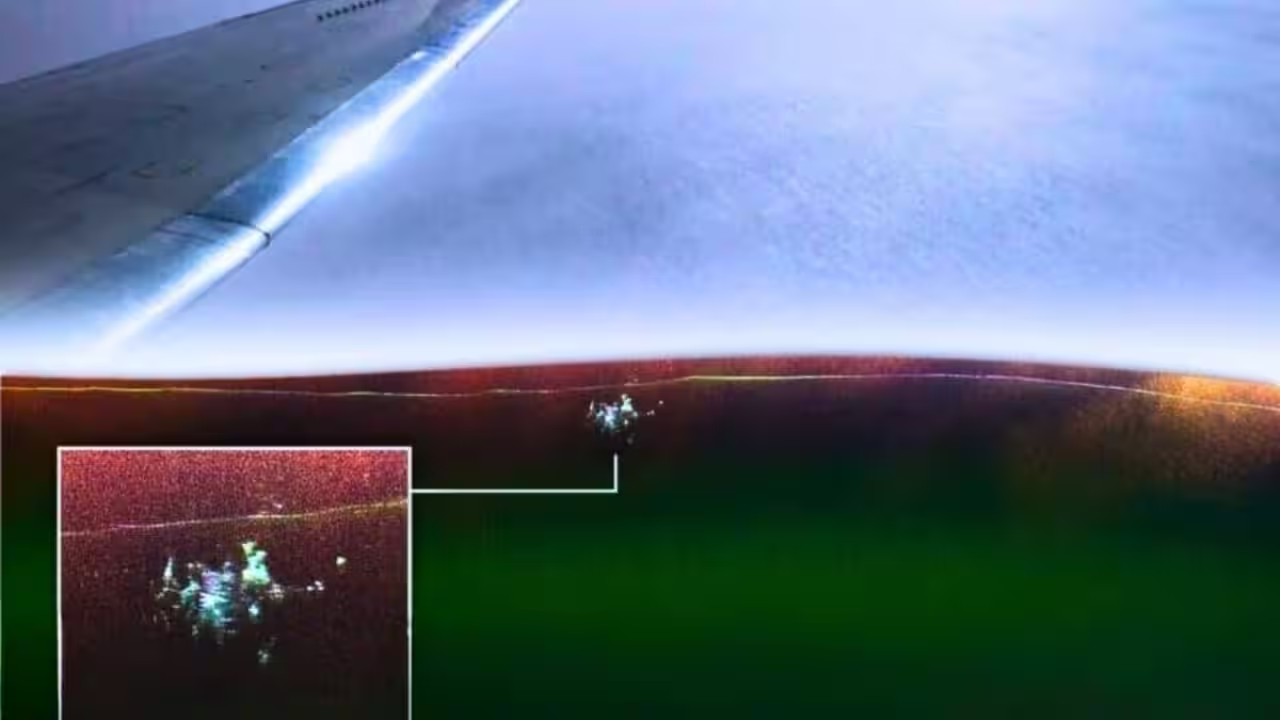
Imagine building a secret base under a vast ice sheet, only to abandon it half a decade later!That’s what the United States of America did over half a century ago. Beneath Greenland’s ice sheet, the US Army once hid a secret base that almost vanished from history. Back in 1959, engineers dug out Camp Century: not just a cold-climate research station, but the staging ground for a wild military experiment. Behind official talk of science and engineering, planners hoped to test whether America could install nuclear missiles in a network of tunnels and caverns gouged from the ice, invisible to enemies and unreachable in a crisis.For years, the base stayed out of sight, sealed up and forgotten as heavy snow and shifting ice layers piled on top. In April 2024, Camp Century emerged back into the spotlight. NASA scientists, flying a radar-equipped jet over Greenland, stumbled onto stunning images of the old base. These weren’t blurry blobs; they were sharp slices straight through the ice, revealing tunnels and structures detail by detail. In November, NASA published its radar map, calling Camp Century a “city under the ice,” a phrase that really captures how ambitious the whole project was.This rediscovery isn’t just a peek at Cold War history or secret engineering. It drags up a much more uncomfortable problem. When you abandon a military operation under miles of ice, what happens as the Arctic heats up and that protective blanket starts to melt? What else is waiting below: rusty machinery, toxic waste, maybe even traces of the old nuclear reactor?What was Camp Century, and why did the US build it?In the late 1950s, the US Army Corps of Engineers took a gamble on Greenland because of its strategic location: perched between Europe and North America, right in the path of a possible Soviet threat. Instead of building a regular base, they cut trench after trench in the upper ice, then roofed them over, eventually creating a sprawling maze. The base was almost a small town buried under the snow: dorms, labs, workshops, kitchens. It could house over 100 people, all kept alive by a portable nuclear reactor that provided power; there was no need to ship endless barrels of fuel across the ice.The secret plan behind Camp Century: Project IcewormCamp Century’s public face was all about science and surviving in harsh conditions. But beneath that, it was a test for Project Iceworm, which was a classified project that sounds like something out of a spy novel. The idea: build a railway under the ice stretching across more than 130,000 square kilometers, with mobile nuclear missiles hopping from site to site, always one step ahead of Soviet surveillance. Camp Century was the pilot test, the proof-of-concept.Why was Camp Century abandoned?But as it turns out, ice isn’t a great building material. It moves, it warps, it cracks under its own weight. Over time, the tunnels deformed, making the base less safe and more expensive to maintain. By 1964, the nuclear reactor was shipped out, and the US quietly shut down operations. Not everything was cleaned up, though; tons of equipment and waste, from diesel fuel to sewage, stayed exactly where it was, buried and assumed safe forever under accumulating snow.Now, that assumption looks shakier every year. Greenland’s climate is changing, and as the ice sheet melts, stuff left behind could start to resurface. A study in 2016 poked into the buried hazards: hundreds of thousands of litres of diesel fuel; PCBs (pollutants you really don’t want leaking out); sewage; and leftover radioactive coolant. If melting outpaces snow accumulation, that toxic mix might seep out, possibly within the next few decades, depending on how fast Greenland warms up.How did NASA rediscover Camp Century in April 2024?NASA’s rediscovery arrived by accident. In April 2024, Chad Greene and his team loaded up a Gulfstream III with a next-gen radar system, aiming to understand Greenland’s base layers. Instead, their radar started picking up parallel lines and echoes: Camp Century, now mapped in high resolution and triangulated with old blueprints. NASA published the images on November 25, 2024, explaining that the structures were buried at least 30 metres (about 100 feet) beneath the surface. Radar images showed its structural layout much more clearly than previous scans.Does this mean the base is suddenly a ticking environmental time bomb?Not exactly. Not yet, anyway. NASA’s images show where Camp Century is, not what it’s leaking. Still, the discovery highlights newer questions about responsibility. The Cold War, which once drove nations to build hidden fortresses, is long over. But climate change is making sure yesterday’s secrets never stay buried.What’s next?Camp Century is still frozen beneath the ice. No excavation, no sudden rush of toxic waste; just more precise data. For researchers, these radar images are a goldmine, helping measure ice depth, map out old tunnels, and predict how the sheet might respond to warming. The base itself is now a case study for how human decisions echo across decades. Something meant to vanish beneath the Arctic isn’t truly gone. If the ice melts enough, the leftover waste might appear, forcing future generations to deal with what was never supposed to resurface.Get the latest movie news, reviews, and celebrity updates. Download the TOI App.
Topics in this story
Gathered from external sources. Rights to this text belong to whoever originally published it.