Who gets to be a genius? Matilda effect and the women missing from science
Albert Einstein is probably the most quoted scientist in the world, and among the lines most popularly credited to him is one he almost certainly never
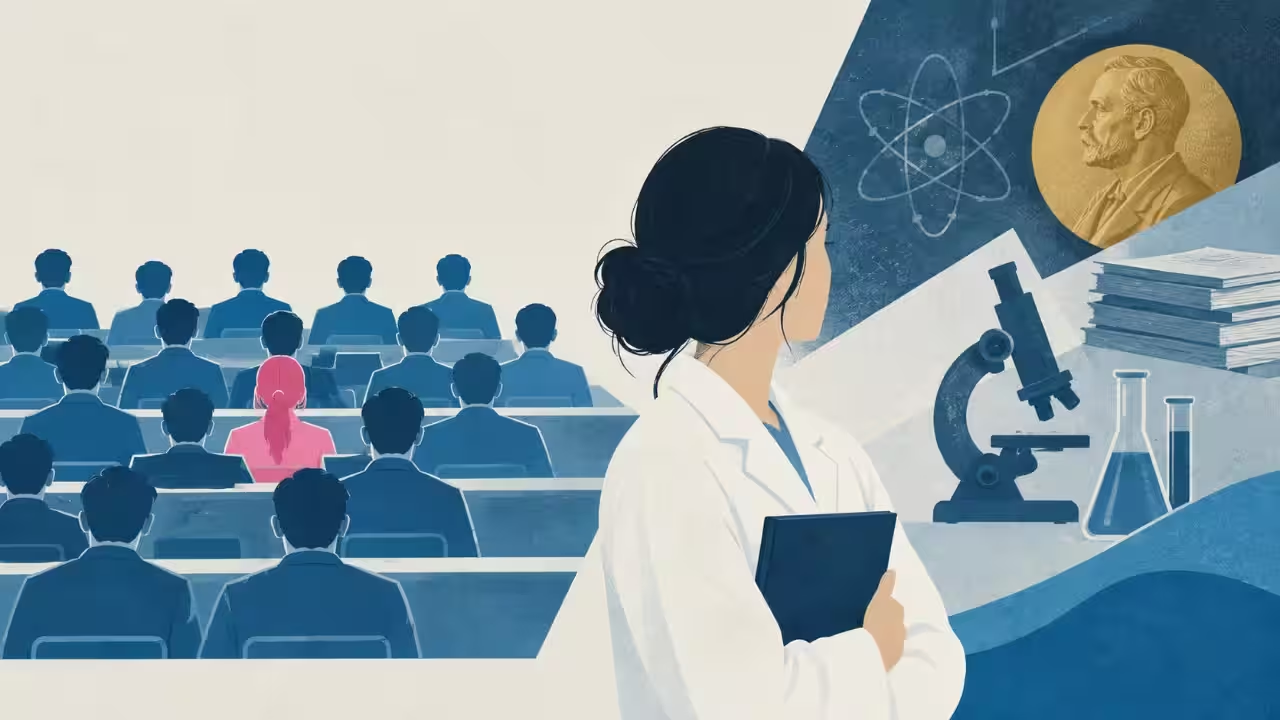
Albert Einstein is probably the most quoted scientist in the world, and among the lines most popularly credited to him is one he almost certainly never said.“Everyone is a genius. But if you judge a fish by its ability to climb a tree, it will live its whole life believing that it is stupid.”But there are some fish out there who have been told neither the water nor the trees are for them.In 1933, a chemistry graduate named Kamala Bhagvat applied for a research place at the Indian Institute of Science in Bengaluru. She had topped her class, yet was turned down.The man who turned her down is one of India’s most celebrated scientists, CV Raman.He reportedly turned her down because he did not think women were suited to research.But Kamala knew her potential better than him and did not take no for an answer, she protested outside his office in the Gandhian way until he gave in. He admitted her on probation. She then went on to Cambridge, where she worked with Robin Hill and showed that cytochrome c is present in plant cells.In 1993, historian of science Margaret W Rossiter gave a name to a persistent injustice in science: the Matilda Effect. In a paper published in Social Studies of Science, she documented how women scientists had been ignored, denied recognition or dropped from the historical record, while their contributions were sometimes credited to male colleagues.The Matilda effectShe named the phenomenon after Matilda Joslyn Gage, a nineteenth-century American feminist who had written about the suppression of women's achievements. Rossiter's paper challenged the idea that scientific recognition was simply a matter of who made a discovery. It was also a question of whose work was noticed, remembered and rewarded.The history of western science is fraught with instances where women’s contributions are overlooked, their work attributed to male colleagues, and recognition has flowed disproportionately to men. In some cases, those men went on to receive the very honours that cemented their place in scientific history.Even Mileva Marić, Einstein’s first wife and fellow physics student at Zurich Polytechnic, remains the subject of debate over the extent of her scientific contribution to his early work. While claims that she co-authored his landmark papers remain unproven, her story raises questions about how women’s scientific ambitions and contributions are remembered.An almost textbook case of the Matilda effect within the Indian science community was that of Bibha Chowdhuri. In the early 1940s she worked with the physicist DM Bose at the Bose Institute in Kolkata on cosmic rays, and the two published a series of letters estimating the mass of the particle they called the mesotron.In 1950 the British physicist Cecil Powell won the Nobel Prize for work that used the same photographic technique. Accounts of Powell’s own writing say he acknowledged Bose and Chowdhuri’s earlier contribution. Her biographer, the historian Rajinder Singh, says her name appears nowhere in the writing on cosmic-ray research at the Kolar Gold Fields, where she later worked.The Matilda Effect highlights failures of recognition. Recognition is integral to science and academia: a researcher’s work is cited, built upon and carried forward by others. Citations help establish a body of knowledge, but they also shape a scientist’s reputation and influence future opportunities. When a woman’s contribution is overlooked, the loss can extend beyond the original discovery. Her work may become harder to find, its influence harder to trace, and her place in the history of a field easier to erase.A 2012 study of 13 scientific societies in the United States found that men continued to receive a higher proportion of research awards than their representation among nominees would predict. Other studies have identified gender disparities in citation practices, although the size and nature of those gaps vary by discipline and method.But how does this framework apply to India? Women accounted for 43% of enrolment in science, technology, engineering and mathematics (STEM) disciplines in Indian higher education in 2021-22, according to the All India Survey on Higher Education. Yet the Department of Science and Technology's Research and Development Statistics Report 2023 put women's share of India's R&D workforce at 18.6%.From education to research: who gets to build a scientific career?Researchers Shruti Muralidhar and Vaishnavi Ananthanarayanan surveyed 98 Indian universities and institutes and found a median of 16.7% women faculty across the STEM fields they examined. Across the eight highest-ranked institutions in their sample, the median was 10%. Their project also documented gender imbalances among speakers at scientific conferences and argued that women were underrepresented and overlooked in career-advancing opportunities such as awards and grants.These figures show that women remain underrepresented in positions from which research is conducted, evaluated and made visible. That is where a contemporary account of the Matilda Effect needs to look beyond the final act of awarding credit.If outright dismissal has faded, something quieter has taken its place. Sania Singh, 23, did her MSc in Applied Mathematics (Scientific Computing and Machine Learning) at Imperial College London. She says the Matilda effect is not what she met. “Women (that she is familiar with) are not being dismissed professionally now,” she says. What she describes is closer to the cumulative consequence of the Matilda effect.Sharing the sex ratio in her cohort, she said that it was one woman to fifty men, and she mentioned that she had no female peers. Her point is that nothing in it counts as discrimination on paper. “It’s these little things that accumulate over time,” she says, and the extra patience that is required of a woman to reach a top lab, stay there and publish “shrinks” the number of women who try.The social environment could be alienating, too. The experience left her feeling invisible in a setting where she had come to study and conduct research.Sania’s experience echoes that of another researcher who spoke to TOI on the condition of anonymity. She said completing her research project had been particularly difficult because the men on her team had, inadvertently, created an “us versus her” dynamic.Neither account describes a discovery being credited to a male colleague. Instead, both point to the less visible work women may have to do simply to participate in research: finding their footing in a group, making themselves heard and navigating an environment in which they feel out of place.This is not the Matilda Effect in its original sense. But it raises a related question: what happens when the barriers begin long before a researcher has a discovery to claim credit for? Recognition is the end of a process that starts with the opportunity to learn, continues through access to research and mentorship, and depends on being able to stay in the field long enough to produce work worth recognising.The consequences may reach further back still, to the girls deciding whether science is for them at all. Women scientists who are overlooked in textbooks, awards and public memory offer fewer visible examples of what a career in science can look like. Representation alone cannot dismantle structural barriers, but seeing women recognised for their discoveries can make their achievements harder to dismiss as exceptions.The fish in Einstein’s misattributed quote is judged by a measure it was never built to meet. But what happens when the fish is capable of swimming, and is still made to feel that it does not belong in the water?For women in science, the problem has never been talent alone. It is also who gets encouraged to pursue it, who gets the space to develop it, and whose work is remembered once it has made a difference.The Matilda Effect gives a name to what happens when women’s contributions go unrecognised. But recognition begins long before a paper is published or an award is handed out. It begins with the chance to ask a question, pursue an idea and be taken seriously.Perhaps the more important question is not whether women can climb the tree, it is why must they keep proving they belong in the water.
Topics in this story
Gathered from external sources. Rights to this text belong to whoever originally published it.