NASA Spots a Bizarre 'Jellyfish' Floating on Mars. Here's What We Know.
H.G. Wells called it.
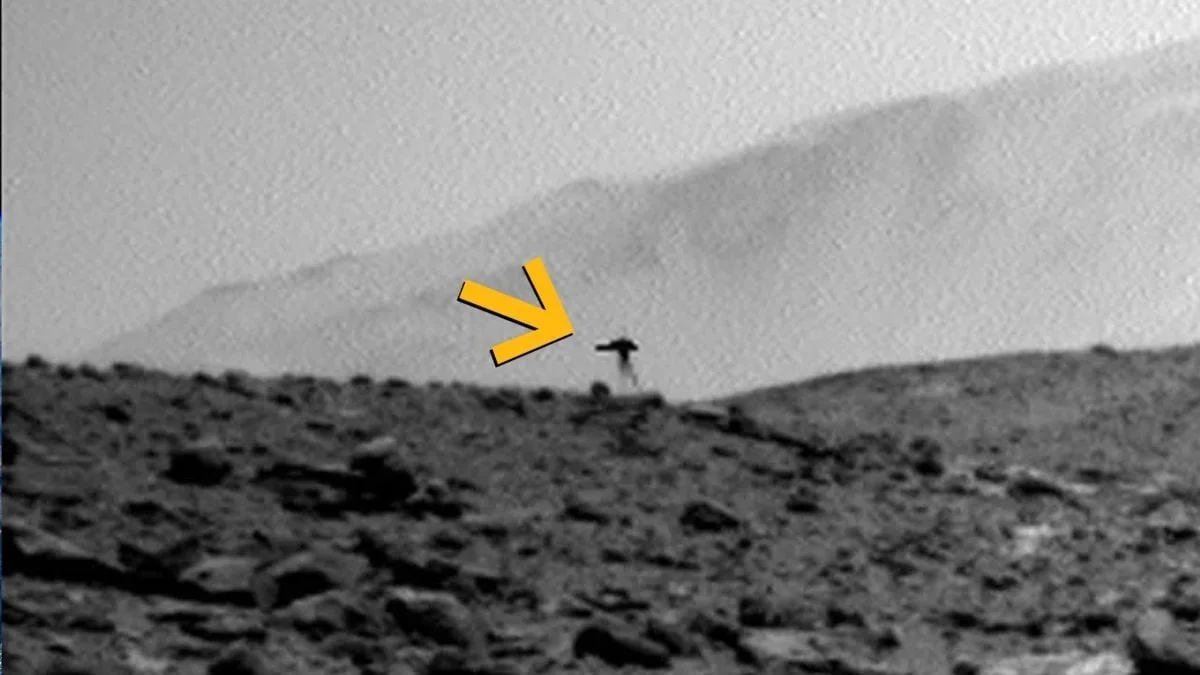
NASA rovers Curiosity and Perseverance have photographed some pretty strange objects on the surface of Mars .
From human-like heads and femur-like bones , to 'mushrooms' and suspiciously geometric structures , these objects are generally ultimately determined to be something Mars has in abundance. Yep, you got it – rocks.
In an image snapped by Curiosity in 2023 , and newly doing the is-there-life-on-Mars rounds , however, the explanation is a little more unusual.
On the far left of an otherwise normal picture of a Martian landscape is a strange dark shadow that looks a little like the silhouette of a jellyfish with tentacles dangling down – or, more appropriately, a Martian Tripod straight out of H.G. Wells' War of the Worlds .
Obviously, this feature is not as easy to explain away as a rock – but, equally as obviously (or it should be), nor are there alien jellyfish drifting about in the atmosphere of Mars.
Instead, the mysterious smudge is likely far more cosmic in origin – a charged particle raining down from space and smacking into the silicon detector of Curiosity's NavCam.
In fact, there's an easy way to be fairly confident that whatever it is we're looking at is not actually an ominous "jellyfish" perched on a Martian ridge.
Curiosity routinely takes multiple images of a target, and this is a good illustration of why.
The eerie jellyfish shot was taken on 20 August 2023 at 22:27:46 UTC . It also took photographs of the exact same scene using the exact same instrument, 13 seconds and 25 seconds earlier .
Neither of the two earlier images shows even a hint of a negative-space jellyfish.
Nor is this the first time a strange, fleeting smudge has appeared in one of Curiosity's images.
Cosmic rays are high-energy particles that constantly rain down from space. Here on Earth, we don't generally have to worry about them – our planet's magnetic field deflects many, while those that get through tend to smash into particles in our thick atmosphere, producing showers of secondary particles high overhead.
Mars isn't nearly so well defended. It has no global magnetic field, and its atmosphere has just 0.5 percent of the mass of Earth's, leaving Curiosity comparatively exposed to the energetic particles hammering down from space.
So it's actually not unusual for cosmic-ray artifacts to show up in Curiosity images. These charged particles routinely strike the detectors of cameras operating beyond Earth's protective magnetic field and atmosphere.
When they do, they can leave behind glitches in the resulting images.
For Curiosity's photos, these often look like bright white patches, as though someone has hit the camera from afar with a tiny laser pointer , or bright white streaks and staticky speckles . They can take a few different forms.
"In the thousands of images we've received from Curiosity, we see ones with bright spots nearly every week," imaging scientist and systems engineer Justin Maki of NASA's Jet Propulsion Laboratory said in 2014 .
But cosmic ray artifacts don't have to be bright white, as they are often described . In a video recorded using Curiosity's Hazcam in 2023 , a "small black artifact" is noted as originating from a cosmic ray striking the sensor.
These events are brief, usually visible in just a single frame – exactly the sort of behavior seen in Curiosity's mysterious "jellyfish".
That doesn't mean we can definitively blame a cosmic ray for this particular apparition. Without analysis from the Curiosity imaging team, other camera or processing artifacts can't be ruled out.
But the images themselves make one thing pretty clear: Whatever produced the jellyfish was almost certainly happening in the camera, not lurking on the surface of Mars.
Mars doesn't need jellyfish, or severed heads, or weird pyramids to be interesting.
The reason we see those things is interesting enough: We have robots exploring an entire other planet on our behalf – one whose geology throws up some bonkers rocks , and which leaves rovers sitting ducks to be bopped on the head by particles that may have traveled half the cosmos to get there.
Topics in this story
Gathered from external sources. Rights to this text belong to whoever originally published it.