Earth's Magnetic Field Flipping Heard as a Sound Is an Unnerving Horror
Just listen to it.
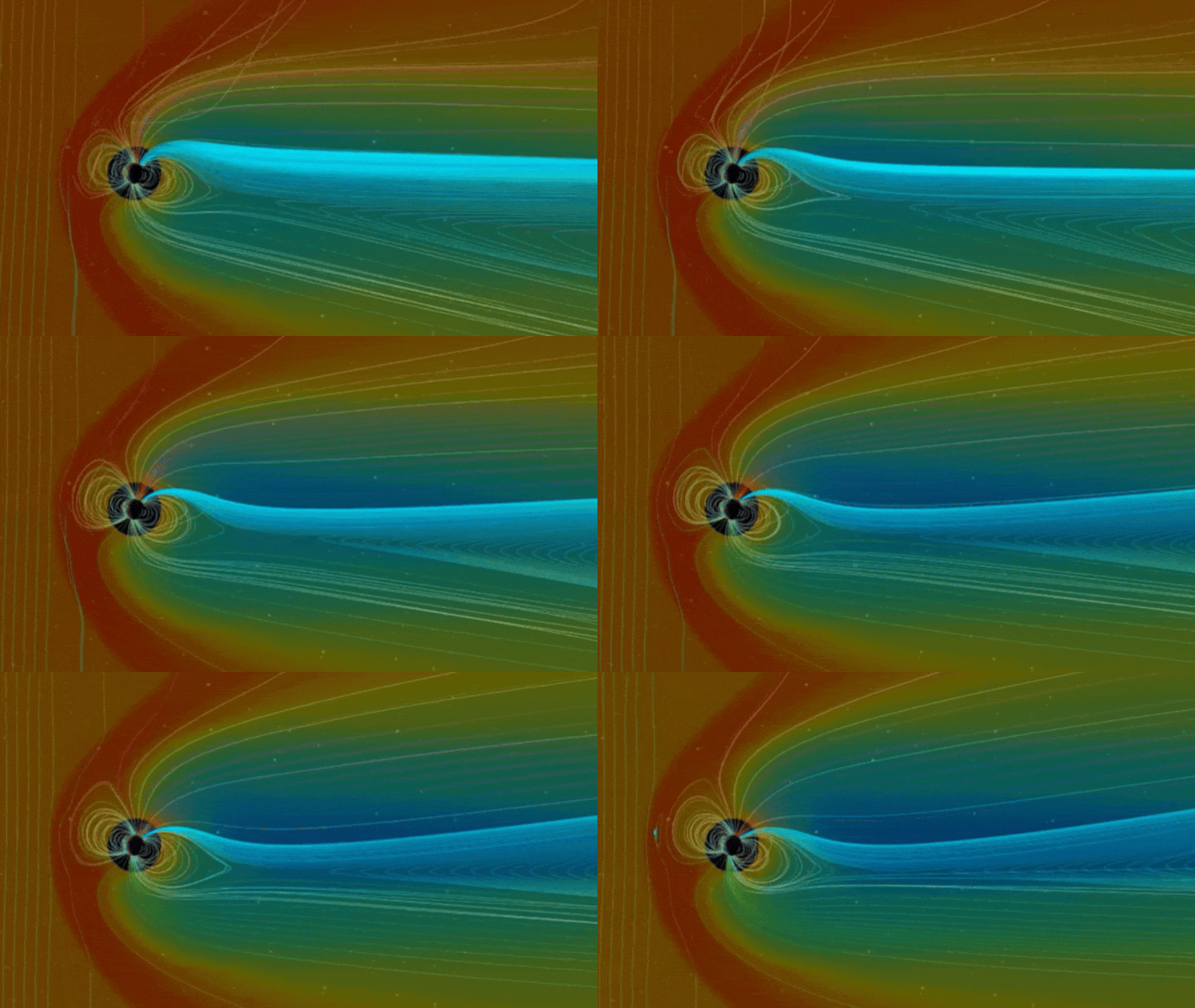
Earth's magnetic field underwent a dramatic reversal 41,000 years ago, weakening to just 5 percent of its usual strength and staying flipped for roughly 440 years.
The reversal, known as the Laschamps excursion, led to increased cosmic radiation reaching Earth, potentially affecting the ozone layer and coinciding with environmental changes and ancient cave art.
While the current magnetic field anomalies, such as the South Atlantic Anomaly, are not necessarily indicative of an imminent full reversal, scientists continue to monitor these changes for potential future impacts on the environment and Earth's system.
You can now listen to the exact sound of Earth's magnetic field falling apart.
Around 41,000 years ago, our planet's magnetic field did something dramatic: It flipped .
Using data from the European Space Agency's Swarm satellite mission , combined with evidence of magnetic field movements preserved in ancient rock and sediment, geoscientists reconstructed the entire event and turned it into sound – layering in recordings of creaking wood and colliding rocks to represent the field's convulsions.
It does not sound like a planet having a good time.
As the ESA described it in 2024, "the process of transforming the sounds with data is similar to composing music from a score" – except the score, in this case, was written by the planet itself, 41,000 years in the past.
To understand why it sounds so wrong, it helps to know what the field is actually doing up there.
Our planet's magnetic field is generated by swirling liquid metal deep in Earth's core, and it extends tens to hundreds of thousands of kilometers into space, deflecting the solar particles that would otherwise strip away our atmosphere.
Normally, its field lines form neat, closed loops – south to north above the surface, north to south below it.
Every so often, without warning, that pattern collapses.
This particular event is known as the Laschamps excursion, named for the lava flows in France where it left its signature.
According to research presented in 2024 , as the reversal took hold, the field weakened to just 5 percent of its usual strength, and stayed like that for centuries.
Records from ice cores and marine sediment from that period show levels of beryllium-10, an isotope produced when cosmic rays slam into the atmosphere, had roughly doubled.
That suggests more radiation was getting through, while separate modeling has suggested this could also have affected the ozone layer .
Earth scientist Chris Turney, who dated the event in a 2021 paper, described it as a moment when "our cosmic radiation shield was totally gone".
As Michelle Starr reported for us back in 2021 when that paper came out:
"This is consistent with climate and environmental changes from this time observed in other records from across the globe, such as the mysterious extinction of Australia's megafauna .
"Curiously, it also coincides with some of our oldest cave art on record , prompting the researchers to hypothesize that the [event] could have driven humans indoors."
The reversal took about 250 years to complete. During that time, the field may have briefly collapsed to somewhere between zero and 6 percent of its usual strength – before settling into its flipped orientation for roughly 440 years.
Even once it stabilized there, it never fully recovered: At best, it hovered around a quarter of today's strength the whole time.
All of which raises an obvious, uncomfortable question: Could it happen again?
Probably not imminently, but Earth's field is doing something at the moment.
The magnetic North Pole keeps drifting , away from Canada and toward Siberia, fast enough that scientists have had to officially update its position.
Over the South Atlantic, ESA's Swarm satellites (the ones responsible for this creepy audio) have been mapping a 'giant dent' in the field – a region called the South Atlantic Anomaly that grew by an area nearly half the size of continental Europe between 2014 and 2025.
"The South Atlantic Anomaly is not just a single block," said Chris Finlay , professor of geomagnetism at the Technical University of Denmark, who led a 2025 study examining the growth in the anomaly.
"It's changing differently towards Africa than it is near South America. There's something special happening in this region that is causing the field to weaken in a more intense way."
Current research suggests this particular anomaly isn't necessarily a sign that a full reversal is coming – weak, wandering patches like it have shown up before without tipping into anything like the Laschamps event.
That doesn't tell us when the next reversal will happen, which is precisely why scientists keep watching.
"Understanding these extreme events is important for their occurrence in the future, space climate predictions, and assessing the effects on the environment and on the Earth system," said Sanja Panovska of GFZ Potsdam, Germany , who reconstructed the magnetic field data behind the sonification back in 2024.
In the meantime, there's now a soundtrack for what it might feel like if they're wrong: the field's dramatic weakening, replayed as the creak of wood and the grind of falling stone.
Topics in this story
Gathered from external sources. Rights to this text belong to whoever originally published it.