Scientists covered an Amazon rainforest plot with 6,000 panels to block half its rain; large trees died and biomass fell by a third
Science News: Deep in the Caxiuanã National Forest in northern Brazil, a patch of rainforest the size of a football pitch tells the story of what a drier Amazon mig.
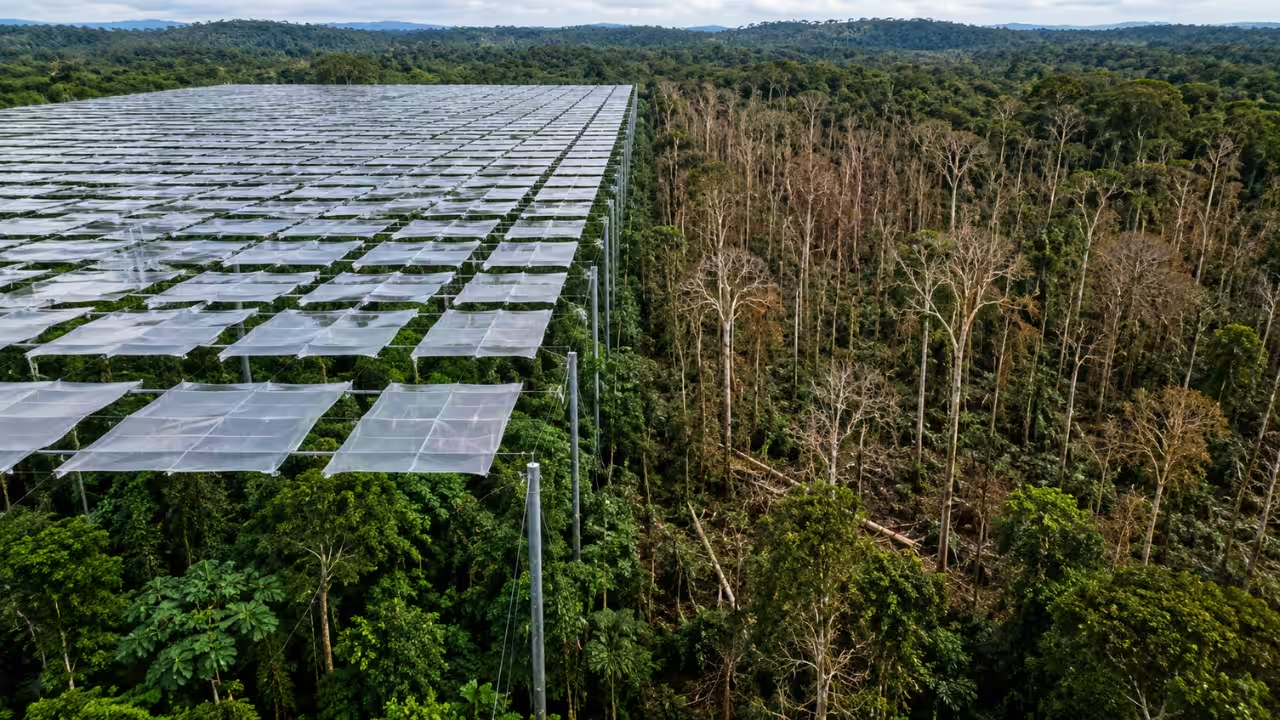
Deep in the Caxiuanã National Forest in northern Brazil, a patch of rainforest the size of a football pitch tells the story of what a drier Amazon might look like. Since 2002, scientists have suspended nearly 6,000 transparent plastic panels above one hectare of pristine forest, diverting roughly half the rainfall away from the soil below and channelling it into gutters instead. It is the longest-running drought experiment of its kind anywhere in the tropics. For years, the trees coped, drawing on deep roots and even absorbing water through their leaves. Then, around eight years in, the resilience gave way. Large, old-growth trees began collapsing at far higher rates than their smaller neighbours and the forest tipped from storing carbon to releasing it. More than two decades on, researchers have traced the full arc of that transformation from collapse to an unexpected, and only partial, recovery.Why did scientists block half the rain in an Amazon rainforestResearchers found that trees employed a range of coping strategies, including redirecting roots to access deeper water reserves and, in some cases, absorbing moisture directly through their leaves. Lucy Rowland, an ecology professor at the University of Exeter who has worked on the project for years, told the Associated Press that this early resistance did not last. Roughly eight years into the treatment, the situation changed sharply, with Rowland noting the forest experienced "a really big decline in biomass, big losses and mortality of the largest trees."Subsequent analysis confirmed that the mortality was heavily concentrated among the biggest trees, which proved far more vulnerable to hydraulic failure essentially the blockage of their internal water-transport systems by air bubbles than smaller trees. According to the study published in ResearchGate, titled ‘Amazon rainforest adjusts to long-term experimental drought’, death from drought in tropical forests was triggered by this hydraulic failure rather than by carbon starvation, the depletion of stored sugars once thought to be the primary killer of drought-stressed trees. As larger trees fell, more sunlight reached the forest floor, drying fallen leaves and raising the risk of fire.How did the Amazon rainforest lose a third of its biomassBy the time the plot had endured fifteen years of experimental drought, it had lost around a third of its original aboveground biomass, a period researchers term the "transition phase." The plot lost 85 megagrams of carbon per hectare during this period, roughly a 34 per cent reduction from its starting biomass of 248 megagrams of carbon per hectare. During these years, the plot switched from being a store of atmospheric carbon to a net emitter of it, as dying and rotting trees released the carbon they had accumulated over decades.What followed surprised the research team. Rather than continuing to decline toward a grassland-like state, as some computer models had predicted, the forest's biomass stabilised over the following seven years, from 2017 to 2023. With fewer large trees competing for a limited water supply, the surviving trees gained access to more water each, easing the physiological stress they had been experiencing. This outcome was the forest reaching eco-hydrological stability, with measurements of leaf water potential, sap flow and stem water content in the drought-treated trees converging with those recorded in the untouched control plot.How did drought permanently change the Amazon rainforestThe stabilisation does not mean the forest escaped unharmed. The authors suggest that this new equilibrium was reached only after a highly disruptive transition phase, during which well over one-third of the biomass was lost, becoming a large biomass carbon source. The resulting forest is now structurally different from before, with a more open canopy and fewer emergent, top-canopy trees, and it holds noticeably less biomass and stored carbon than the neighbouring untouched forest or, on average, the Amazon basin's rainforests.Researchers involved in the project stress that a single one-hectare plot cannot capture all the pressures a warming, drying Amazon might face, including rising atmospheric temperatures and vapour pressure deficits that were not directly simulated in the experiment. In November 2024, most of the plastic panels were removed, and scientists are now monitoring how the plot recovers. As João de Athaydes, a meteorologist and vice-coordinator of Esecaflor, said, the team wants "to understand what happens next", specifically, whether the forest can return to something resembling its original state, or whether the changes brought about by two decades of induced drought will prove permanent.
Topics in this story
- tree mortality due to drought
- drought adaptation strategies in trees
- ecological recovery of rainforest
- Amazon rainforest biomass study
- Amazon rainforest drought experiment
- Caxiuanã National Forest
- biomass loss in rainforest
- hydraulic failure in trees
- forest carbon emissions
- impact of climate change on Amazon
Gathered from external sources. Rights to this text belong to whoever originally published it.