In 2020, researchers tested chicken-feather waste as an asphalt modifier; at 2%, the feather blend performed comparably to a synthetic paving polymer and showed better storage stability in lab tests
Could one of the food industry's most overlooked leftovers get a second life beneath our wheels?
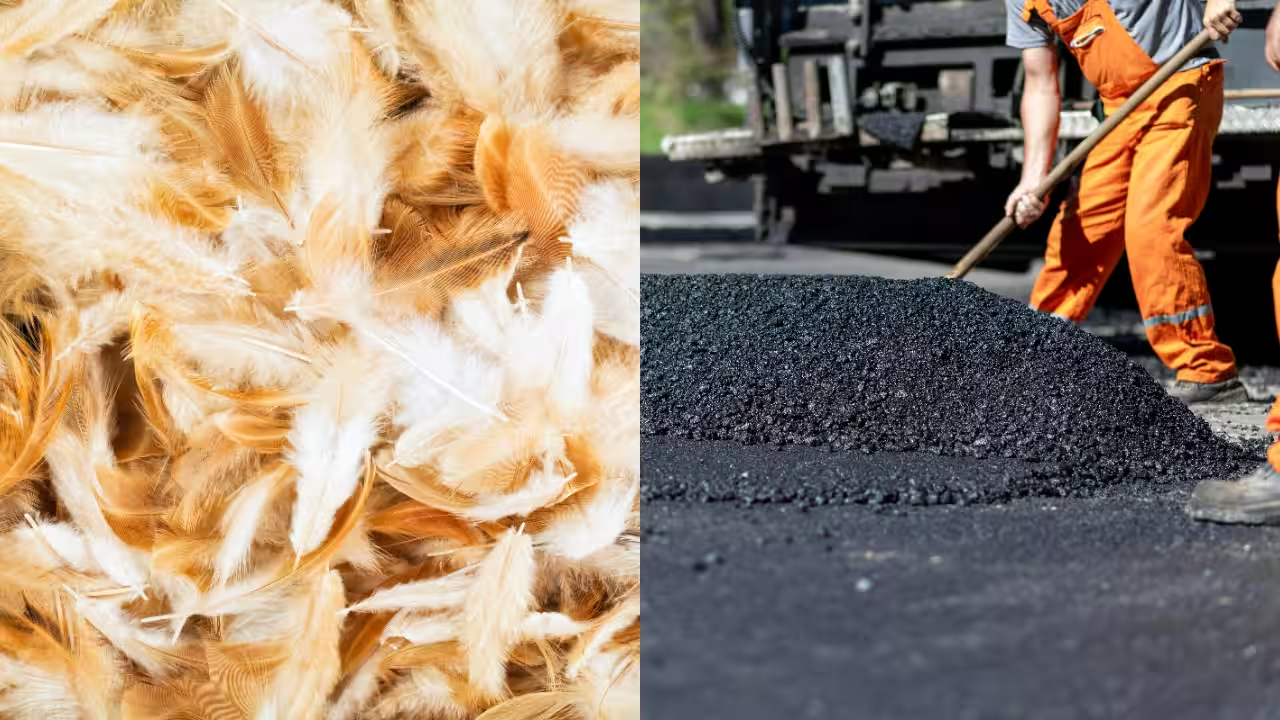
Could one of the food industry's most overlooked leftovers get a second life beneath our wheels? Chicken feathers are often considered a waste product after poultry processing, but they’ve emerged as an unlikely candidate for improving asphalt. According to research titled 'Influence of chicken feather on the rheological properties and performance of modified asphalts' published in 2020, under Construction and Building Materials, tiny particles made from discarded feathers could replace or supplement synthetic materials traditionally used to reinforce road surfaces. According to a release shared by Science Direct, the results were promising. Asphalt with 2% chicken-feather particles had performance similar to that of a blend of asphalt containing the same amount of synthetic styrene-butadiene-styrene (SBS) polymer. More importantly the feather-modified mixture exhibited better storage stability in laboratory tests. Scroll down to read the details.Poultry waste converted into road materialAsphalt is one of the most used materials in infrastructure as the binder component of roads, and also for waterproofing and protective coatings. But traditional asphalt has its drawbacks. Pavement deteriorates, through rutting, cracking and fatigue, due to heavy traffic, repeated loading and temperature and environmental variations. To address these issues, engineers often add polymers and other modifiers to enhance the material’s elasticity, strength, flexibility and resistance to deformation. SBS is one of the most tried and true.But the growing volume of organic and solid waste has driven researchers to look for alternatives which can serve for a technical purpose and at the same time reduce the pressure on disposal. Chicken feathers are of special interest because they are produced in large quantities by the poultry industry, but their uses in high-value applications are rather limited, the study published by Science Direct states.Why feathers caught the attention of the researchersThis study investigated the use of chicken-feather bioparticles (CFBP) as an asphalt modifier. Blends containing 2%, 4% and 6% by weight of feather particles were prepared and their behavior compared to that of asphalt modified with SBS.The team looked at the rheological properties, which are useful in showing how asphalt behaves under stress, temperature and loading over time. The tests looked at things like complex modulus, elastic modulus, viscous modulus and phase angle.These properties are important as roads should bear the repeated pressure without permanent deformation. A more pronounced elastic response can help asphalt to bounce back after loading and changes in stiffness and phase behavior can impact on its resistance to rutting and other types of damage.You could taste the 2% mixThe study also states that the most striking comparison to the synthetic polymer blend was obtained with the 2% chicken feather mixture. The rheological behavior was found to be similar to that of an asphalt modified with 2% SBS suggesting that feathers derived material can have a similar modifying role at relatively low concentrations.The feather-based mixture also demonstrated a significant benefit during storage. In polymer-modified asphalts, phase separation may occur when the components are not compatible enough. The polymer-rich and asphalt-rich portions can separate over time, causing problems with handling, consistency and pavement performance.In laboratory tests, 2% chicken feather blend exhibited better storage stability than the corresponding SBS modified blend.A potential sustainability benefitThe research study is significant not only for laboratory measurements. Replacing some of the synthetic modifiers in asphalt with waste-derived material could provide a pathway to transform poultry waste into a useful construction resource. It may also reduce reliance on petroleum-derived synthetic polymers and potentially reduce the cost of materials . At the same time, using feathers that otherwise would be considered waste could help solve an environmental problem associated with large-scale poultry production, it states.That doesn’t mean feather-modified asphalt is ready to replace traditional road materials everyplace. The findings are based on laboratory work and further research is needed to understand how the mixtures behave under real traffic, weather and long-term aging conditions.But the study points to a broader change in construction research: waste does not need to be waste. Discarded tires, industrial by-products and agricultural residues are among the materials once considered difficult to dispose of and now increasingly being explored as ingredients for more resource-efficient infrastructure. The road ahead could be surprisingly useful for something as mundane as a chicken feather.Images Courtesy: istock
Topics in this story
Gathered from external sources. Rights to this text belong to whoever originally published it.