In 2025, researchers found that adding waste eggshells to clay bricks can cut heat conductivity by 50% and help keep buildings cooler
Science News: Eggshells are not usually thought of as a building material, yet a study has found that adding them to clay bricks can cut heat conductivity by half. .
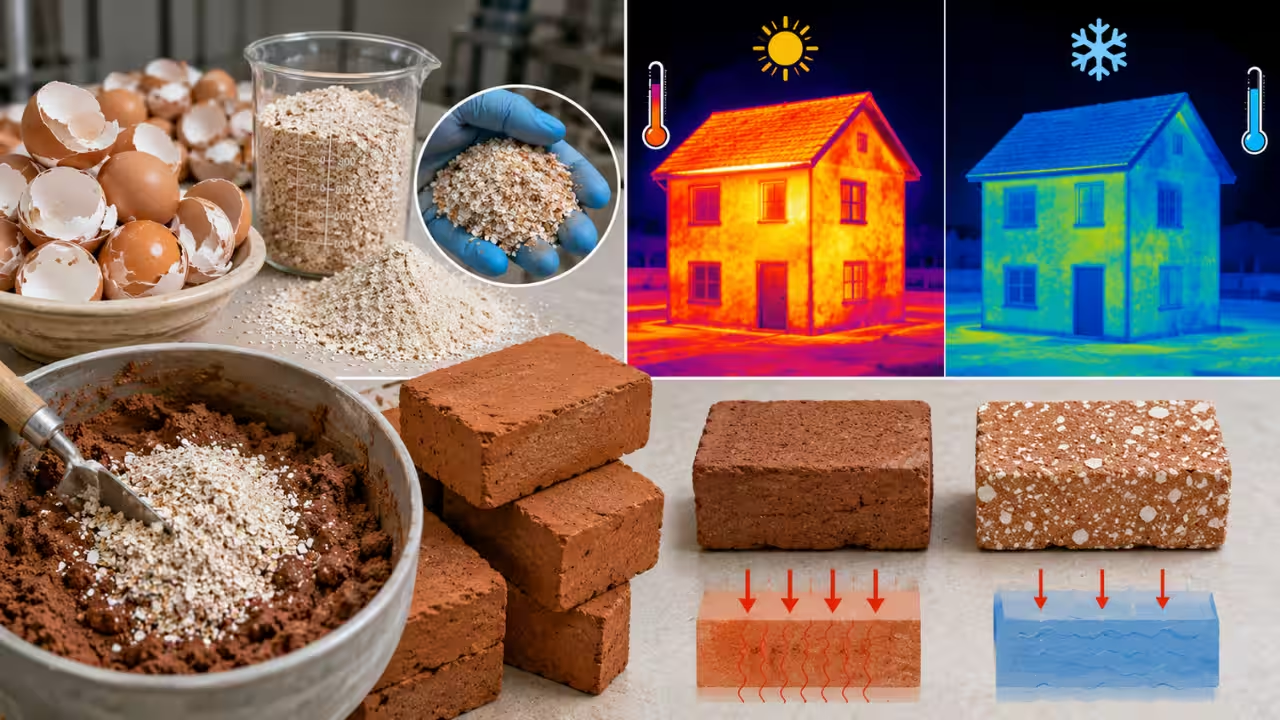
Eggshells are not usually thought of as a building material, yet a study has found that adding them to clay bricks can cut heat conductivity by half. Researchers in Egypt ground up waste eggshells, mixed them into local clay, and fired the resulting bricks at 1100°C, discovering that a 10% eggshell blend performed dramatically better at resisting heat transfer than an ordinary brick. According to the study published in Nature, titled ‘Green building development utilising modified fired clay bricks and eggshell waste’, buildings account for close to 40% of global energy use, much of it spent on heating and cooling; a material that insulates more effectively could make a real dent in household energy bills. It also tackles a waste problem hiding in plain sight: billions of eggshells are thrown worldwide every year. The researchers found that the eggshell addition changes the brick’s internal structure, creating conditions that reduce the movement of heat through the material. That combination of waste reduction and improved insulation makes the approach particularly promising for sustainable construction in warmer regions. The findings suggest a cheap, low-tech way to make homes more energy-efficient, particularly in hot climates where air conditioning already accounts for a large share of electricity demand.How do eggshells make clay bricks better at blocking heatThe idea behind the research was straightforward but had barely been tested before. Eggshells are mostly calcium carbonate, the same mineral found in limestone, and when fired at high temperatures alongside clay, they trigger chemical reactions that reshape the brick's internal structure. The team, led by Wafaa Soliman and colleagues from Sohag University, the Central Metallurgical Research and Development Institute, and the National Research Institute of Astronomy and Geophysics, sourced their clay from the Kharga Oasis in Egypt's Western Desert and combined it with cleaned, dried, powdered eggshell in varying proportions, from 1% up to 10%.Each mixture was moulded by hand, dried for three days, then fired for four hours at 1100°C in a muffle furnace. As the eggshell content rose, the carbonate inside broke down and released carbon dioxide gas during firing, leaving behind tiny pores throughout the brick. Those pores act as pockets of trapped air, and trapped air is a famously poor conductor of heat, which is precisely why the treated bricks performed so differently to their untreated counterparts. The researchers also examined how these changes affected the bricks' physical properties, allowing them to connect porosity with measurable improvements in thermal insulation.Why did 10% eggshell bricks perform better at blocking heatThe figure shows the 50% reduction in thermal conductivity of bricks containing 10% eggshell fired at 1100°C, dropping from 0.6081 W/mK in pristine bricks down to 0.3562 W/mK. That result comfortably beats the European insulation standard threshold of 0.430 W/mK for construction materials. Alongside conductivity, the same bricks showed a 30% fall in thermal diffusivity and a 30% fall in thermal effusivity, both measures of how quickly heat moves through and is absorbed by a material.A brick with 7% eggshell content told a slightly different story, striking what the researchers describe as an optimal balance. That formulation cut dry shrinkage by 38.7%, increased average pore size by 78.8%, and pushed apparent porosity up to 52.7%, while still holding onto a reasonable bulk density of 1.66 g/cm³. Beyond 10% eggshell, however, the benefits began to reverse, as excess calcium caused clumping and weakened the overall structure rather than improving it further.How much does eggshell waste reduce brick strengthCompressive strength, essentially how much weight a brick can bear before crumbling, fell sharply as eggshell content increased, dropping to as low as 0.05 MPa in the most heavily dosed samples. For context, bricks used in serious construction typically need at least 10 MPa to be classed as suitable for load-bearing walls, so by that measure, the eggshell-enhanced bricks tested here fall well short of structural use on their own.The researchers are candid about this limitation in their conclusions, noting that further work is needed to understand how these bricks would hold up over years of real-world use. Rather than positioning eggshell bricks as a wholesale replacement for conventional ones, the more realistic near-term application looks to be as an insulating layer or filler material, where thermal performance matters more than raw strength. That distinction matters for anyone imagining eggshell walls holding up a roof.Why could eggshell bricks be useful in hot climatesEgypt's climate makes this research particularly pointed. High solar radiation and extensive window exposure mean many buildings overheat during the day, pushing air conditioning use and electricity demand higher. A construction material that naturally resists heat transfer reduces that burden without requiring residents to change their behaviour or install expensive retrofits. It is also a tidy solution to a waste problem that rarely gets attention: over 110 billion eggshells end up in landfill globally each year, according to figures cited in the study, and Egypt's own egg production is expected to keep climbing towards 2030.No exotic chemicals, no specialised machinery beyond what brick-makers already use, just a waste product that would otherwise be discarded. If future research can close the gap on compressive strength, perhaps by combining moderate eggshell doses with other additives, this could move from a promising laboratory result to a genuine option for greener construction, particularly in hot, arid regions facing similar cooling demands to Egypt's.
Topics in this story
Gathered from external sources. Rights to this text belong to whoever originally published it.