Nasa abandons $30 million plan to save ageing Swift space telescope after rescue craft malfunctions
Science News: Nasa's ambitious attempt to save its ageing Neil Gehrels Swift Observatory has come to an unexpected end after the spacecraft sent to perform the resc.
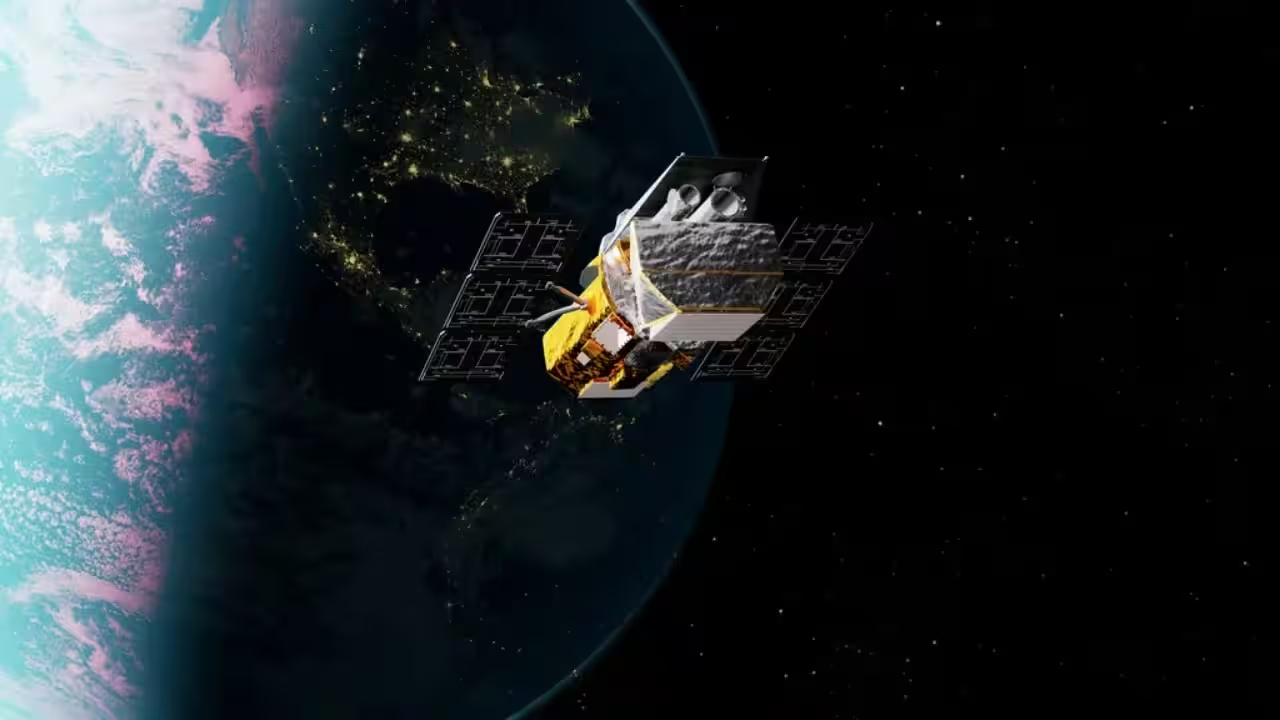
Nasa's ambitious attempt to save its ageing Neil Gehrels Swift Observatory has come to an unexpected end after the spacecraft sent to perform the rescue developed problems of its own. The agency had partnered with Katalyst Space Technologies to launch LINK, a robotic servicing spacecraft designed to rendezvous with Swift, capture the observatory and push it into a higher orbit, extending its scientific life. LINK launched on July 3, 2026, but soon encountered an ongoing attitude-control problem that affected its ability to carry out the planned rescue. On August 19, Nasa and Katalyst confirmed that LINK would no longer capture or boost Swift, although it will still attempt proximity operations to demonstrate technologies for future satellite servicing missions. Swift has spent more than two decades studying some of the universe's most powerful and rapidly changing phenomena.Why Nasa needed to rescue the ageing Swift ObservatoryNasa's Neil Gehrels Swift Observatory has spent more than 20 years orbiting Earth and observing gamma-ray bursts, among the most powerful explosions in the universe, alongside other rapidly changing cosmic events. The observatory can study objects across visible, ultraviolet, X-ray and gamma-ray wavelengths, making it an unusually versatile astrophysics mission. However, Swift's low-Earth orbit has gradually decayed, with increased solar activity accelerating the process by increasing atmospheric drag. Without intervention, the observatory was heading towards eventual atmospheric re-entry. Nasa saw the situation as an opportunity to test whether a commercial robotic spacecraft could extend the life of an ageing satellite rather than simply allowing it to fall back to Earth. The agency awarded Katalyst Space Technologies a $30 million contract in September 2025, giving the company less than a year to develop the rescue mission.LINK was built to capture Swift and push it into a higher orbitThe rescue plan centred on LINK, a robotic servicing spacecraft developed by Katalyst Space Technologies. After launching aboard a Northrop Grumman Pegasus XL rocket from Kwajalein Atoll on July 3, LINK began its journey towards Swift. The plan called for the spacecraft to approach the observatory, capture it and use its own propulsion system to raise Swift into a higher, safer orbit. The mission was particularly ambitious because Swift was not designed to be captured by another spacecraft, making rendezvous, navigation and robotic grappling technically challenging. LINK itself, however, encountered attitude-control problems during its early operations in orbit. A first issue arose in mid-July and was resolved with an initial software patch, but a more serious multi-axis spin developed in late July, during which two of LINK's three reaction wheels failed. Engineers worked to stabilise the spacecraft, using thruster burns to slow the spin and a further software update to restore attitude control. Despite those efforts, Nasa and Katalyst ultimately determined that LINK could not safely complete the capture and boost operation.Swift will likely re-enter Earthâs atmosphere later this yearThe failed boost means Swift is now expected to continue losing altitude rather than being moved into the higher orbit originally planned. The outcome is particularly striking because engineers had made progress in recovering LINK earlier in August. On August 6, Nasa reported that teams had reduced LINKâs multi-axis spin from about 9 degrees per second to 1.47 degrees per second using burns from one of its electric propulsion thrusters. The next step was to upload new flight software designed to help maintain the spacecraftâs stability and allow it to manoeuvre towards Swift. That recovery initially appeared promising. Nasa later reported that the software update restored LINKâs attitude control, but the spacecraft continued to experience a control issue. By August 19, Nasa and Katalyst Space had determined that LINK would not capture or boost Swift. Instead, LINK will attempt rendezvous and proximity operations with the observatory, demonstrating capabilities that could be useful for future satellite-servicing missions. The setback does not erase Swiftâs scientific legacy. Launched in 2004, the observatory has spent more than two decades studying gamma-ray bursts and other powerful cosmic events across multiple wavelengths. Nasa now expects Swift to eventually re-enter Earthâs atmosphere, while the remaining LINK operations could still provide valuable lessons for future missions designed to repair, relocate or extend the lives of ageing spacecraft.
Topics in this story
Gathered from external sources. Rights to this text belong to whoever originally published it.