In a commercial wind-farm test, operators deliberately yawed an upstream turbine away from the wind; the downstream turbine gained about 14%, lifting the pair’s output by 4%
Discover how a groundbreaking experiment at a commercial wind farm used wake steering to increase energy output by adjusting turbine angles, enhancing efficiency, and overcoming wake effects.
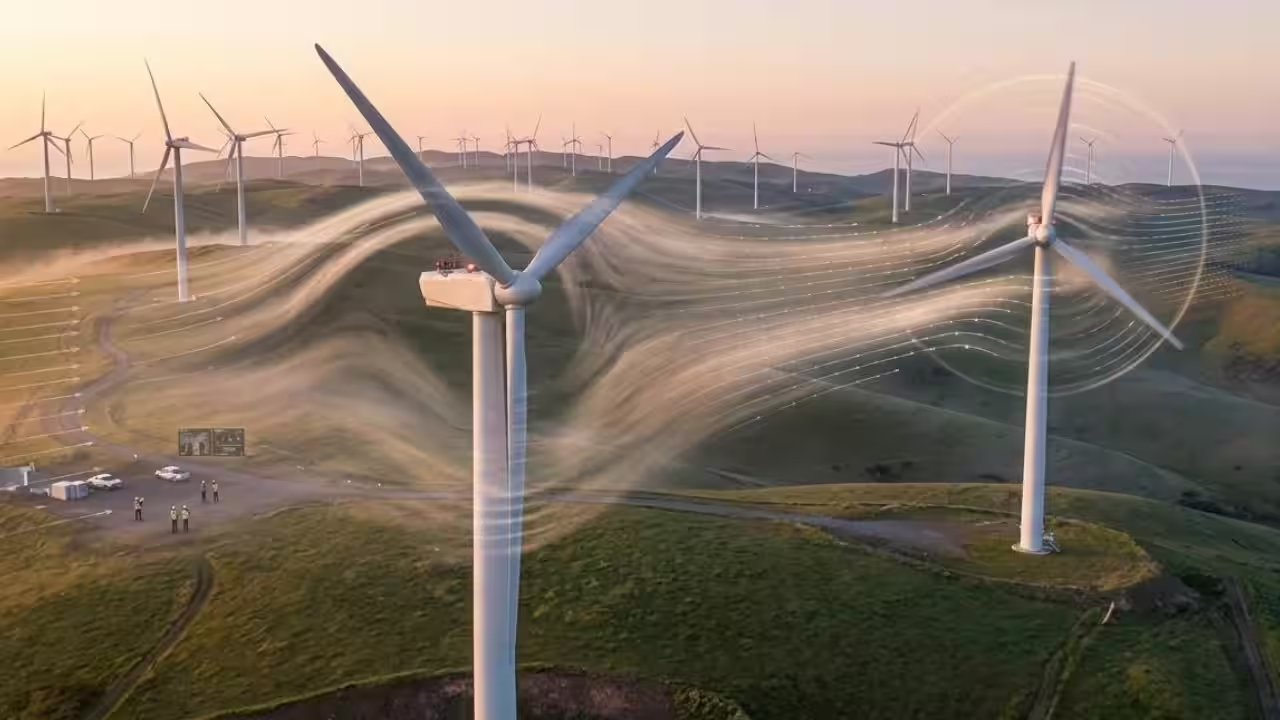
Wind turbines are usually positioned to capture as much of the incoming wind as possible. But inside a wind farm, that approach can create a problem of its own. An upstream turbine extracts energy from the air and leaves behind a slower, more turbulent stream known as a wake. When another turbine sits in that path, it can produce considerably less power.According to a study published in Wind Energy Science, engineers tested an unusual solution at a commercial wind farm. Instead of allowing an upstream turbine to face directly into the wind, they deliberately turned its rotor slightly away from the incoming flow. The turbine sacrificed some of its own production, but its wake moved away from the machine behind it. As a result, the downstream turbine gained about 14% in energy, while the combined output of the two turbines increased by about 4% over the tested wind-direction sector.Turning the wake instead of stopping the turbineThis experiment was conducted during a research campaign at a wind farm facility in the United States, which included the participation of the National Renewable Energy Laboratory and the University of Colorado Boulder. This strategy was referred to as wake steering. The concept was fairly straightforward. Under normal operations, a wind turbine generated a wake that travelled across the downstream region and had the potential to disrupt another nearby turbine. The upstream turbine’s yaw angle could be adjusted to divert the wake.This did not mean stopping the turbine. What it involved was running the turbine’s rotor at an angle relative to the direction of the wind. The test was done on two turbines that were placed in proximity. Different yaw offsets were introduced to the upstream turbine, and their effects on the energy generated by the downstream turbine were analysed.A gain for one turbine, and a gain for bothAt first, deliberately reducing the output of a turbine located upwind may seem counterproductive. After all, a wind farm is built to generate as much electricity as possible. But the turbines influence one another through the air flowing between them. When an upstream turbine is operated in a way that reduces the strength of its wake, more energetic air can reach the turbine behind it, allowing the downstream machine to generate more power. When the energy lost by the upstream turbine is taken into account, the combined output of the two turbines still increased by about 4%. The 14% figure refers specifically to the increase in production from the downstream turbine, while the 4% figure represents the net gain across the pair.Why wind-farm layout mattersThe distance between the turbines is necessary to prevent wake effects, but land space and cost considerations may not permit such an adjustment. In wake steering, the operating methods of the turbines are altered, not their positioning. The commercial experiment also showed why the method cannot be standardised. The scientists discovered that atmospheric stability had an impact on the obtained results. Wind conditions change constantly, and wakes respond to variables such as wind direction, turbulence, and other atmospheric factors. A setting that works in one scenario may not work in another.Mechanical factors also need to be considered. Any change in yaw results in different loads on the turbine, which means that any increase in energy must be accounted for in terms of how it might affect maintenance and components. It is possible to coordinate the operations of turbines in such a way that one turbine can sacrifice some of its output in order to allow the other one to restore its energy output.
Topics in this story
Gathered from external sources. Rights to this text belong to whoever originally published it.