After wildfires turned the ground black, grasshoppers rapidly evolved darker colouration; as vegetation returned, black morphs declined
A wildfire can transform a landscape in a matter of hours, leaving behind a ground surface dominated by blackened soil, ash and charred vegetation.
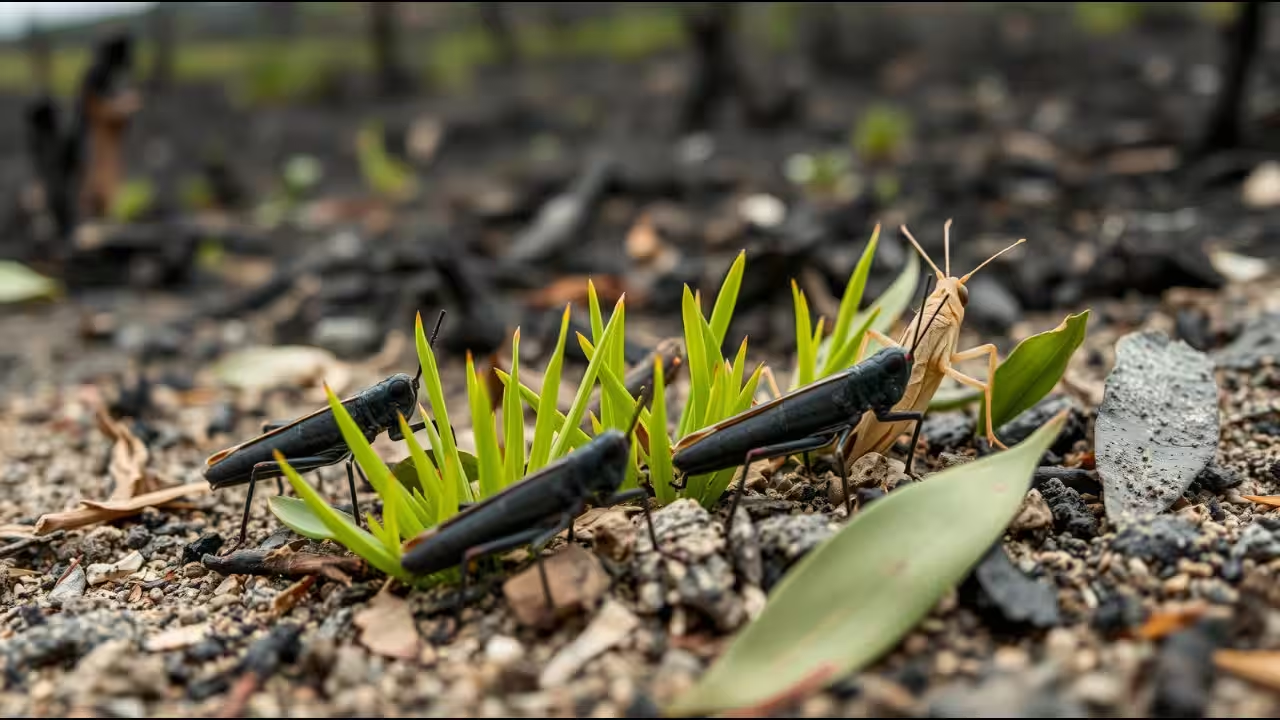
A wildfire can transform a landscape in a matter of hours, leaving behind a ground surface dominated by blackened soil, ash and charred vegetation. For the pygmy grasshopper Tetrix subulata, that sudden change appears to have been followed by an equally striking shift in colour. Populations living in recently burned areas of Sweden contained far more black, or melanistic, grasshoppers than those living in nearby unburned habitats. In a study published in Evolution titled Rapid evolution of fire melanism in replicated populations of pygmy grasshoppers, Anders Forsman, Magnus Karlsson, Lena Wennersten, Jenny Johansson and Einat Karpestam compared 20 populations and found that melanistic individuals made up about 50% of the grasshoppers in recently burned areas, compared with roughly 9% in unburned populations. The researchers also found that the frequency of the dark morph fell to about 30% four years after the fire, as the habitat began to recover. Their experiments provided evidence that the differences had a genetic component, suggesting that the changing proportions of dark and light grasshoppers reflected evolutionary change across generations rather than individual insects simply changing colour in response to the blackened ground.The dark morph's advantage faded within just a few yearsThe decline in melanistic grasshoppers as burned habitats recovered was also consistent with earlier research on the species. In a study published in Oecologia titled Dynamics of colour polymorphism in a changing environment: fire melanism and then what?, Magnus Karlsson, Sofia Caesar, Jonas Ahnesjö and Anders Forsman examined colour-pattern dynamics in a natural population of T. subulata inhabiting a previously burned clear-cut area. The researchers found that black phenotypes initially dominated after the fire, but their frequency subsequently declined as the environment changed. The study also documented increasing diversity among colour morphs during the recovery of the habitat. These findings are consistent with the idea that the selective conditions affecting colour can change as a burned landscape develops. Rather than individual grasshoppers becoming black immediately after a fire and then becoming lighter as vegetation returns, the evidence points to changes in the relative frequency of inherited colour variants within the population.Predation by sight-hunting animals appears to drive the patternCamouflage against visually oriented predators has been proposed as one mechanism behind these changes. In a study published in Ecology and Evolution titled Reduced predation risk for melanistic pygmy grasshoppers in post-fire environments, Einat Karpestam, Sami Merilaita and Anders Forsman tested whether the protective value of black colouration changed depending on the visual background. The researchers presented human participants with images of black grasshoppers against samples of natural habitats and measured how easily the insects could be detected. They found that black colouration provided greater protection against detection in backgrounds containing more blackened material from fire. The researchers concluded that the results supported camouflage and predation as important drivers of fire melanism in pygmy grasshoppers. However, the experiment used human observers as model visual predators, so it provides experimental evidence for the camouflage mechanism rather than direct evidence that natural predators alone produced the population-level changes.The findings show how quickly evolutionary change can occurThe grasshopper research is notable because the changes in colour-morph frequency occurred over a relatively short period. The 2011 Evolution study compared populations exposed to different fire histories and found that the frequency of melanistic individuals changed between successive years. Its common-garden breeding experiments were designed to determine whether differences in colour frequencies reflected genetic differences or developmental plasticity. The researchers found evidence that the variation had a genetic basis, meaning that the changing frequencies could represent evolutionary responses to changing selection rather than a temporary colour change experienced by individual insects. The authors described the findings as evidence for extraordinarily rapid contemporary adaptive evolution in replicated natural populations. The important distinction is that the grasshoppers did not individually switch their colour in response to the blackened ground. Instead, the proportion of individuals carrying different inherited colour patterns changed as the environmental conditions changed.The species didn't just turn black and stay that wayThe research therefore points to a more dynamic process than a simple shift toward black colouration after a fire. The 2008 Oecologia study found that after black phenotypes initially became dominant, the distribution of colour morphs changed as the habitat recovered, with greater diversity among the observed patterns. The 2011 Evolution study similarly found that the frequency of melanistic individuals in burned populations declined over four years. Together, the findings suggest that fire can rapidly alter the selective environment experienced by T. subulata, favouring different colour variants at different stages of habitat recovery. Black colouration may provide better camouflage when the ground contains extensive areas of charred material, while that advantage can diminish as vegetation returns and the visual background changes. The result is not a permanent population of black grasshoppers, but a shifting balance among inherited colour forms as the environment itself changes.
Topics in this story
Gathered from external sources. Rights to this text belong to whoever originally published it.