For decades, scientists thought North America had its own cheetah; ancient DNA reveals the extinct cat split from the puma lineage 2.6 million years ago
Wildlife & Biodiversity News: Its appearance told one story; its DNA tells another. For decades, the extinct Miracinonyx trumani was known as the “American cheetah” because its lon.
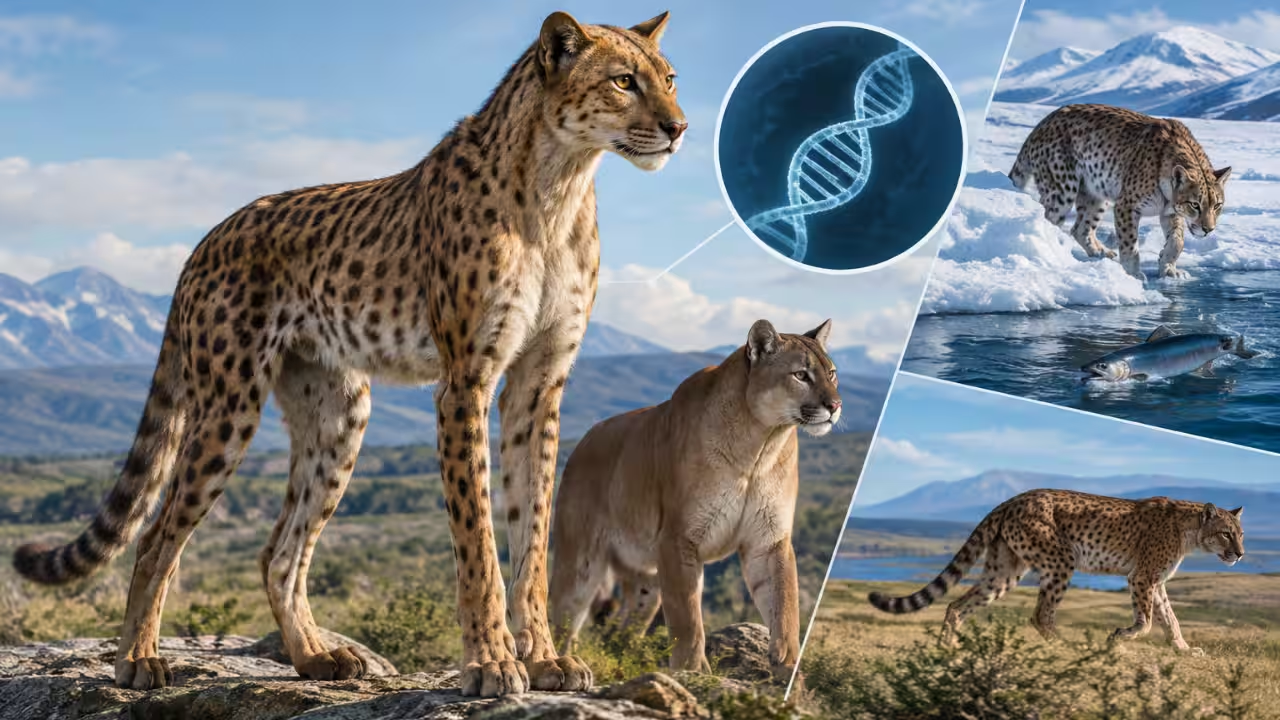
Its appearance told one story; its DNA tells another. For decades, the extinct Miracinonyx trumani was known as the “American cheetah” because its long legs, slender body and adaptations for speed made it look remarkably similar to Africa’s modern cheetahs. But a new genetic study has overturned that long-held picture. Published in Current Biology, the research used ancient DNA from fossil remains to show that M. trumani was actually a close relative of the modern puma, with the two lineages diverging about 2.6 million years ago. The study also reveals that some of these supposedly cheetah-like cats had a surprising diet, with northern populations apparently eating fish in the Arctic.The “American cheetah” was not actually a cheetahMiracinonyx trumani lived across parts of North America during the Pleistocene, with evidence placing the species from roughly 2.5 million to 16,000 years ago. Fossils showed that it had a body built for running, including long limbs and a relatively slender frame. Those characteristics led scientists to compare it with the modern cheetah, and the nickname “American cheetah” became widely used. The new genetic evidence, however, tells a different evolutionary story.Researchers analysed nuclear DNA from four M. trumani fossils, including specimens from Wyoming and the Yukon in northwestern Canada. By comparing their genomes with those of living and extinct cats, they found that M. trumani was a sister species of the modern puma, rather than a close relative of the cheetah. The two lineages separated roughly 2.6 million years ago. That means the similarities between the extinct cat and today's cheetahs were not evidence of close ancestry. Instead, they were an example of convergent evolution, in which unrelated animals independently develop similar physical characteristics because they face similar environmental pressures.Why did it look so much like a cheetah?The resemblance makes sense when the animal's lifestyle is considered. Both M. trumani and modern cheetahs evolved body shapes suited to fast movement. Long limbs and a lightweight build would have helped M. trumani pursue prey across open landscapes. But appearance can sometimes give scientists an incomplete picture of an extinct animal. Without genetic evidence, it was difficult to determine whether the American cat had inherited its body shape from a cheetah-like ancestor or had independently evolved similar features. The DNA has now provided a clearer answer.According to the researchers, the name “American cheetah” can therefore be misleading because it suggests both a close genetic relationship and a specialised hunting lifestyle similar to that of modern cheetahs. Neither assumption is supported by the new evidence.Ancient DNA reveals a surprising Arctic dietThe genetic discovery was not the only surprise. The researchers also examined stable carbon and nitrogen isotopes preserved in the fossils to reconstruct what the animals ate. The results suggested that M. trumani was not necessarily a specialised hunter of terrestrial herbivores throughout its range. The northern specimens, recovered from the Yukon, showed chemical signatures consistent with a diet rich in aquatic animals. Researchers believe these cats may have eaten fish, potentially including salmon.They may have caught fish themselves, scavenged fish after spawning or used both strategies. The available evidence cannot determine exactly how the animals obtained their aquatic food. That finding is particularly striking because the northern M. trumani populations lived in an environment very different from the grasslands where their southern counterparts hunted. The Wyoming specimen, by comparison, had isotope signatures more consistent with a predator feeding largely on terrestrial herbivores. This suggests that the species could adjust its diet substantially depending on where it lived.The cat's range was larger than scientists realisedThe Yukon fossils also expand the known geographical range of M. trumani by about 20 degrees of latitude farther north than previously recognised. The findings indicate that the species was capable of surviving in remarkably different environments, from temperate parts of North America to the Arctic. Researchers say this flexibility resembles the adaptability seen in modern pumas, which occupy a wide range of habitats and consume many types of prey.Genetic evidence also revealed changes that may have helped northern populations cope with extreme seasonal light conditions. Researchers identified loss-of-function mutations in genes involved in regulating circadian rhythms, potentially reflecting adaptation to the very long periods of daylight and darkness found at high latitudes.Why did the American cheetah disappear?The study also offers clues about the species' eventual extinction. Researchers found that M. trumani had relatively low genetic diversity in both the Wyoming and Yukon populations. However, the animals did not show the signs of severe inbreeding or sudden population collapse that scientists might expect immediately before extinction. Instead, their genetic diversity appears to have declined gradually over a long period. The researchers suggest that this slow loss may have reduced the species' ability to respond to environmental changes, potentially contributing to its eventual extinction. M. trumani eventually disappeared around 16,000 years ago, during the later stages of the last Ice Age.The discovery ultimately changes more than the family tree of one extinct predator. It shows how much scientists can miss when an ancient animal is reconstructed mainly from its bones and appearance. The so-called American cheetah may have looked like a speed specialist, but its DNA and diet reveal something more complex: an adaptable North American cat that was genetically closer to today's pumas and capable of surviving in environments ranging from temperate grasslands to the Arctic.
Topics in this story
Gathered from external sources. Rights to this text belong to whoever originally published it.