Scientists put brown anoles on 3 artificial Florida islands; within 3 months native green anoles climbed higher, then evolved larger, stickier toe pads
A recent study published in Science highlights how native green anoles evolved larger, stickier toe pads and changed their perch behavior within months of brown anole invasion on artificial Florida islands.
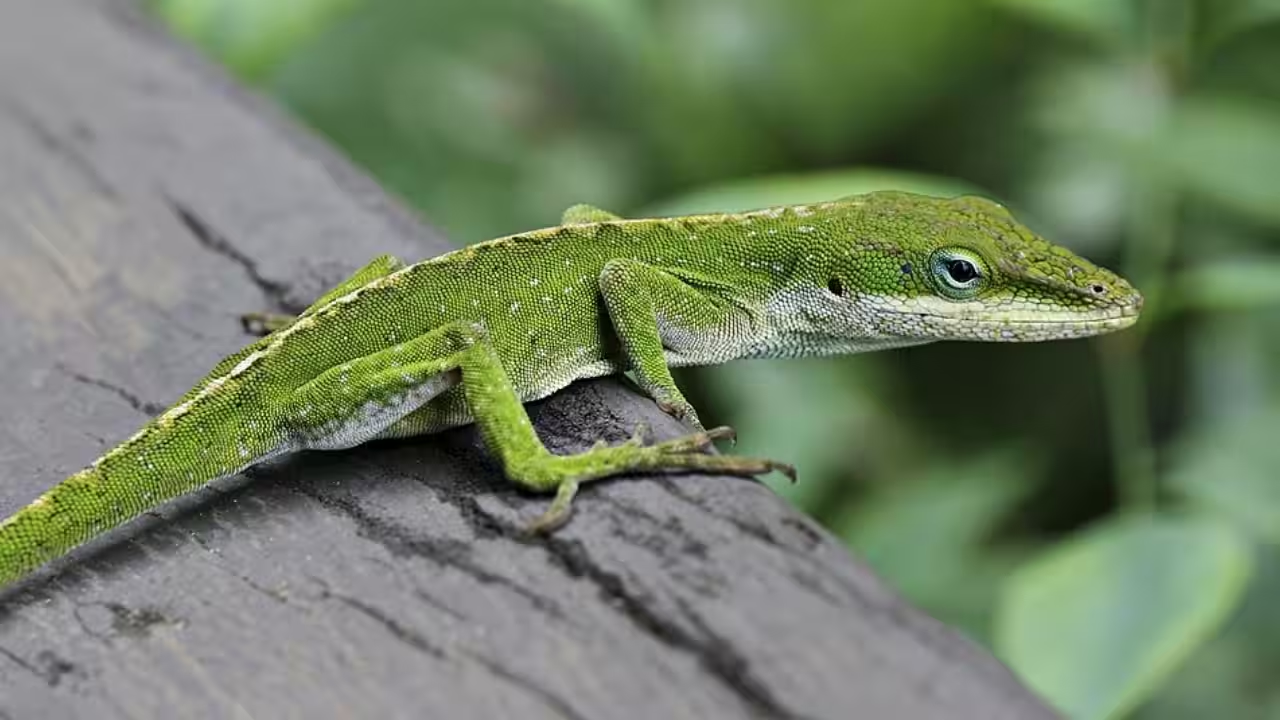
In the 1990s, when Cuban brown anoles were introduced to three small artificial islands off Florida’s eastern coast, the native green anoles who were already living there began changing where they perched. In just three months, the green lizards were found already climbing higher into the trees, away from the lower areas which were increasingly occupied by the newly introduced animals. Over the next 15 years, researchers noted a second change: green anole populations living alongside the invader had evolved larger toe pads with more adhesive scales, which are traits associated with a stronger grip on narrow branches. Published in the journal Science in October 2014, the findings made way for a rare opportunity to observe behavioural change followed by measurable evolutionary adaptation in a native species.Three islands received the invasive lizardsThe research centred around two closely related species: the native green anole (Anolis carolinensis) and the Cuban brown anole (Anolis sagrei), which is native to the Bahamas and Cuba. While green anoles are common across the southeastern United States, brown anoles have spread through parts of the region after being introduced. Both species overlap in their use of habitat and food resources, thus creating opportunities for competition when they occupy the same area.Yoel Stuart, an evolutionary biologist, alongside his colleagues, used six small islands in Florida’s Intracoastal Waterway to examine the outcomes when the two species shared the same habitat. The islands were man-made, formed from material dredged during earlier construction work. Researchers introduced brown anoles to three islands of different sizes and left three similarly sized islands without any invaders. This arrangement of the experiment allowed the team to compare changes in the native lizard’s behaviour between locations that are invaded and uninvaded.The team had expected a competition for food and space to influence how the native lizards used their habitat. The possibility of predation on hatchlings also played a role, as adults of either species could eat the young of the other. Therefore, moving higher into the trees could reduce encounters with brown anoles that generally occupied lower perches. These interactions were considered by the researchers as pressures behind the native lizards’ change in habitat use, instead of establishing a single mechanism as the sole cause.Green anoles changed their behaviour within three monthsThe shift was noticed quickly. The brown anoles were introduced in May 1995, and by August the same year, green anoles on the three experimental islands were already perching relatively higher than those on control islands. With continued monitoring, the researchers documented that the difference in perch height persisted.Higher branches, meanwhile, presented different physical challenges. They were usually thinner, smoother and less stable than the lower perches the lizards had previously used. Therefore, holding onto these surfaces required a better grip. In anoles, that ability is associated with the size of the toe pads and the number of lamellae, which are specialised scales on their undersides. These scales carry microscopic hair-like structures known as setae, which help the lizards to cling to surfaces.Larger toe pads emerged over generationsSubsequently, researchers returned to the islands to check if the behavioural shift was accompanied by physical changes. In 2010, they compared green anoles from islands where brown anoles were introduced with populations on islands that remained uninvaded. The native lizards living alongside the introduced species showed larger toe pads and more lamellae. These traits are associated with improved clinging ability on narrow and smooth perches.The crew estimated that this divergence had developed over approximately 15 years, or around 20 generations. This implied that measurable evolutionary differences could emerge over a relatively short period when populations faced sustained ecological pressures.To analyse whether the toe-pad differences were just caused by individual lizards growing up on higher branches, the team opted to conduct a common-garden experiment in 2011. They collected gravid green anole females from invaded and uninvaded islands, gathered their eggs and raised them under identical laboratory conditions. The offspring retained the toe-pad characteristics similar to those observed in their respective parental populations. These supported the hypothesis that the differences had a genetic basis; researchers even acknowledged that secondary transgenerational plastic factors deserved further study.
Topics in this story
Gathered from external sources. Rights to this text belong to whoever originally published it.