Why Trump is planting controversial genetically modified trees near the White House
While President Donald Trump has criticized many environmentally friendly initiatives, he has consistently championed planting trees.
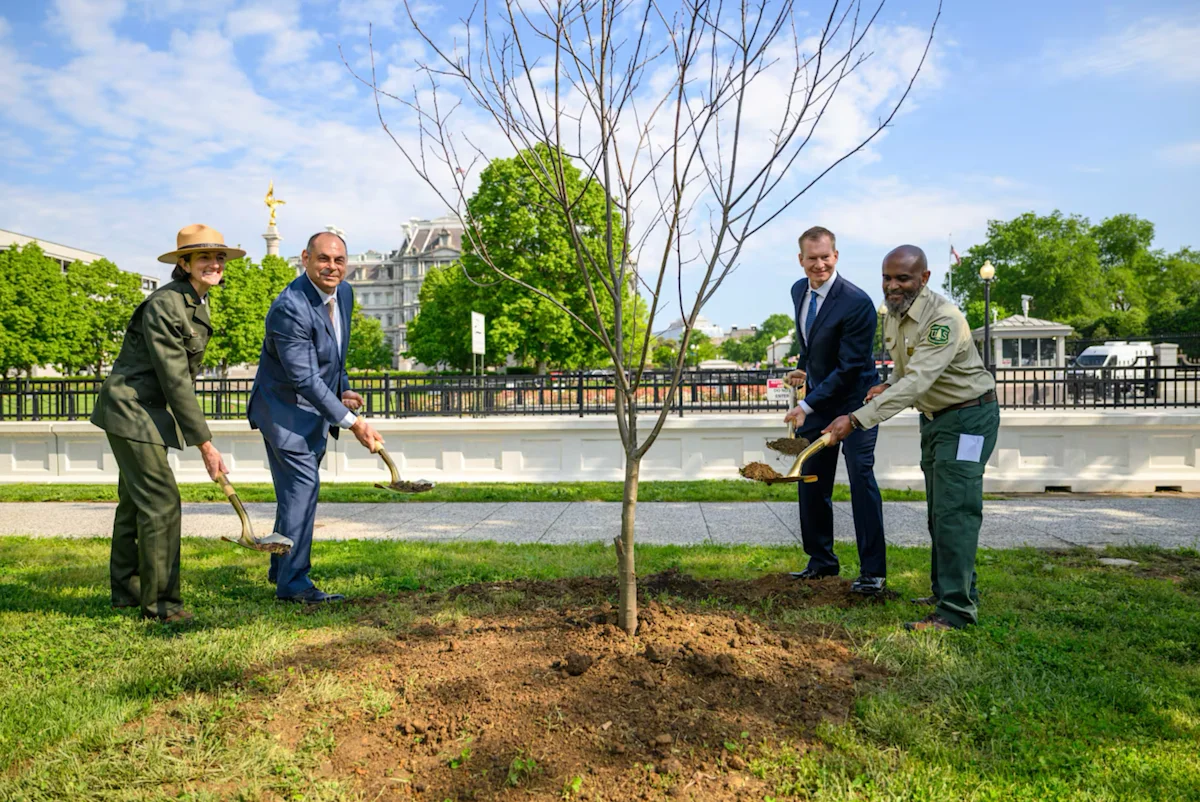
When the Trump administration planted a pair of modified American chestnut trees near the White House this spring — and more recently eased permitting requirements for planting such trees — it renewed a fierce scientific debate over how to restore the once iconic species.
The pair of genetically engineered American chestnuts were planted in President's Park across the street from the White House as part of an Arbor Day commemoration in April. The variety, known as Darling 54, included a wheat gene that fends off the blight that nearly wiped out the species a century ago and left it functionally extinct in the wild.
The White House said in a statement that general concerns about genetically modified organisms — like those held by many in the Make America Healthy Again movement — do not apply in the case of the American chestnut trees. Last week, the Agriculture Department separately deregulated the Darling 54, meaning that it would no longer require strict permits to plant the tree, although it will still be subject to broader Environmental Protection Agency rules. It is the first time a "forest tree" has been deregulated, a more common process for agricultural crops.
News and guidance on climate, science and technology. Sign up for free
"This is about forest restoration. The tree carries a single gene that allows it to tolerate a fungal pathogen introduced from abroad," the White House said. "The concerns that animate most criticism of agricultural biotechnology simply do not apply here."
While President Donald Trump has criticized many environmentally friendly initiatives, he has consistently championed planting trees . But in planting the trees, the administration also ignored certain strict controls on the planting of such organisms, allowing transgenic pollen to escape into the environment, according to internal documents reviewed by The Washington Post and a person familiar with the matter, who spoke on the condition on anonymity and was not authorized to speak to the media.
American chestnuts historically blanketed Mississippi to Maine, with 4 billion trees making up roughly a quarter of the canopy. Roasted chestnuts commonly marked the holiday season. But in the early 1900s, a fungal disease known as chestnut blight nearly wiped out the species. And a growing number of other threats like a root rot disease called phytophthora have made reintroducing the tree a challenge.
Proponents of the modified trees hailed the planting of the variety near the White House as a step forward in public acceptance of genetic engineering as a solution to reintroduce the species.
"Having those Darling 54 trees on the White House grounds, that was an upswelling of excitement," said Thomas Klak, a scientist who grew the two trees on a plot in Maine before they were transplanted to Washington, D.C.
But skeptics of genetic engineering said the planting could have irresponsibly introduced a transgenic gene into the wild with unknown consequences.
"We are in uncharted territory," said Michael Hansen, a senior staff scientist and expert on genetic engineering for Consumer Reports, a nonprofit advocacy group. "It could affect the fitness of the trees or how they interact with the ecosystem. You don't know until you do those studies."
Internal documents reviewed by The Post and a person familiar with the matter, who was not authorized to speak to the media, indicate that while steps were taken to collect the fruit from the trees, government staffers did not take adequate steps to control the flowers that release pollen.
That appears to have violated the terms of the USDA permit that allowed for the trees to be planted. The permit, reviewed by The Post, stated that the permit holder needed to "ensure confinement of the regulated article to prevent its unauthorized release, dispersal, and/or persistence in the environment."
A White House official confirmed that the trees were planted under a permit from USDA's Animal and Plant Health Inspection Service (APHIS), but did not answer questions on whether steps were taken to contain the transgenic pollen.
But the company that organized the planting and obtained the permit says the flowers were not an issue. SilvaBio CEO Michael Bloom said the company removed what flowers it could when its staff was on site and worked with the National Park Service to remove the rest later.
The USDA said in a statement that it is unaware of any permit violations involving the two chestnuts. The department said the Darling 54s were separated from any other chestnut trees by more than a mile, which should have prevented "unauthorized release."
Some American chestnut trees, still sprout in the wild, including in Rock Creek Park and in Silver Spring, Maryland, and others are planted at the U.S. Capitol and Congressional Cemetery.
If that pollen drifted to those non-genetically engineered chestnut trees in the Washington area, it could theoretically pollinate them and introduce the transgenic wheat gene into the wild outside of strict controls, said Michael Goergen, president and chief executive of the American Chestnut Foundation. That could have unknown consequences for local forests, Goergen said.
"As part of the research protocol, that isn't supposed to happen," Goergen said. "What could it mean in terms of contamination of the gene pool? "
The day the American chestnuts were planted near the White House, officials from the Agriculture Department and other departments spoke about pressing forward with deregulating the transgenic variety, Klak said.
Four months later, USDA announced that the Darling 54 chestnut had been deregulated.
"Restoring it is worth pursuing through every sound scientific avenue — traditional breeding, biocontrol, and biotechnology alike," the White House official said on Monday, following the deregulation last week.
People would no longer be required to obtain a USDA permit — like the one issued for the two chestnuts in President's Park — for small-scale plantings. The Environmental Protection Agency now must issue rules for larger plantations and wider planting activities before the trees can be sold commercially.
Asked if the administration pushed for this change, the White House official said USDA authorities acted "under its own statutory authority through the standard regulatory process." The State University of New York's College of Environmental Science and Forestry, which originally developed the Darling 54, initially filed the petition to deregulate the tree in 2020.
"APHIS conducted a plant pest risk assessment and a full environmental impact statement, took public comment across multiple periods drawing thousands of submissions, and concluded that the blight-tolerant American chestnut is unlikely to pose a greater plant pest risk than a conventional American chestnut," the official said.
The conditions of its USDA permit still would have applied up until its deregulation, the official said.
It's the first time the department has deregulated a genetically engineered tree that grows in the forest, rather than a commercial fruit tree grown on a plantation, said Andrew Newhouse, director of chestnut restoration at SUNY ESF.
"The regulatory approval is huge," Newhouse said. "It's the first time biotechnology has been applied in this way for conservation, where a vast majority of the previous approvals through this have been agricultural crops. "
Newhouse said the ultimate goal of seeing American chestnuts planted widely and returned to U.S. forests is still years off, but the deregulation is an important step toward that.
While the change will allow an expanded reach of the modified trees, the Darling 54 has divided the American chestnut restoration community.
The American Chestnut Foundation abruptly broke off its years-long support for the development of the genetically engineered variety of the tree in 2023, after scientists realized they had mistakenly planted Darling 54, instead of Darling 58 trees as intended, which inserts the same gene in a different spot.
Goergen said there are concerns the Darling 54 does not grow quickly enough to compete with other trees in the wild. The foundation has since championed recurrent genomic selection, a more traditional method of breeding American chestnuts with Chinese, Japanese or other chestnut varieties after analyzing their DNA for desirable traits.
Goergen predicts the more traditional breeding method will produce a viable variety that can compete in the wild and survive both the blight and phytophthora, another root disease that also kills the American chestnuts, in three generations. That will take at least 20 years, he said.
Newhouse says the Darling 54s' resistance to blight are a key step but not the end of the restoration effort. Both breeding and genetic engineering are necessary to solve the problem, he said. The Darling 54s could now be traditionally bred for genes that allow them to grow faster or resist root rot.
That may be key to the survival of the two American chestnuts near the White House, as phytophthora thrives in warm and wet environments, like the D.C. area.
Otherwise, Trump's trees may face the same fate as an American chestnut planted by George W. Bush in 2005.
Visitors to the White House will find no trace of that tree two decades later. Infected with root rot, it later died.
Topics in this story
Gathered from external sources. Rights to this text belong to whoever originally published it.