Hong Kong scientists found that ultrathin diamond sheets can generate electricity when bent, revealing a hidden piezoelectric effect
Science News: Diamond has long been regarded as a nonpiezoelectric material. Now, researchers have identified a piezoelectric effect in ultrathin, ultraflexible pol.
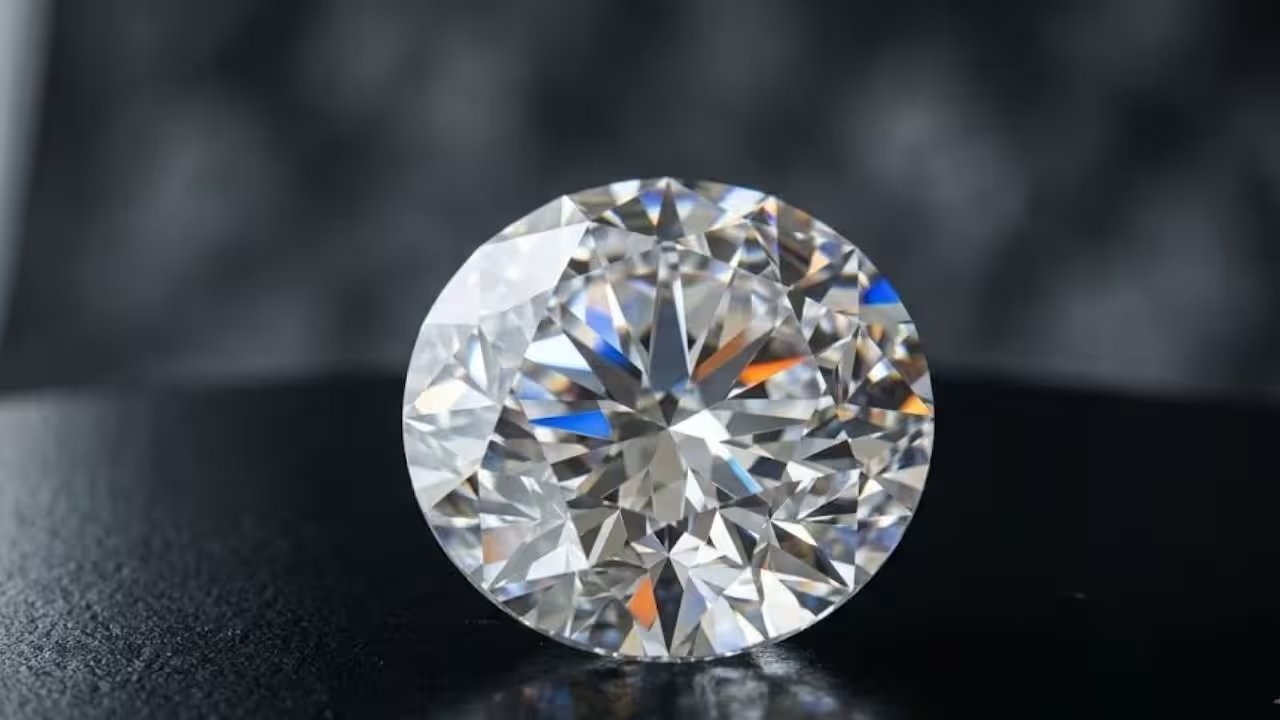
Diamond has long been regarded as a nonpiezoelectric material. Now, researchers have identified a piezoelectric effect in ultrathin, ultraflexible polycrystalline diamond membranes. Piezoelectric materials produce an electrical response when they are mechanically pressed, bent, or stretched. In the study, the researchers found that the effect in diamond membranes varies with their thickness, with the strongest response observed in membranes about 5 micrometres thick.According to the research published in Science Advances, titled ‘Uncovering piezoelectric effect in polycrystalline diamond membranes’, experiments showed that the membranes produced measurable piezoelectric responses when deformed. The researchers used first-principles calculations to investigate the origin of this behaviour. Their findings indicate that local asymmetries introduced by grain boundaries are responsible for the piezoelectricity. These boundaries alter the electric polarisation near them when the membrane is deformed.How thin diamond sheets respond when they are bentThe researchers observed piezoelectric behaviour in ultrathin polycrystalline diamond membranes rather than in conventional bulk diamond. The strongest response was observed in membranes approximately 5 micrometres thick, where the piezoelectric voltage coefficient reached about 82.2 millivolts per newton per metre. The researchers also found that the piezoelectric coefficient remained stable when the membranes were heated to 600 kelvin. Measurements across different membrane thicknesses showed that the effect was not uniform and changed as the membranes became thicker.Why grain boundaries are responsible for the effectThe researchers investigated why the piezoelectric response appears in polycrystalline diamond membranes. Unlike a single crystal, polycrystalline diamond contains many individual grains that meet at grain boundaries. According to the study, these boundaries introduce local asymmetries into the material. First-principles calculations showed that the asymmetry changes the electric polarisation within a limited region around a grain boundary when the membrane is deformed.This change in polarisation produces the observed piezoelectric response. The calculations also showed that the piezoelectric coefficient changes with the size of the crystalline region considered near the boundary.What makes these diamond membranes differentThe finding differs from the behaviour of conventional single-crystal diamonds. The researchers note that commercially available single-crystal bulk diamond has a zero d33 piezoelectric coefficient, while their measurements detected nonzero d33 values in the thin polycrystalline membranes. The effect was also dependent on membrane thickness, with the most pronounced response occurring at around 5 micrometres. The membranes were produced using microwave plasma chemical vapour deposition and subsequently separated from their silicon substrates.The researchers described them as both ultrathin and ultraflexible. Their experiments included measurements of electrical output under different bending strains, with the output voltage increasing as the bending strain increased.Researchers identify possible uses for the new diamond sheetsThe researchers state that the finding could support the exploration and development of diamond-based applications in energy harvesting, intelligent sensing and wearable electronics. These areas use materials that can couple mechanical changes with electrical responses, making the observed piezoelectric behaviour relevant to such research. The study also found that the piezoelectric coefficient remained stable at temperatures up to 600 kelvin, highlighting a property of the membranes examined by the researchers.However, the paper presents the work as a foundation for further development rather than as a demonstration of a completed commercial technology.
Topics in this story
Gathered from external sources. Rights to this text belong to whoever originally published it.