Spotify is coming to United Airlines seatbacks — with help from Starlink
United Airlines launches a native seatback Spotify app powered by Starlink Wi-Fi, letting passengers stream personal playlists and video podcasts in flight.
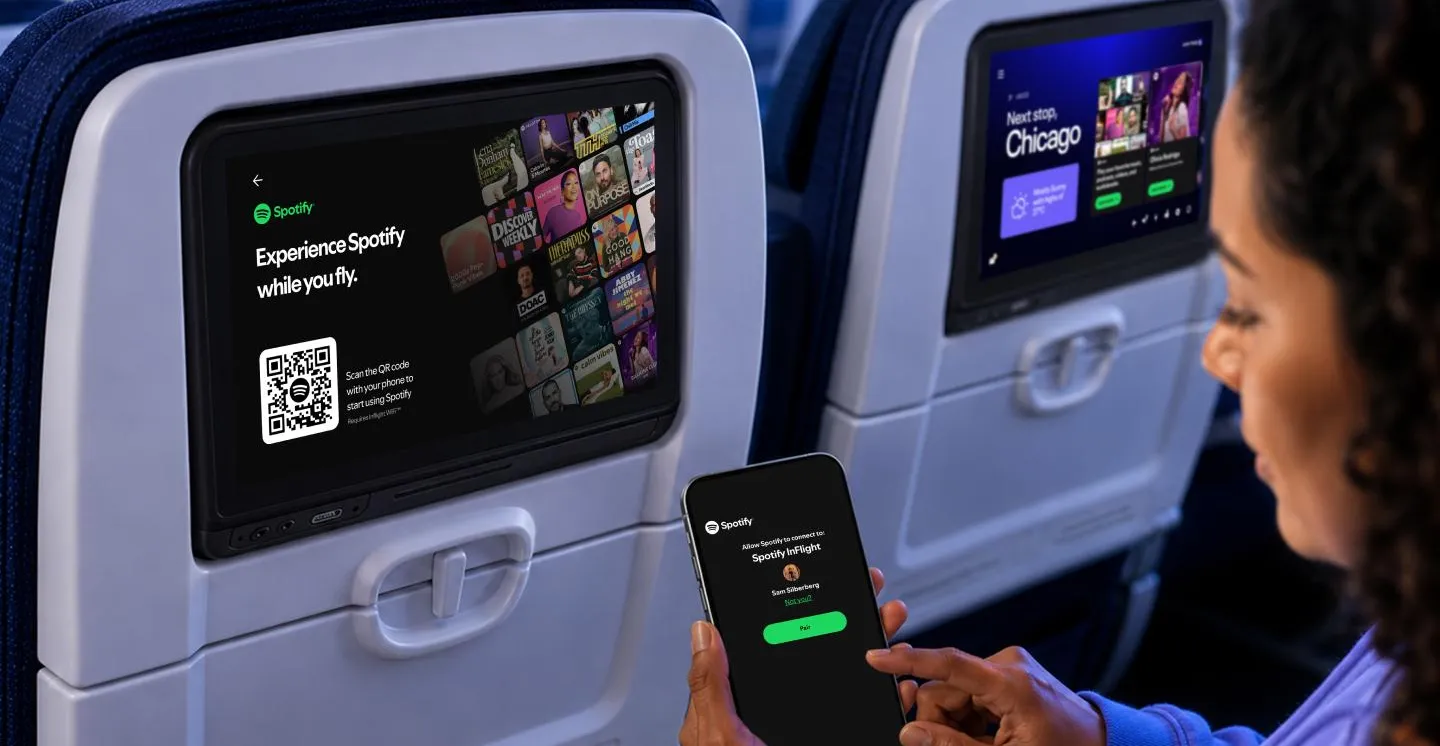
United has built a custom, native Spotify app for seatback displays, allowing passengers to log directly in to their personal accounts and stream their own libraries, playlists, and video podcasts while flying 35,000 feet in the air. The new integration is being powered by Starlink’s satellite Wi-Fi, which is currently being installed throughout United’s entire fleet. The news marks a major shift in legacy in-flight entertainment. Gone are the days of stethoscope-style plastic tubes, armrest dials, and canned playlists. These older airplane systems were built on the assumption that flights had no internet, so all movies and music had to be stored directly on the plane. Now, with the inclusion of Starlink’s Wi-Fi, passengers can stream content live from the internet, just like they do at home. United announced a partnership with Spotify a little over a year ago to explore how to preload some music content on seatback displays. But the airline decided that a more personalized experience, in which customers can activate their own accounts and stream their own music, was the logical next step, said Mark Muren, managing director for product marketing at United, in an interview. “It’s supreme, perfect personalization in that it’s that customer’s actual account, all of their material available there,” Muren added. The new integration would not have been possible without Starlink’s network of geostationary satellites, said Grant Milstead, United’s VP for digital, in the interview. Independent tests have confirmed that Starlink’s Wi-Fi works better than most other providers because of the sheer number of satellites it has in low Earth orbit, which currently stands at over 11,000. This robust infrastructure allows the company to offer Wi-Fi with much lower latency thanks to the shorter distance the signal has to travel as compared to satellites in geostationary orbit. “You know, for us, having fast, low-latency connectivity has been the enabler,” Milstead said. “Without Starlink, we couldn’t generate that living-room-in-the-sky experience.” "“Without Starlink, we couldn’t generate that living-room-in-the-sky experience.”" - Grant Milstead, United’s VP for digital United chose Starlink because of its reputation for robust connectivity without any of the usual dropped signals or coverage dead zones that have typically plagued in-flight Wi-Fi providers, Milstead said. “One of the reasons that we chose Starlink is for the global connectivity, even in the poles for some of our transatlantic and transpacific flights,” he added. “And so, candidly, the bandwidth and the coverage and the reliability has been so strong that we’ve seen consumers be able to stream across seatback with no interruptions. So we really haven’t had to do some of the complex engineering we’ve had to do in the past.” Using Starlink’s Wi-Fi, United passengers can now choose to stream their music on Spotify through the seatback display or their own mobile devices. And new apps are soon to come, with the airline looking to partner with other third-party streaming apps in the future. The Spotify deal will serve as a blueprint for integrations to come, Muren said. “Spotify has been a great partner,” he added. “I think they shared a vision for what we’re doing here very early on ... I can imagine a world where really any platform that customers are accustomed to using in their living room, as Grant says, or during their workday or anywhere in between ... there’s room for that at United.” United’s not alone in this thinking; other airlines are racing to install satellite Wi-Fi in their own planes. Many are also going with Starlink, such as American, Qatar, Emirates, Lufthansa, Air France, and British Airways. Delta Air Lines is partnering with Amazon’s LEO project, while JetBlue is sticking with Fly-Fi powered by Viasat. It won’t be long before United’s faster, more reliable Wi-Fi experience is the status quo across the industry. But United thinks it can still win over customers with better technology experiences. “Starlink being a differentiator for United is a moment in time,” Milstead acknowledged. “We know that fast Wi-Fi is coming for every airline. I think the mobile app is a pretty significant differentiator for United, [and] I think you will see the seatback screen be a differentiator in the future when connectivity is the expectation.”
Topics in this story
Gathered from external sources. Rights to this text belong to whoever originally published it.