Uber’s Wayve Deal Shows How It Wants to Win Without Building Cars
Uber launched autonomous rides in London with Wayve and Ford, part of an asset-light strategy backed by strong free cash flow, rising EBITDA margins, and a m...
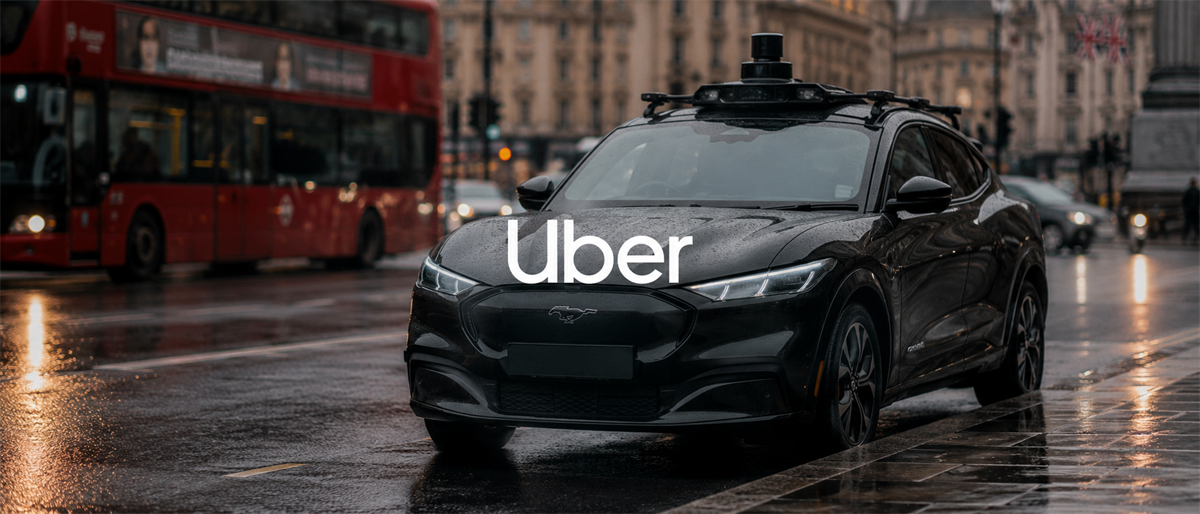
Uber launched its first international supervised autonomous ride-hailing service in London on Sept. 3, using Wayve-powered Ford Mustang Mach-E vehicles.
Uber is pursuing an asset-light strategy, avoiding vehicle manufacturing costs by partnering with autonomous technology and hardware providers to scale globally.
Strong free cash flow, rising EBITDA margins, and heavy institutional ownership support a moderate buy consensus with roughly 36% implied upside.
The market often misinterprets the structural evolution of logistics networks, pricing them on legacy models rather than future capabilities. This dynamic is currently playing out with Uber Technologies, Inc. (NYSE: UBER). On Sept. 3, Uber initiated its first supervised autonomous ride-hailing service in London. By deploying all-electric Ford Mustang Mach-E vehicles powered by Wayve's AI Driver, Uber is demonstrating a clear pivot in its business model.
Rather than absorbing the heavy capital expenditures required to manufacture proprietary autonomous vehicles, Uber is positioning itself as the commercialization and distribution layer for third-party technology. This asset-light approach allows Uber to bridge the gap toward long-term autonomous margins while avoiding the risks of automotive manufacturing. Investors assessing the current valuation might notice a disconnect between the traditional human-driven logistics multiple and the highly scalable, AI-integrated hybrid network being built.
Understanding the mechanics of the Wayve partnership reveals why this strategy appeals to institutional capital. Wayve utilizes an AV2.0 approach, relying on mapless, hardware-agnostic artificial intelligence (AI) that learns from complex environments rather than relying on traditional hand-coded rules. This adaptability is critical in a regulatory and geographical maze like London, where mapping every variable is nearly impossible.
The structural advantage for Uber rests on the deliberate avoidance of hardware development. Developing self-driving cars requires billions in research, development, and manufacturing overhead. By supplying the localized rider demand and the routing network, Uber allows partners like Wayve to focus on the intelligence while original equipment manufacturers like Ford (NYSE: F) and Nissan (OTCMKTS: NSANY) handle the hardware. Over 140,000 London riders have already opted in to the service, suggesting that consumer adoption barriers may be lower than previously anticipated.
Topics in this story
Gathered from external sources. Rights to this text belong to whoever originally published it.