Robot Brains For 75 Cents/Hour? Former Nvidia Researchers Raise $90 Million
Want to make your dumb robot smart? $3 an hour is all it costs. Or 75 cents, if you’re okay with a slightly less capable physical AI model.
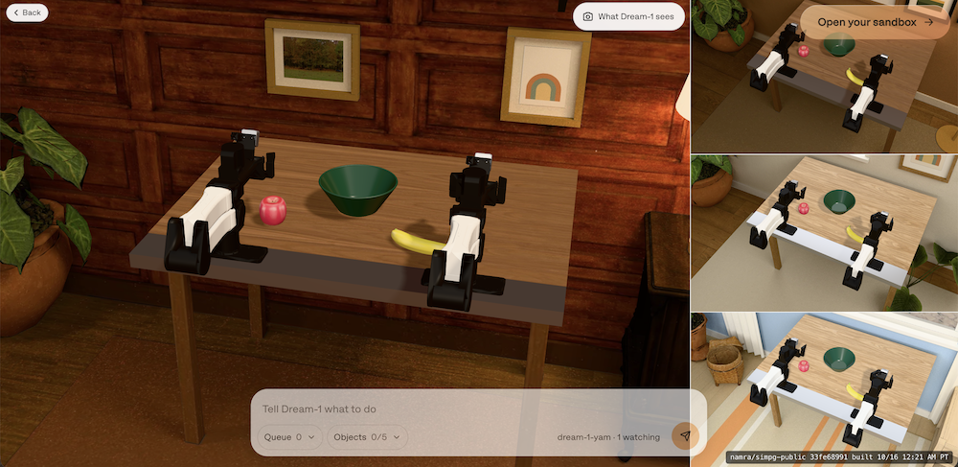
Want to make your dumb robot smart? $3 an hour is all it costs. Or 75 cents, if you're okay with a slightly less capable physical AI model. Dream Labs, a San Francisco startup founded this year by former leaders of Nvidia's GR00T robotics research team, announced a $90 million seed round today. Dream Labs also launched the Dream API, which it says is the first publicly available API for a robot foundation model.
It's kind of magic: send the API your robot's camera feed plus some plain-English instructions, and it essentially operates your robot … even if it has never seen that particular model before. The team behind the startup says this is the missing link in physical AI.
"The hardware is ready. What's been missing is a brain any robot can use," CEO and co-founder Joel Jang said in a statement. "When you get into a rental car, you don't relearn how to drive. You find the controls and your past driving experience does the rest. Dream-1 approaches a new robot the same way, so a new robot can do useful work in minutes, not months."
The model behind it is called Dream-1. Dream-1 is trained on video of people doing everyday tasks (just like Figure with Index or Neura Robotics in Germany). The model predicts what will happen next in a scene, then works out what the robot should do about it. Because it learns from human video rather than from one specific machine with one specific set of instruction software, Dream Labs says the skills transfer across hardware.
And they've got a big claim: out of the box, Dream-1 can control any robot with two arms and parallel grippers. Essentially instantly, or zero-shot, as roboticists say.
Cross-embodiment transfer – teaching robot B to do what robot A is already doing – is one of the hardest problems in robotics. Almost every robot on the planet is specifically trained for its specific body and its specific task. What one machine learns rarely transfers to another, which has slightly different arms, hands, motors, geometry, friction, and more. There are about 5 million industrial robots working in factories globally, according to Dream Labs, and nearly all of them are programmed for a single task.
Six months ago, Jang says, adapting the team's model to a new robot took 30 minutes of data from that robot. Before that, getting anything working could take 100,000 hours.
"That was six months ago. Now we just need the robot."
The trick is treating robot control as a video problem. "If the AI model can predict a video of a robot doing it, then it can do it," Jang says. "So now control becomes a video prediction problem."
Topics in this story
Gathered from external sources. Rights to this text belong to whoever originally published it.