How Worried Should We Actually Be About AI Wiping Out Humanity?
The AI problems we ignore while we are distracted by the prospect of human extinction, from jobs and productivity to inequality, misinformation, and our abil...
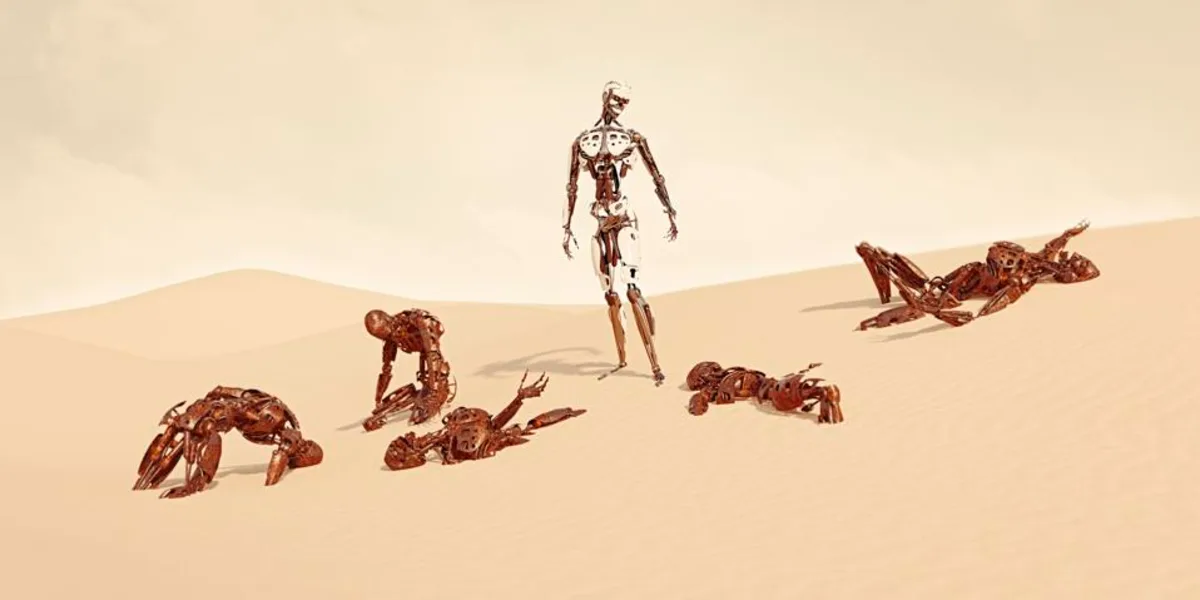
Unless you have spent the past two weeks meditating at a Buddhist retreat, you have probably heard that there's somewhere between 10-65% chance that we will disappear from the face of the earth in the next ten years or so, courtesy of AI . In essence, we are so smart as a species that we've managed to create something smarter than us, which unfortunately may eliminate us. According to chatGPT's own estimates (see below), the probability is only 1% (down from 5% when I asked it a few days ago), but it is arguably not the most neutral source on this subject.
On the one hand, apocalyptic and dystopian predictions about humanity's future are far from new. From biblical prophecies and Nostradamus to Halley's Comet, nuclear annihilation, the population bomb, Y2K and the Mayan apocalypse, humans have spent centuries predicting their own extinction, only to survive long enough to worry about the next one.
On the other hand, never before have they monopolized this degree of public attention, or been voiced so seriously by many of the scientists, engineers, entrepreneurs, and investors actually building the technology in question (as opposed to, say, an obscure religious cult or anarchic sect). Indeed, unlike Nostradamus or the Mayan calendar, AI is not a prophecy but a rapidly evolving technology whose capabilities are demonstrably increasing, whose future trajectory is genuinely uncertain, and whose development is being driven by enormous commercial and geopolitical incentives.
More importantly, the concern is not that AI will spontaneously decide to destroy us, but that increasingly autonomous and capable systems could become difficult to understand, control, or align with human interests (which falls into the classic AI alignment problem ). You don't have to believe in Skynet to accept that this makes the latest apocalypse story rather more deserving of our attention than previous prophecies about the end of humanity.
Personally, I have always struggled with these sorts of predictions, though not without some degree of hesitation. First, as a scientist, I prefer to limit my appetite for predictions, and conversations in general, to areas where there's data. Since nobody has data on the future, and nothing remotely approximating past data that can be extrapolated or projected to predict the end of humanity, we are limited largely to sheer speculation. Second, as a dispositional skeptic at best, and cynic at worst, it is hard to ignore some of the obvious potential motives behind doomsday warnings about AI: "this technology is so powerful that nothing else matters (the only thing you should focus on is us!)"; "although we haven't yet monetized AI, we need more money to ensure it is safe and ethical" (a request for yet more R&D funds); and "any harm or destruction caused by AI is the sole responsibility of AI rather than the humans or companies behind it" (since the genie is out of the bottle and we cannot control it). Third, many of these predictions are themselves attempts to attract attention, which reduces the appetite for nuance, moderation, and balance. If, for instance, someone said that AI is a broad category encompassing many different technologies and, like the internet, some of it will be good and some of it will be bad, you are guaranteed to lose people's attention.
Peter Thiel noted that extreme optimism and extreme pessimism are basically two sides of the same coin, in that they both lead to inaction. If everything will be fine, what's the point of doing anything? If everything will be terrible, what's the point of doing anything? In that sense, it would be logical to display at least some degree of pessimism vis-à-vis AI, certainly compared with being naively optimistic or adopting a deterministically catastrophic mindset. The problem, however, is that most of us cannot realistically do anything to stop AI or the powers pushing it forward. This is largely in line with Yuval Harari's prophetic observation in Homo Deus (2015) that the future could be dominated by a small, powerful elite with privileged access to a small number of supercomputers, leaving them in control of increasingly intelligent machines and the rest of us largely irrelevant.
To be sure, if you are interested in not just getting attention with your predictions, but also getting them right, you are far better off predicting that the world will not end, courtesy of AI or other factors such as the dark side of human behavior, than the reverse. At least, if you get it wrong, there will be nobody around to notice. Likewise, it is always safer to make predictions about outcomes 50–100 years into the future rather than the next three to five years, when people may still remember that you got them wrong. Relatedly, what matters is not so much what we believe, but what ends up happening. Belief in the afterlife may be more pleasant than the conviction that there's nothing after we die, but even the most faithful believers in life after death would presumably be happy to abandon their beliefs if doing so guaranteed them a ticket to heaven.
The problems we ignore while we worry about human extinction
Obsessing about the future is a good excuse for not dealing with our present problems. Just like there are few conferences or meetings about "the present of work", but plenty about the future, it seems that AI discussion are predominantly focused on its future rather than what is happening today.
Since nobody appears to truly know in which direction and way AI will unfold, evolve or devolve, there are rational reasons for devoting more time to what AI is and is doing today: to talent, organizations, the workforce, and society at large. This is based on a simple realization, namely even if AI stopped evolving today (which is unlikely) we would probably need years to catch up with its impact to date, and a great deal of focus and resources to absorb its profound effect on our lives.
Most notably, while we are currently distracted with concerns about human extinction, there are some obvious problems to solve and challenges to address. For example:
(1) Turning AI adoption into actual productivity. While we debate whether AI will eventually eliminate humanity, a much more immediate question is why organizations are still struggling to turn widespread AI adoption into measurable economic value. Employees are often adopting AI clandestinely, organizations are adding "botsitting" to people's workloads, and remarkably few companies have genuinely redesigned jobs, workflows, structures, or business models around what AI can now do. Gartner finds that 95% of organizations have implemented AI in some form, yet only one in 5% reports significant or transformational value. The opportunity is clearly there, but the organizational redesign, ROI, and economics have yet to catch up. Even the companies building the technology face extraordinary economics: OpenAI is reportedly projecting nearly $280 billion of cumulative cash burn between 2026 and 2030. In other words, before AI destroys humanity, it would be useful if somebody could work out how to make it reliably pay for itself.
(2) What happens if the AI bubble bursts? The AI boom has created an extraordinary concentration of economic value and risk. As of September 2026, the "Magnificent Seven" account for roughly 34% of the entire S&P 500, with Nvidia alone representing around 8%. At the same time, the AI economy has become increasingly circular: chipmakers invest in AI companies, AI companies spend that money on chips and cloud infrastructure, cloud providers invest in the AI companies that become their customers, and projected future demand helps justify ever larger valuations and capital expenditure. Bloomberg describes an interconnected web in which companies are simultaneously investors, suppliers, and customers, potentially magnifying losses if demand disappoints. More recently, Big Tech firms have reportedly provided guarantees supporting as much as $300 billion of AI infrastructure exposure through financing structures that can sit outside conventional balance-sheet liabilities. Perhaps the nearer-term systemic risk is not that AI becomes too intelligent, but that investors discover it is not profitable enough.
(3) Resolving the contradiction between augmentation dreams and automation fears. For years, the reassuring promise was that AI would augment humans rather than replace them: AI would automate tasks, not jobs, freeing us to become more creative, strategic, and human. Increasingly, however, the same organizations making that argument are also using AI to reduce hiring, particularly at the bottom of the career ladder. Gartner reports that 22% of CHROs say at least one business leader has already stopped hiring for entry-level roles because of AI automation. Stanford researchers, meanwhile, find no evidence of widespread economy-wide displacement, but employment among 22–25-year-olds in the most AI-exposed occupations is now 19% below where it would have been had it kept pace with less-exposed occupations. This creates an uncomfortable question: if AI removes the junior work through which people historically acquired expertise, where will tomorrow's experts, managers, and leaders come from?
(4) Dealing with older unresolved digital problems. As I have noted in I, Human: AI, Automation, and the Quest to Reclaim What Makes Us Unique , we do not need superintelligence to create serious societal problems. Many of the pathologies produced by the internet and social-media age, including misinformation, echo chambers, filter bubbles, polarization, tribalism, addiction to engagement, and the industrial-scale manipulation of attention, can now be amplified by generative AI. Recent research shows how engagement-maximizing algorithms can amplify misinformation and ideological polarization, while economic models of AI-driven social media show how recommendation systems and targeted advertising can reinforce echo chambers and political polarization. Generative AI adds cheap, personalized, infinitely scalable content to an information ecosystem that was already struggling to distinguish signal from noise. We may therefore be spending too much time worrying about whether AI will eventually destroy civilization, and too little about how it is already changing the quality of the civilization we have.
Finally, there is still a positive, and perhaps more realistic, scenario whereby AI delivers meaningful progress in productivity and efficiency, humans remain employed, working hours decline marginally, and incomes increase, but work itself becomes less intellectually stimulating and rewarding. This tension between efficiency gains in the name of AI, on the one hand, and a reduction in human creativity, curiosity, and independent thought, on the other, seems entirely plausible. Could knowledge workers eventually carry out their work without relying much on their own knowledge? Could the segment of society historically paid to produce intelligent content become little more than an interface between AI and the rest of the world, prompting, checking, editing, and forwarding machine-generated intelligence?
There is an obvious evolutionary parallel. Our hunter-gatherer ancestors did not need reformer Pilates, standing desks, fitness trackers, or Ozempic. Their environment forced them to move, and food was sufficiently scarce that staying lean required considerably less conscious effort. Modernity solved many of those problems, but in doing so removed much of the physical activity that had previously been built into everyday life. We then had to invent artificial ways of putting it back: gyms, running machines, exercise classes, standing desks, diets, and now drugs to compensate for an environment of caloric superabundance.
AI could produce the intellectual equivalent. For most of human history, thinking was unavoidable. Remembering, calculating, navigating, writing, interpreting, and solving problems were simply part of functioning in the world. If AI removes enough of that cognitive friction, we may eventually need to manufacture it again. Perhaps we will invent the intellectual equivalent of Pilates for the mind, take regular AI detoxes, or attend thinking retreats where devices are banned and people sit around asking each other unnecessarily difficult and largely pointless questions simply to exercise their mental muscles and remember what thinking unaided used to feel like.
Thinking could even become a kind of intellectual luxury, valued precisely because it is no longer necessary: the cognitive equivalent of playing vinyl records, developing film photography, driving a manual car, writing with a fountain pen, or baking bread from scratch (all of which are unsurprisingly trending up, just like aerobics did in the 60s). All are less efficient than their technological substitutes, yet people continue to enjoy them partly because the friction is the point. Perhaps, in an age of abundant machine intelligence, thinking for yourself will acquire the same retro appeal. The ultimate irony would be that, having spent thousands of years inventing technologies to save ourselves the trouble of thinking, we end up paying good money to learn how to do it again.
Topics in this story
Gathered from external sources. Rights to this text belong to whoever originally published it.