China Is Building an AI Future Far From Its Biggest Cities
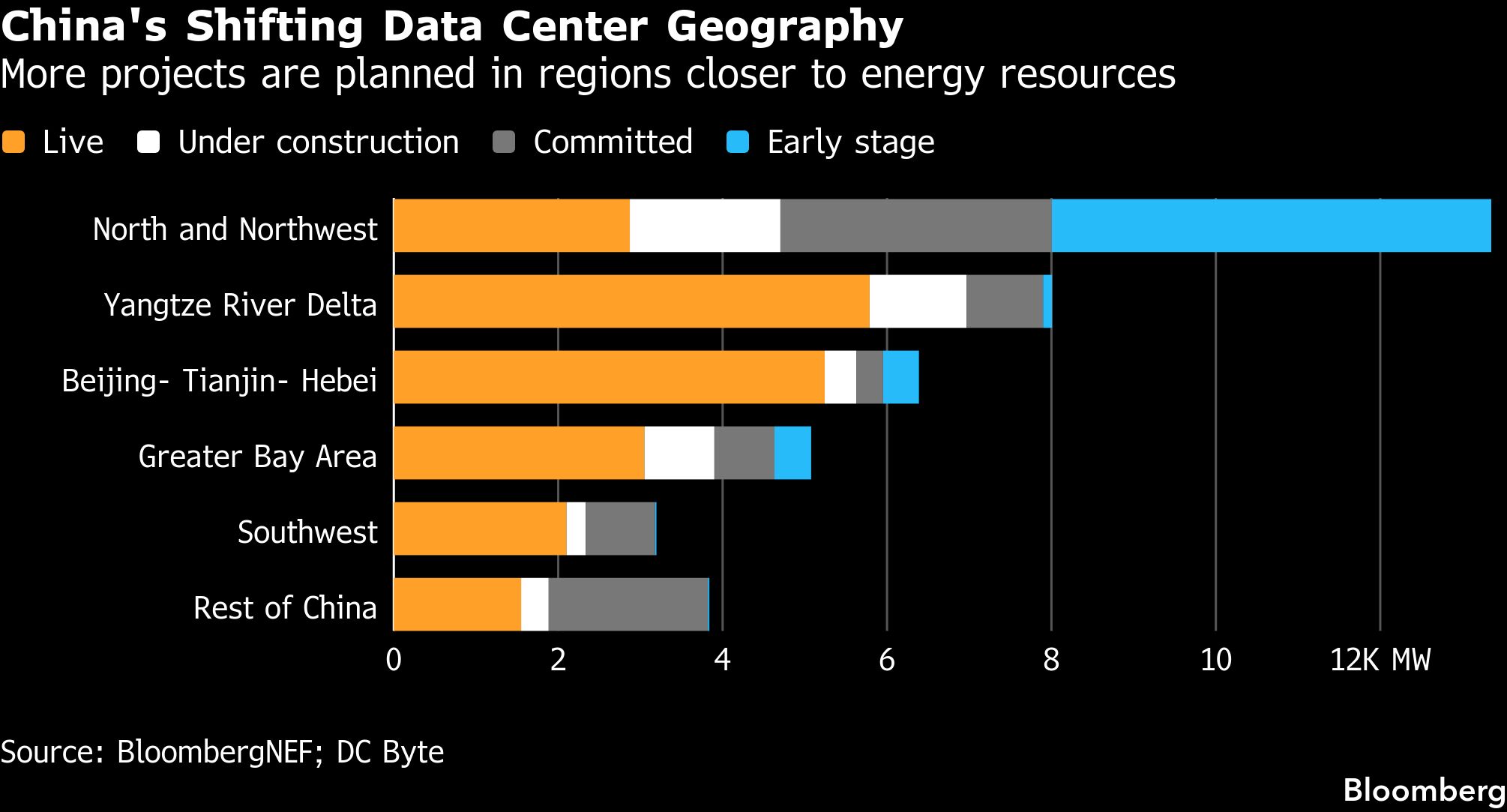
More than half of the country’s data center pipeline is already in the north and northwest, according to new BNEF data.
(Bloomberg) -- Set in rolling grassland, Ulanqab is an unlikely technological hub.
Yet this modest city of less than 2 million people in Inner Mongolia has found itself on the front line of China's efforts to relocate computing power away from its crowded eastern megacities and out to its western regions, where both space and inexpensive green energy are abundant.
At one cluttered intersection on the eastern edge of the city on a Friday lunchtime, workers streamed out of a cluster of data-center construction sites — a reminder of the scale of the endeavor here, some 350 km (roughly 217 miles) northwest of Beijing. Still wearing hard hats and high-visibility vests, their pants and boots caked in dust, they congregated at a cluster of trucks selling cheap meals, beer and cigarettes.
"Every day, there are hundreds of workers," said a woman surnamed Yin, who uses only one name and whose family runs a stall serving plates of chicken, egg and tofu skin to workers at the busy intersection for 10 yuan (roughly $1.50). "It never stops."
Under way since 2022, Beijing's technological shift — a campaign known officially in Chinese as dongshu xisuan, or roughly, "Data in the East, Computing in the West" — is already impacting the distribution of projects. According to new research published by BloombergNEF on Tuesday, more than half of the country's data-center project pipeline is now across the north and northwest, including Inner Mongolia, the region that includes Ulanqab.
By 2028, this region is expected to surge past Beijing, Shanghai and other established urban areas to become the country's top source of computing capacity, BNEF found. DeepSeek and Z.AI Co. are among the Chinese AI pioneers erecting giant data centers of a gigawatt or more in the area, racing to put in place the infrastructure they need to power AI development.
North and northwestern China has emerged as "the main growth pole for new development, despite having a much smaller operating fleet," BNEF analysts wrote in the report. "Lower-cost power, cooler climates and greater land availability in these regions are attracting developers, while power-intensive, less latency-sensitive workloads are migrating from established demand centers."
Topics in this story
Gathered from external sources. Rights to this text belong to whoever originally published it.