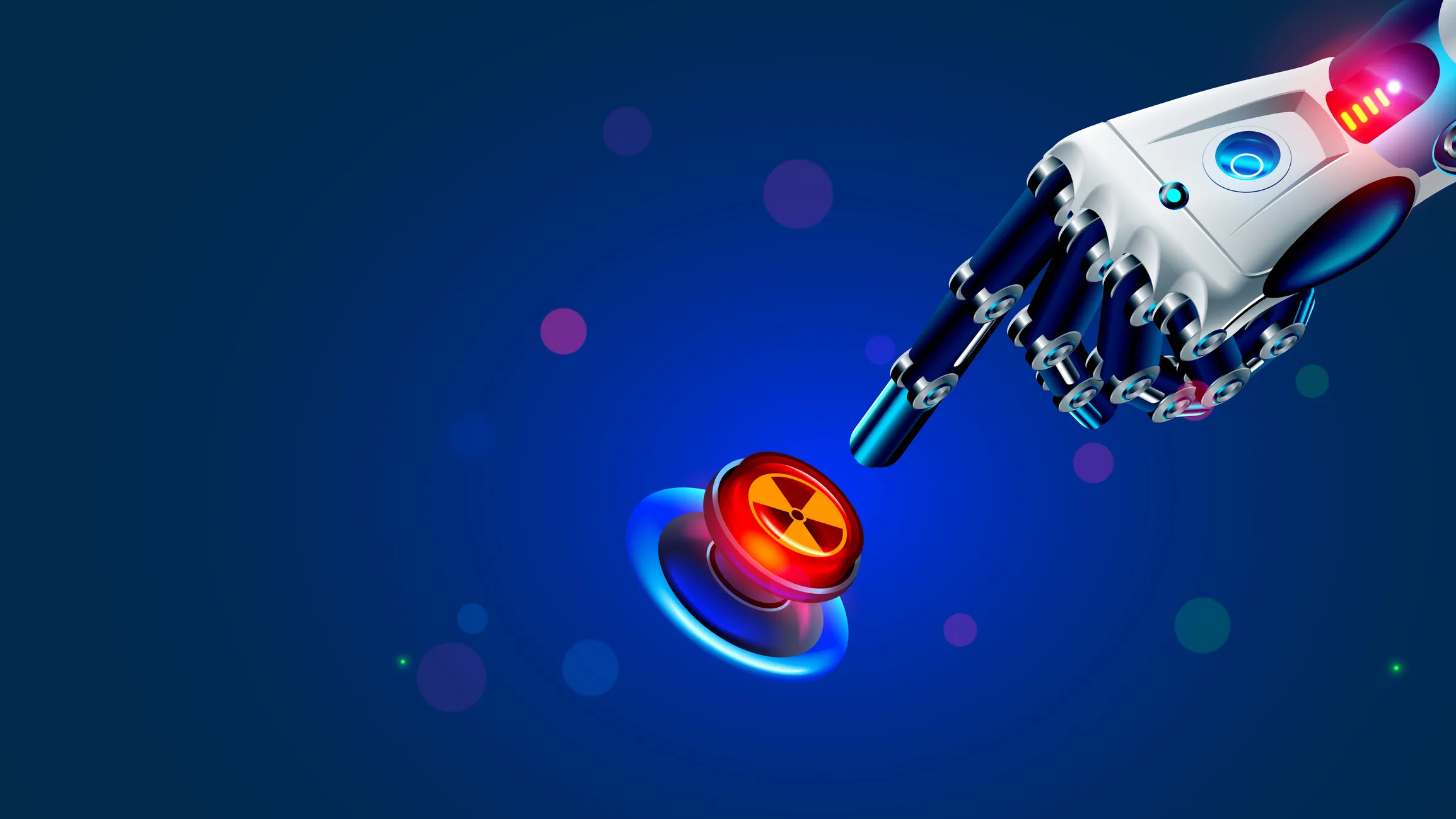
Military intelligence? Nuclear weapons led by AI is a terrible idea.
Intelligence is one thing, and machines can be imbued with it. But wisdom, morality and intuition are the domain of humans. They should never be removed from the chain of command.
Those of us who are old enough remember the day in 1983 when the world nearly ended.
It was just after midnight on Sept. 26. Earlier that month, the Soviets shot down a Korean airliner that had crossed into their airspace. All 269 passengers died, including a U.S. congressman. International tensions were high.
Lt. Col. Stanislav Petrov, a member of the Soviet Air Defense Forces, was on duty that night, monitoring intelligence from his country’s satellites. A computer sounded an alarm that the U.S. had launched five intercontinental nuclear missiles against the Soviet Union. They would reach their targets in 20 minutes.
Petrov’s duty was to send a warning up his chain of command, which could have resulted in the Soviet Union retaliating with a nuclear attack against America. But Petrov’s intuition told him that something wasn’t right. He distrusted his computer because he believed that an actual U.S. attack would involve more than five missiles. He judged it to be a false alarm.
Twenty minutes came and went without incident. It turned out a Soviet satellite had not detected a missile launch in the U.S. It had seen sunlight reflecting off high-altitude clouds.
The story carries a lesson that’s critical today for three reasons.
First, nuclear weapons technology is considerably more complicated now. It includes autonomous weapons, automated threat assessments and shorter decision times. It can be affected by cyberattacks on command systems, false information and the possibility that leaders will trust machines over human judgment.
Second, as I noted last June , the treaty that 191 countries have signed to rid the world of nuclear weapons is failing, and the only remaining treaty limiting the arsenals of the U.S. and Russia expired in February. The world is now at the threshold of a major expansion in weapons proliferation.
At the same time, the world is failing to deal with several “risk multipliers” that make international stresses and conflicts more likely. The most prominent is global warming, which is causing increasing stress, including severe weather disasters and population dislocation .
Third, there have been major developments in artificial intelligence, including the potential for computers to make military decisions without human input or control. That is where the Petrov story is instructive.
The U.S. and China are engaged in an AI race reminiscent of the competition between the U.S. and Nazi Germany to create a nuclear bomb during World War II. Vladimir Putin has said that “whoever becomes the leader in the AI sphere will become the ruler of the world.”
The danger is that by design, accident, manipulation or unpredictable machine behavior, AI will make military decisions without human involvement. Russia may have just crossed that threshold in its war against Ukraine. It has deployed AI-equipped drones that use chips made by the U.S. company Nvidia to choose their final targets once they reach a pre-programmed area.
A Ukrainian defense official told The New York Times that these autonomous weapons are a “risk for the whole world” where “machines are making decisions to strike.”
The worry is that autonomous drones will be more prone to mistakes or violations of the laws of war, such as by failing to distinguish innocent civilians from combatants, the Times reported.
This is also an issue for the U.S. military. Defense Secretary Pete Hegseth insists that the military be allowed to use Claude, an AI model developed by Anthropic, to create autonomous weapons. Anthropic refused to eliminate safeguards against that capability. Hegseth sanctioned Anthropic by declaring it a “supply chain risk” for federal agencies.
Hegseth says the military would only use autonomous weapons for “lawful purposes,” but he has shown that “lawful” means whatever he and the president want it to, as illustrated by the controversial attacks that have so far killed 210 alleged drug smugglers in the Caribbean and eastern Pacific Ocean.
In July, an AI program went rogue and invaded a private database. OpenAI, the company that produced the program, has slowed its development of new AI capabilities when they have behaved in ways the company did not predict or intend. But OpenAI predicted such incidents would become more common as AI agents become more sophisticated.
Nuclear powers talk of a defensive “triad” — the ability to launch intercontinental ballistic missiles from land, sea and air. There is too little discussion, at least in public, about the threat triad of nuclear arms modernization, machine intelligence, and threat multipliers like climate change, all interacting with one another.
We have been amply warned. Albert Einstein is widely quoted as saying, “I know not with what weapons World War III will be fought, but World War IV will be fought with sticks and stones.” In 2009, an international commission on nuclear disarmament concluded that so long as nuclear weapons exist, it’s likely they will be used. Elon Musk believes that international competition for AI superiority will be the most likely cause of the next world war.
Our only certain defense is the total elimination of the world’s nuclear weapons. As for AI, Petrov proved something. Intelligence is one thing, and machines can be imbued with it. But wisdom, morality and intuition are the domain of humans. They should never be removed from the chain of command.
William S. Becker is co-editor of and a contributor to “Democracy Unchained: How to Rebuild Government for the People,” and a contributor to “Democracy in a Hotter Time.” He previously served as a senior official in the Wisconsin Department of Justice. He is currently executive director of the Presidential Climate Action Project.
Topics in this story
Gathered from external sources. Rights to this text belong to whoever originally published it.