Carlos Alcaraz's serve may be a work in progress, but the Spaniard is going places
Carlos Alcaraz has played six tournaments since returning to competition in August and won four of them, taking his title tally for the year to six.
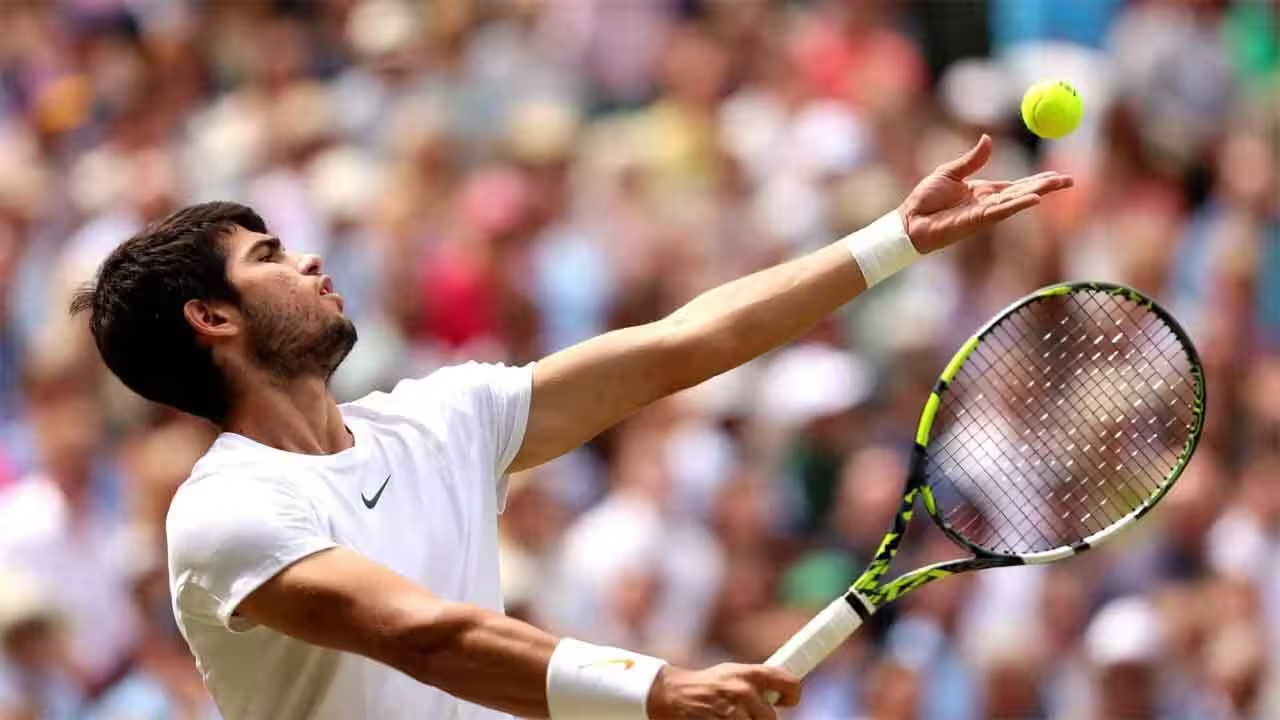
Carlos Alcaraz has played six tournaments since returning to competition in August and won four of them, taking his title tally for the year to six. But it is not just the number of titles, or even the fact that his last three triumphs have come on speedy indoor hardcourts - traditionally not the strongest part of his game - that makes this run particularly impressive. It is that he has achieved all this while his serve remains awork in progress.The 23-year-old Spaniard defeated world No. 1 Alexander Zverev in straight sets in Sunday’s title match in Turin to claim his first ATP Finals crown. Yet his average first-serve speed was nearly 8 kmph slower than what he had managed in last year’s final against Jannik Sinner.Alcaraz averaged 196 kmph on his first serve and 170 kmph on his second in Turin, although his second-serve speed against Zverev was significantly slower.Alcaraz, who injured his wrist in Barcelona in April, returned to competition at the US Open in August, where he reached the quarterfinals. Since then, he has won titles in Tokyo, Vienna, Paris and Turin, compiling an impressive 22-1 record in that stretch.After Sunday’s final, Alcaraz spoke about his grandfather, who reminds him of the three C’s before he steps on court, whether for a match or practice.“In Spanish it is ‘Cabeza, corazon, cajones’, in English it is ‘head, heart, balls’,” he said in Turin.While Alcaraz wasted little time rediscovering his forehand after returning to competition, the serve has proved adifferent challenge. The seven-time major champion, who stands at 6ft and, along with Italian Flavio Cobolli, is the shortest player in the ATP’s Top 10, has had to find ways to extract more from his serving action.There has been a subtle change in his motion since August, including a lift of the front foot that places more weight on the back foot and helps with the loading. He has also lowered his ball toss and quickened his motion. In the superfast indoor conditions in Turin, those adjustments gave his serve an added edge.“I understand how I should serve, and when I’m relaxed, I do a really smooth movement and I accelerate. When I feel nervous, I want to do more than I should do,” he said. “I’m not (a) server. I need to gain the point from the baseline, so I have to realise that and understand that. Once I got it, I think the serve goes much better.”Zverev may have finished the year as No. 1, but it is Alcaraz who has given the closing months of the season their most compelling storyline.He began 2026 under a barrage of questions after parting ways with Juan Carlos Ferrero, the coach who had guided him through his formative years, at the end of a successful 2025 season. The debate over whether the coach made the champion or the genius made the coach has, in many ways, been answered.Alcaraz has had to fight for his own territory this season, and his response has been emphatic. Ferrero has since signed up to work with 24-year-old world No. 4 Ben Shelton, who dismantled Alcaraz’s challenge at the US Open but has since lost twice to the Spaniard. Their meetings are already being talked up as one of the rivalries to watch in the new season.For Alcaraz, though, the bigger challenge will be to build on a remarkable finish to 2026. The serve is evolving, but he has shown that he can win on the biggest stages even when one of the most important weapons in his arsenal is not firing at full strength.If he can combine the improvements in his serve with the fluency of his baseline game, the prospect of an even more formidable Alcaraz in 2027 should concern the rest.Get the latest Sports News and Live updates. Download the TOI app.
Topics in this story
Gathered from external sources. Rights to this text belong to whoever originally published it.