Roger Federer’s simple career mantra stunned Golden State Warriors — Steve Kerr saw the same secret in Steph Curry’s pursuit of greatness
Tennis News: Roger Federer’s career was built on numbers that seem almost impossible to comprehend.Twenty Grand Slam titles. One hundred and three tour-level troph.
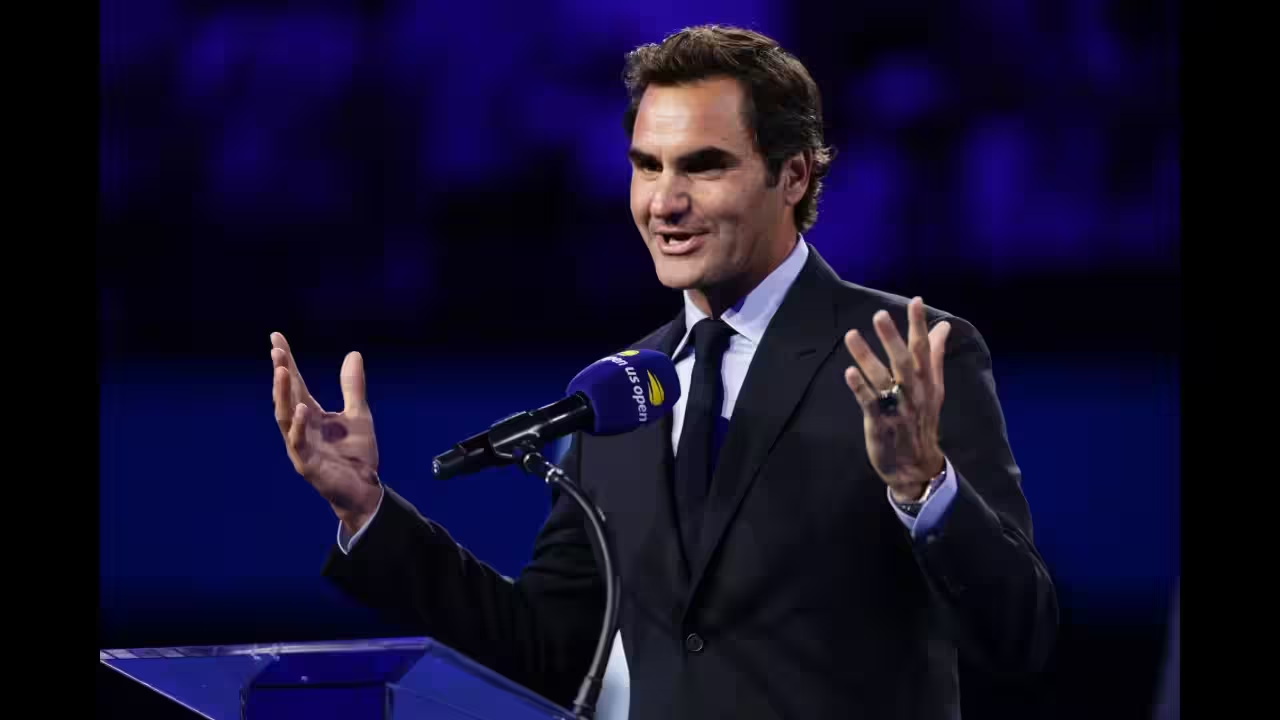
Roger Federer’s career was built on numbers that seem almost impossible to comprehend.Twenty Grand Slam titles. One hundred and three tour-level trophies. Three hundred and ten weeks as the world No. 1, including 237 consecutive weeks at the top. Five successive US Open titles between 2004 and 2008, a record that remains untouched in the Open Era.But years ago, when the Swiss great was asked by a group of Golden State Warriors players how he had managed to sustain that extraordinary level for so long, his answer had remarkably little to do with the usual language of sporting greatness.No talk of outworking everyone. No grand speech about sacrifice. No obsession with being better than the next player. Instead, Federer spoke about something far more ordinary: his daily routine and the joy he found in it.The anecdote has stayed with Warriors coach Steve Kerr ever since.Federer’s remarkable career, in perspectiveFederer, 45, was officially inducted into the International Tennis Hall of Fame on August 29 in Newport, Rhode Island. A few days later, he returned to New York to receive his Hall of Fame ring inside Arthur Ashe Stadium and spent time around the US Open — the tournament where he produced one of the toughest records in modern tennis.Federer won five consecutive US Open titles from 2004 to 2008. He remains the only player, man or woman, to win five straight titles in New York during the Open Era.Yet one of the most revealing stories about his approach to longevity came not from a Grand Slam final or a record-breaking season, but from a conversation with the Warriors during their 2017 trip to China.A question from Draymond GreenFederer was in Shanghai for the Masters tournament when the Warriors invited him to speak to the team.Kerr later recalled how Draymond Green asked the 20-time Grand Slam champion a question that seemed to invite the standard answer about relentless work and sacrifice.“I’ll tell you a great story about Roger Federer. We were playing in China with the Warriors in 2017. Roger was in Shanghai for the Masters tournament, so we invited him to come speak to the team.”“Draymond Green asked him, ‘How do you sustain success? How have you managed to win majors 20 years after you first won one?’ Everyone was expecting him to say, ‘I work harder than everybody,’ the will, all the clichés.”Instead, Federer talked about getting up in the morning, making breakfast for his children, taking them to school and then going to train.Federer’s answer was surprisingly simple“Roger Federer says, ‘I get up every morning and I make breakfast for my kids. Then I take them to school and drop them off. Then I go practice tennis for about two hours, and I’ve figured out a really good routine where I don’t destroy my body, but I can get all the work in I need.’”And then came the line that Kerr remembered most.“‘Then I go have lunch with my wife. In the evening, we cook dinner together. The kids are all home from school. We ask them about school. There’s so much joy in the house. We put them to bed, and then I put my head on the pillow and go, “Man, that was just a great day.” And I’ve been doing that for 20 years.’”For Kerr, the message was striking because Federer had reduced the mystery of sustained excellence to something that sounded almost deceptively simple.“And it was like, yes. That’s it. That’s the formula. That’s what leads to sustained success.”Not just about working harderThe important part was not simply how much Federer trained. It was that he had built a life in which training, competing and everything around it remained something he genuinely enjoyed.“He loves tennis. He loves his family. He loves life.”That was a very different answer from the one the Warriors expected to hear.Instead of presenting longevity as a battle against exhaustion, Federer described a routine that allowed him to keep returning to his craft without losing his enthusiasm for it.Why Federer made Kerr think of CurryYears later, Kerr would draw a parallel between Federer and Stephen Curry — two superstars from entirely different sports who have nevertheless made extraordinary athletic excellence look almost effortless.Federer’s movement around a tennis court and Curry’s movement on a basketball court have a similar visual quality: precision, balance and timing wrapped in an apparent ease that can obscure the work underneath.Kerr sees something deeper connecting them.When asked about Curry’s day-to-day conditioning and what stood out about the way the Warriors star maintained himself, Kerr immediately went back to the idea of routine.Curry’s routine is “like a metronome”“Just the consistency of his routine – it’s like a metronome every day. It’s exactly the same. He is in the training room, he is in the weight room, he’s on the court. It’s clockwork, but there’s also a sense of joy and energy within that work. He enjoys it so much, he loves the process.”For Kerr, that combination of discipline and enjoyment is what separates longevity from simply surviving a long career.“I think that’s one of the things that ties all great athletes together. I’m talking about the superstar athletes, the Roger Federers of the world, the Steph Currys of the world. There’s a routine that is not only super disciplined and is really enjoyed each day.”“There is a passion that comes with it, and that’s what sustains it over time. And when you love something like those guys do, you work at it and you get better and you just keep going…”Curry’s love for the workCurry, when asked about Kerr’s comparison, responded with a touch of humour.“I’ve got to get a list of all the guys he’s compared me to: [Former Spurs star] Tim Duncan, Roger Federer.”But beneath the joke, Curry’s explanation of his own career sounded remarkably close to the philosophy Kerr had remembered from Federer.“I love to work. You kind of get lost in the sessions you have on the court in practice…in the weight room, wherever it is, because you know it’s going to lead to you being as prepared as possible for those games. [I] try to have as much fun as possible…”There are difficult days, Curry acknowledged, but the underlying approach remains the same.“[There are] days you are tired…but it’s all built on my approach from the time I started, and just trying to carry that every year for as long as I can…win, lose, whatever it is, no matter how you play, you have to keep coming back to the well to keep sharpening the toolkit and finding ways to evolve your game.”That philosophy has allowed Curry to keep reinventing himself as his career has progressed.Get the latest Sports News and Live updates. Download the TOI app.
Topics in this story
Gathered from external sources. Rights to this text belong to whoever originally published it.