Welcome to the US Open. Please bring your wallet
The U.S. Open has beceom a bucket-list event. But at what cost?
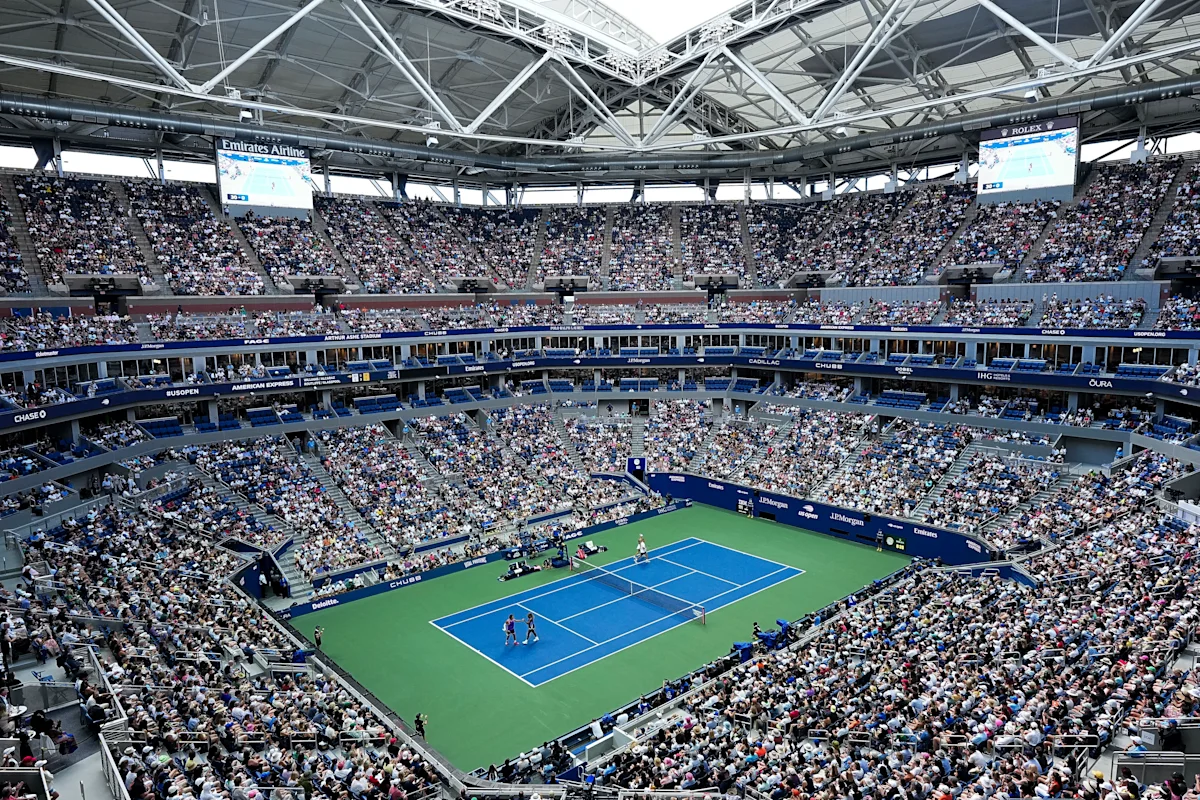
NEW YORK — At some point within the past handful of years, the US Open joined the Masters and the Kentucky Derby in the elite tier of sporting events that many Americans, whether they care about the sport or not, want to cross off their bucket list.
In the era of social media, this was probably unavoidable. For as long as the tournament has been here at the Billie Jean King National Tennis Center, it has been as much about the sensory festival that takes place outside the courts as the tennis itself.
Everything here is designed to catch the eye. From the red carpet area where celebrities arrive to the luxury brands that set up stores around the perimeter of the show courts to the pink hue of the Honey Deuce — the tournament's signature cocktail — it's all optimized to signal that you're part of an exclusive experience that transcends the mundane, even old-fashioned act of attending a sporting event to watch sports.
What was once a very New York-coded event — Wall Street corporate types and entertainers filling the expensive seats in Arthur Ashe Stadium, the local loudmouths drinking late into the night and creating the most daunting atmosphere in tennis — has become a tableau to fill your Instagram feed with images of a lifestyle you can only get by coming here.
"Every Slam has their own identity, and the US Open has always been the big show Grand Slam," said Madison Keys, who is playing here for the 15th time. "You can see (now) there's a lot more, like, influencers."
For its part, the US Open is leaning all the way into its newfound cultural cachet. It has created a separate credential for content creators in hopes of selling the experience of attending a tennis tournament to a younger, wider demographic. Craig Tiley, who was hired away from Tennis Australia to run the U.S. Tennis Association earlier this year, said he envisions the US Open becoming "the tennis Disneyland."
But the tradeoffs of straying from the core tennis audience — and the USTA's chase to extract every possible dollar out of this event — have begun to emerge as a hot topic.
In the days leading up to the event, ticket prices on the secondary market surged to more than $300 for a grounds pass that retails for $65. Fan Week, which takes place around qualifying the week before the main draw and offers free access to the grounds, has gotten so big that you now have to register for a pass to prevent overcrowding. Over the first couple days of the main draw, it was common to see long lines of people trying to get into the outer courts, where seating is first-come, first-serve. And even if you can get in the door, there is no break from captive capitalism at the concession stands where you'll pay $30 for a Carnegie Deli-branded hot pastrami sandwich, $23 for the Honey Deuce and $42 for a glass of the Moët & Chandon Nectar Imperial Rosé.
For older fans who remember a simpler (and cheaper) time at this tournament, it might bring to mind the classic Yogi Berra line about Ruggeri's restaurant in St. Louis: "Nobody goes there anymore — it's too crowded." But actually the opposite is true. As demand continues to spike, there seems to be no end to how much money the USTA can squeeze out of these three weeks, even if fans have to endure a longer line or two and reach deeper into their pockets to get through the gates.
"I think it's a nice problem, I guess you could say, because there is an insatiable appetite to come out to Flushing and to watch all the opportunities we have for the fans," Tiley said. "One of the things we need to be very conscious of is getting the balance of how well we manage that. It will be something that we'll continue to make sure that we stay on top of. We're not going to be one of those events that just want to pack the precinct for the sake of packing it."
As the US Open continues down this path, however, it will face increased scrutiny about whether its purpose has become out of line with its ambitions.
On Monday, the USTA announced a "groundbreaking partnership" with Kalshi to be the first "Official prediction market" of the US Open, which is an odd look for a sport where players receive tremendous amounts of online abuse from gamblers and match fixing has been a longstanding problem at the sport's lower levels.
Meanwhile, the tournament is being played in the midst of a two-year, $800 million renovation of Arthur Ashe Stadium that focuses on adding premium (i.e., more expensive) seating and luxury suites rather than additional access for the common fan.
And all this for a nonprofit organization whose mission statement is "Growing tennis to inspire healthier people and communities everywhere."
In many ways, the completion of the Ashe renovations will bring the US Open full circle. When the tournament moved in 1978 from the small but elite West Side Tennis Club on the other side of Queens to this new public facility with a huge stadium, it brought tennis out of American country club culture to the masses for the first time.
Now, it's just like every other premium sports experience in this country: Unaffordable for most, more popular than ever and the ultimate stage for players to market themselves and their sponsors.
"Even if you're not a quote-unquote 'tennis fan,' people know about the US Open," said three-time Grand Slam doubles champion Taylor Townsend, who is using the tournament to debut custom outfits she designed with a celebrity stylist. "I think there's a super cool intersection between culture and sports across the board and we're in a fun and entertaining time. I'm honored to be someone that is pushing culture forward, to inspire people, to carry the torch for representation and having a completely different brand identity than any other outlet out here and doing things in a unique way. So the US Open kind of gives me the runway to be able to do that because of what it means for everyone."
This is all, of course, great for the players who see their faces plastered on billboards all over New York and mingle with the city's elite at various sponsor events in the week leading up to the tournament. Also, prize money this year will be a record $108 million, with $5.5 million each to the men's and women's singles champion. Even a first-round loss in the singles main draw is worth $140,000.
The tournament's largesse has minted a lot of financial winners including the USTA, which makes 90 percent of its annual revenue (more than $600 million) off the event. But it has changed the tournament in ways that seem hard to dial back.
As a response to the ticket price discourse, New York mayor Zohran Mamdani managed last week to negotiate for 1,000 tickets to be sold at $100 each only to New Yorkers via an online lottery. More than 300,000 people registered in hopes of landing one.
As much as accessibility is a worthy goal, it's not possible to engineer it in a way that satisfies everyone. That's supply-and-demand at work. At the same time, letting the secondary ticket market rip to the point where it costs more than $300 to get in the door feels discordant with the mission of an organization whose goal is supposed to be growing interest in tennis.
"One thing that's critically important to us as an event is we want kids to be able to experience, there's the sense or having the aspiration of wanting to become a player in their future lives when they get to see the players of today," Tiley said. "We need to continue to find ways to make it affordable, and most importantly, accessible. The US Open, as a sporting and entertainment event, is up there, No. 1 or No. 2 in the United States and potentially globally, and that demand is something we have to match with the balance of making sure kids have access."
That's going to become harder and harder if the tournament and its influencer army continues to make this a bucket list experience for more people. Contrast that with the Masters, which has chosen (for the most part) to keep its vibe bespoke and its prices low by controlling its ticket supply through a lottery and strictly prohibiting resales.
It's great for those who are lucky enough to get tickets. It's agony for those who apply for the lottery year after year and continually get shut out, even if they have the means to attend.
Is an experience that can't be bought on the secondary market better than an event like this where anyone can buy their way in? That's in the eye of the beholder (or, more to the point, the ticket holder). But no matter the price or the inconvenience, people still can't get enough. If there's a limit to what people will pay to see Grand Slam tennis, the US Open has not yet rubbed up against it.
"Every year I come here, I'm like, 'Wow, it's pretty insane,'" said 46th-ranked Alex Michelsen. "There are so many people, but I love it."
Topics in this story
Gathered from external sources. Rights to this text belong to whoever originally published it.