Andy Roddick built a fortune after tennis: Details on his endorsements, business ventures, real estate and media success in his remarkable second act
After retiring from tennis, Andy Roddick has built a remarkable second act through endorsements, business investments, and media success, showcasing his financial acumen and philanthropic efforts.
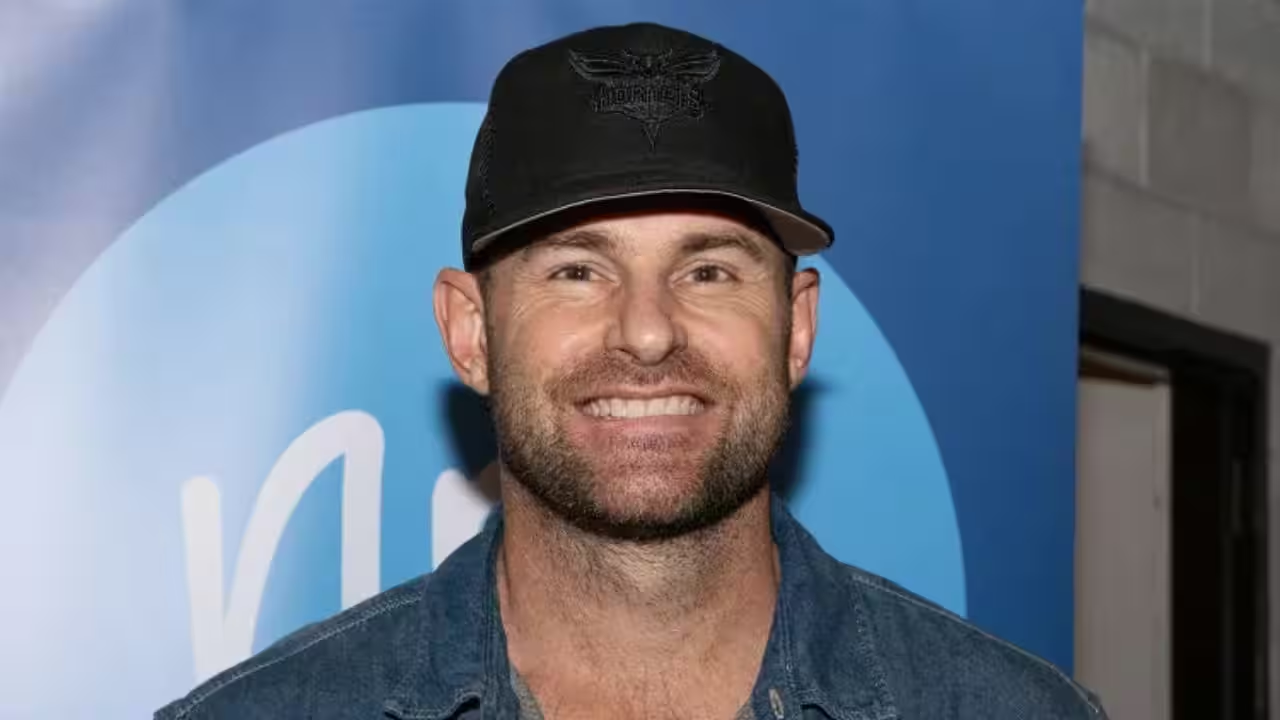
Andy Roddick's transition away from professional tennis has become almost as notable as his playing career. The former world No. 1 retired in 2012 after winning the 2003 US Open, reaching four other Grand Slam finals and collecting 32 ATP Tour singles titles. Rather than relying solely on his previous sporting income, Roddick spent years building businesses and investments designed to generate value beyond the court.That strategy has increasingly paid off as Roddick has returned to the public spotlight through media and entertainment. His commercial interests include real estate and consumer brands, while his podcast Served with Andy Roddick has developed into a significant media property, and in 2026, his multi-year ESPN analyst deal has added another prominent platform to a second career that combines tennis expertise with entrepreneurship.Andy Roddick’s wealth-building strategy after tennisRoddick began thinking about his post-tennis finances while he was still competing. Instead of treating endorsement and prize money as income that could simply be spent, he focused on turning earnings into assets capable of producing long-term returns.A major part of that strategy was commercial real estate. In an interview with Forbes, Roddick explained that his business included triple-net leased commercial properties, with tenants including major companies such as Starbucks and Home Depot. The model appealed to him because long-term leases could provide relatively predictable cash flow while the underlying properties appreciated over time.His investment approach was also deliberately diversified. Forbes previously reported a portfolio framework that allocated approximately 40% to triple-net commercial real estate, 25% to listed equities, 15% to venture investments, 10% to professionally managed hedge funds and 10% to tax-deferred investments. The precise allocation can change over time, but the underlying philosophy was clear: build wealth through multiple asset classes rather than depending on tennis income.According to Celebrity Net Worth, Andy Roddick has an estimated net worth of $40 million. The estimate notes that his career tournament prize money exceeded $20.6 million, with tens of millions more generated through endorsements during his playing career.Real estate has also played a personal and entrepreneurial role in Roddick's financial story. He and his wife, actress and model Brooklyn Decker, have been involved in buying, developing and selling properties.One of the better-known examples was their Austin, Texas, estate. The couple purchased a 15-acre property for approximately $3.7 million in 2013 and later built a custom home on the site. After initially seeking $6 million, the property ultimately sold for about $4.65 million in 2019.Andy Roddick expands ventures beyond tennisOne notable example was TravisMathew, the lifestyle and apparel company. Roddick became an investor and brand ambassador in 2013, demonstrating his preference for taking an equity position rather than relying entirely on conventional athlete sponsorships. Forbes later described his decision to invest in the company as an example of how he sought to use capital after retirement.His business interests have also included Sweetens Cove Spirits Company, while other reported investments have included Tiff's Treats and ViewFi Health. In 2024, Vox Media described Roddick as a co-founder of Sweetens Cove and founder of Roddimeyer NNN real estate, alongside his expanding media activities.His entrepreneurial activity has also extended into sports and entertainment. Roddick has maintained a strong connection with tennis while deliberately expanding into areas that can operate independently of tournament competition. That distinction is important because professional athletes often face a sharp income transition after retirement. Roddick's strategy was designed to address that problem before it arrived.Andy Roddick balances media, endorsements and philanthropyOne of the biggest developments in Roddick’s life since retiring from tennis has been the growth of Served with Andy Roddick. The podcast kicked off in January 2024 with journalist Jon Wertheim and producer Mike Hayden. It was a pretty small project at first, but quickly evolved into a major tennis media platform.The podcast has since grown an audience across audio, video and social platforms, with high-profile guests like Rafael Nadal. Forbes estimates Served generated about $4 million in advertising revenue in the year leading up to 2026 and the larger network has kept growing.The show’s growth also explains why Roddick’s strategy following his playing days has become more and more media-centric. His previous life as a world No 1 gives him access to players and stories and his forthright approach provides a personality-led format that is not traditional match analysis.Roddick's media expansion reached another level in 2026 when ESPN announced a multi-year agreement with him as a tennis analyst, and the deal covers match and studio coverage, including Wimbledon and the US Open.His ESPN role gives him a major broadcasting platform while allowing his knowledge of professional tennis to remain central to his work. His first Wimbledon assignment in 2026 marked a return to the tournament where he reached three finals but never captured the title.Entertainment and philanthropy remain part of his legacyRoddick has also expanded into entertainment, and his appearance in the Apple TV film The Dink added another dimension to his public profile, bringing his tennis background into a mainstream sports comedy setting. Forbes reported that his television and film work generated nearly $1 million in estimated earnings alongside his podcast income.At the same time, the former champion continues to maintain a strong philanthropic focus through the Andy Roddick Foundation. Vox Media noted that the foundation has raised more than $30 million to support underserved young people in Central Texas through education and sports-based mentoring programmes.Roddick's second act consequently extends well beyond accumulating wealth. The combination of investment discipline, entrepreneurial ownership, media work and philanthropy has allowed the former US Open champion to build a career that remains connected to tennis without depending on professional competition.His financial journey illustrates how an elite athlete can use the peak years of a sporting career to prepare for decades beyond it. From commercial real estate and business investments to Served, ESPN and entertainment, Roddick has steadily turned his reputation into a broader professional platform, and according to Celebrity Net Worth, his estimated $40 million fortune reflects a career that continued developing long after his final competitive match.Stay updated with the latest Asian Games 2026 news, check the Asian Games medal tally and complete Asian Games schedule.Get the latest Sports News and Live updates. Download the TOI app.
Topics in this story
Gathered from external sources. Rights to this text belong to whoever originally published it.