Messi, the immigrant who never forgot his homeland
How Lionel Messi remained rooted in his Argentine heritage throughout a career that redefined global soccer and modern sports history.
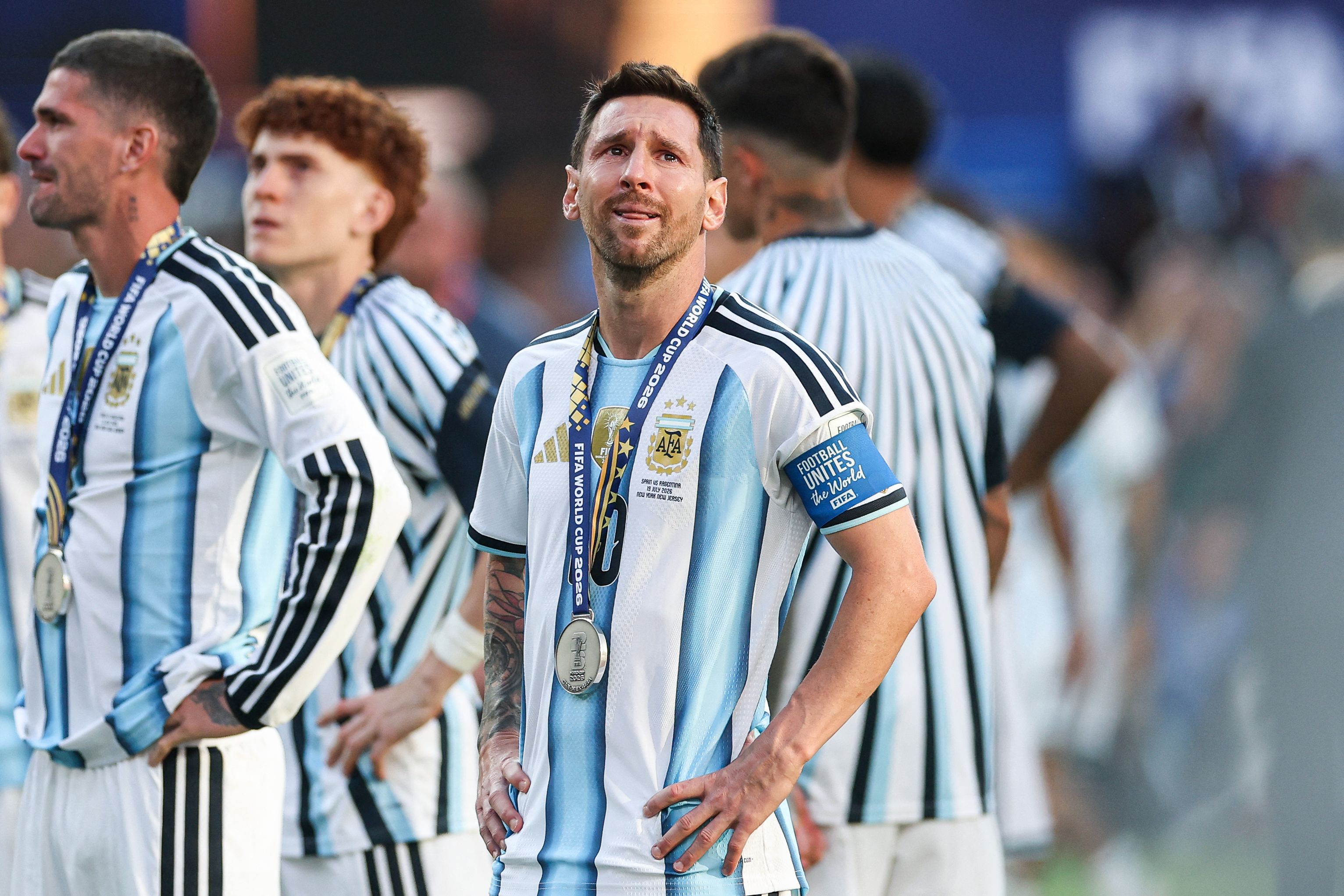
Everything around him was chaos. Red jerseys moved through the chaos, converging in embraces of euphoria and glory. Tears and anger led his teammates to turn what had been a sporting contest into a battle once the match was over. The stadium music blended with the victorious fans’ shouts of jubilation and the losing side’s songs of pride and gratitude. His gaze remained fixed on the stands most crowded with his compatriots. Some claimed he turned his back on the award ceremony out of anger. In reality, Lionel Messi was trying to imprint every image on his memory, to hold onto every sound, every feeling. He wanted to absorb it all, knowing that moment would serve as the raw material for the countless times he would remember this day. He was sad for having lost the World Cup Final, but he wept inconsolably because he knew it was his final match with the Argentina National Team. Messi is an immigrant who left his homeland as a child to seek better opportunities for himself and his family, just like millions of people who leave their native countries every day. And like most migrants, he never forgot his love for his country. He could have chosen to represent Spain instead of Argentina, a decision that likely would have earned him three or four World Cup titles. Yet he never denied his roots. Beyond his immense talent, his humility and respect in a foreign land are key reasons why he remains a global Latin American icon.. The greatest soccer player in history spent only the first 13 years of his life in Rosario. His origin story is well known: diagnosed with a growth hormone deficiency, he required costly treatment that his family could not afford and his local club refused to cover. FC Barcelona stepped in to pay for the medical care. The economic situation in Argentina, as across much of the region, remains complex, often leaving the airport as the only viable path forward. In the youth divisions of the Catalan club, he immediately stood out. Soon, efforts began to have “La Pulga (the flea),” as he was nicknamed at the time, play for the Spanish national team. But his and his family’s attachment to their roots was very strong. Even as a child, he stated in an interview that his dream was “to play for the Argentina national team.” Acting fast, the Argentine Football Association organized a friendly match to debut Messi for their under-20 squad and be “locked in.” That’s how his journey began, on June 29, 2004, just days after he turned 17. Argentine fans were eager to see him play for the senior national team. That moment came on August 17, 2005, in a friendly against Hungary. Incredibly, Messi came on 19 minutes into the second half and was unjustly sent off just seconds later. Perhaps it was a chaotic sign that his path to international glory would not be easy. It is worth taking a brief look back to understand the magnitude of Messi’s legend in the sky blue and white jersey. His journey followed the “hero’s path” of any good movie script. From the mud to the sky. His debut came in the midst of an era full of disappointments and frustrations in Argentina. The country was locked in a constant search to find the “New Maradona” to restore national glory. To make matters worse, Messi was left-footed, wore the number 10 and dazzled everyone. The comparison was as inevitable as it was unfair, placing immense pressure on his shoulder. While he was winning absolutely everything with Barcelona, titles with the senior national team eluded him. Within his beloved country, the criticism was fierce. His love for the jersey was questioned, his attitude, everything. It was even constantly criticized that “he didn’t sing the national anthem” before the start of the matches. And this was directed at him, who could have chosen an easier path elsewhere in the world. Yet he endured the scrutiny with grace, maintaining his composure and setting an example. Then came Brazil 2014. A World Cup on the soil of the “intimate enemy.” Argentina reached the final after 24 years. Everything seemed perfect; it was supposed to be the ultimate trophy. But Germany had other plans. Two more agonizing disappointments followed in consecutive Copa América finals against Chile. Messi hit rock bottom and gave up: “I’ve now lost four finals… My time with the national team is over. Four finals. It’s not for me. Unfortunately, I tried. It was what I wanted most. It didn’t happen for me, but I think that’s it.” But like a true champion, he reconsidered and quickly returned to the national squad. That period marked the most challenging stretch of his international career. After the lost finals, the team barely qualified for Russia 2018 and had a very poor showing. In 2019, he gave one of the most inspiring statements of his career. He made it clear on Fox Sports that he would not give up: “I want to finish my career having won something with the Argentina national team. And if not, at least having tried every possible time. That’s the message for the kids who follow me. Not just for soccer, but for life. Because that’s what life is: stumbling, getting back up, and trying again. Fighting for your dream.” Validation finally arrived at the 2021 Copa América in Brazil, where he lifted his first senior trophy 16 years after his debut. From that point on, the pressure lifted, allowing his genius to flow unburdened. At Qatar 2022, Messi captured the ultimate prize. The arduous journey to reach that moment made the triumph even sweeter. Fans rallied around his resilience, humility, and unwavering loyalty to his country. At 38, playing in his sixth World Cup, he proved decisive once again. In case there was any lingering doubt, he checked off another box that had always been brought up in comparisons with Maradona: he eliminated England, the great rival, with a brilliant performance. This time, his body didn’t allow him to play the final against Spain at his usual supersonic level. And the perfect ending wasn’t possible. But after this tournament, there was broad consensus that Messi stands as the greatest of all time. Argentine superstar Lionel Messi announced Monday that he is retiring from his country’s national team.“It was a decision that hurt — and still hurts deep down — but I understand that the time has come,” he said in a statement on Instagram. “I swear to you that I always gave it my all — not just in these last few years when we won everything, but before that too; I always fought and left everything on the field for this jersey, to bring you joy and make you feel proud to be Argentine through football.”Messi is widely considered to be one of the sport's all-time greatest players, and for many he is at the top of the list. He is Argentina's all-time leading goalscorer, and he led his country to a World Cup victory in 2022. At club level, he is the all-time leading scorer for FC Barcelona and the Spanish soccer league La Liga.Messi has won the Ballon d'Or trophy, given annually to the sport's top player, a record seven times. He has also won four Champions League titles with Barcelona. The captain’s eventual retirement from the national team came as no surprise. The death of his father weighed heavily on him, as reflected in his emotional farewell statemen: “I don’t know what I’m going to do without you, I don’t know how to go on. I only played soccer and now I have serious doubts that I’ll keep doing it for much longer.” Besides, he’s 39 years old and time is starting to take its toll. Still, as obvious and expected as this farewell may have been, it doesn’t make it any less painful. There are unique and unrepeatable experiences in life. Sports lovers understand the privilege of seeing Michael Jordan, Roger Federer, or other GOATs live. It’s like watching a shooting star with a unique color pass through the vast sky, brighter than the rest, unrepeatable. His talent can still be appreciated in the MLS, although he has already given several hints that his time as a professional is coming to an end. Without a doubt, an era has ended—not only for Argentines, but for all soccer lovers. In his farewell post, Messi closes by writing, “Thank you God for making me Argentine.” Love for one’s country doesn’t depend on where you live. It depends on where you are from. And Messi is Argentine.
Topics in this story
Gathered from external sources. Rights to this text belong to whoever originally published it.