How Messi's struggle to emerge from Maradona's shadow sealed his eternal glory in Argentina
Lionel Messi has come a long way in his Argentina career — but he'll go down as one of the nation's greats.
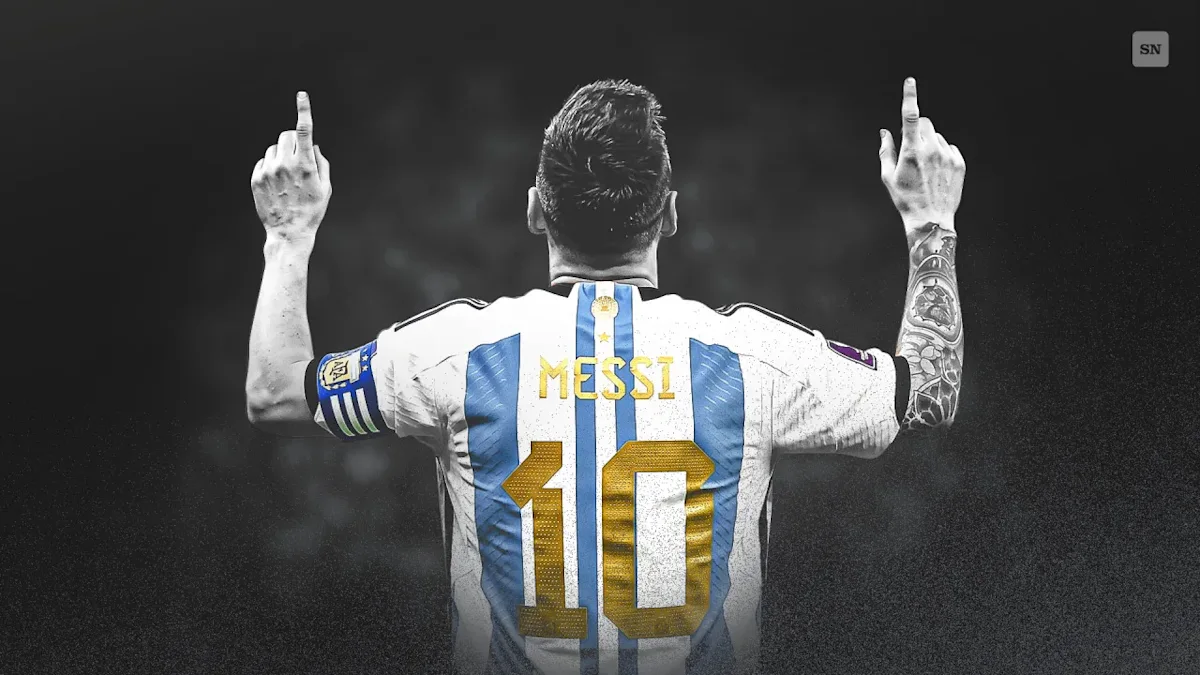
No one does a mass outpouring quite like Argentina soccer fans.
Take the estimated five million who poured onto the streets of Buenos Aires to celebrate the national team finally winning a third World Cup in 2022, Lionel Messi 's long-awaited finest hour.
Or the millions who took to town squares across the country when the nation's eternal icon Diego Maradona died in November 2020. Ongoing coronavirus restrictions never stood a chance.
On Tuesday, at River Plate's Estadio Monumental in the nation's capital, similar emotions will mesh. The stakes aren't as high, but there will be waves of joy and sadness when Messi plays in Argentina colours for the final time against Benin on Tuesday.
The eight-time Ballon d'Or winner is bowing out on top at the right time. It will feel like a sporting death as tears are shed, but what a sporting life. Messi has the eternal gratitude and love of a soccer nation quite unlike any other.
After inspiring Argentina to glory in 2022 and sparkling at the 2026 World Cup – eight goals, four assists and evergreen brilliance – Messi is assured of a lifetime of affection unimaginable to most mortals.
What makes this all the more remarkable is that it was never guaranteed. Indeed, for a decent chunk of Messi's international career – at a time when he was the consensus best player on the planet – the universal love of his homeland didn't even seem likely.
"Football, for us, isn't rational . Even though we didn't invent it, even though we're not the best at it, even though we don't always win, even though our organizations are a ship adrift," Mauricio Codocea wrote on these pages after the 2022 World Cup final. "The thing about us Argentinians and football is that we feel it more than anyone else. We feel it like Maradona did. We feel it like Messi does."
This is the story of Messi's long walk home to the country he left as a child, how he took that country on his shoulders as an adult and felt it as much as every single one of them.
Turning out in his home province at a major tournament for Argentina, Messi was introduced as "the best in the world" by the stadium announcer at Santa Fe's Estadio Brigadier General Estanislao Lopez.
The response was polite applause. Fair enough: perhaps the locals were nervous following a lacklustre opening draw against Bolivia in the 2011 Copa America. There was little room for further error with Colombia in town.
Next up, after Messi's No. 10, was the Albiceleste's No. 11. "The player of the people, Carlos Tevez!" The masses roared. This outpouring of affection for Tevez on Messi's turf offered a snapshot of the discussions and presumptions over Argentina's star player as he entered his prime years.
His otherworldly quality was beyond question. Messi had just won his second Champions League in three seasons at Barcelona and was two Ballons d'Or into an unbroken four-year run. But he increasingly came up short in the popular imagination in terms of intangible and shifting measures of authenticity.
A century ago, Argentina was the birthplace of what might be referred to today — derisively or otherwise — as football hipsters. Writers working for the influential sports magazine El Grafico wrote in romantic terms about how the sport brought to South America as a well-mannered British game had developed a uniquely Argentinian edge as it evolved within burgeoning working-class communities. This amounted to greater cunning, improvisation and trickery, underpinned by a sleight-of-hand if required.
The writer Ricardo Lorenzo, better known by his pseudonym of Borocoto, felt this democratisation of football made it as fundamental to the Argentine experience and identity as tango music. As recounted by Jonathan Wilson in his book on the history of football in Argentina, Angels With Dirty Faces , in 1928 Borocoto described raising a statue to the imagined inventor of dribbling.
"A pibe (a kid/urchin) with a dirty face, a mane of hair rebelling against the comb; with intelligent, roving, trickster and persuasive eyes and a sparkling gaze that seems to hint at a picaresque laugh that does not quite manage to form on his mouth, full of small teeth that might be worn down through eating yesterday's bread," Borocoto began.
"His trousers are a few roughly sewn patches; his vest with Argentinian stripes, with a very low neck and with many holes eaten out by the invisible mice of use. His stance must be characteristic; it must seem as if he is dribbling with a rag ball. This is important: the ball cannot be any other. A rag ball and preferably bound by an old sock."
For all his inimitable gifts, as a middle-class kid from Rosario, Messi had not had to spend too much time chewing on yesterday's bread and kicking around a rag ball in careworn clothing, even before Barcelona and their European riches uprooted Leo and his family, bringing them to Catalonia when he was 13 years old. Tevez, on the other hand, fitted this archetype like a glove, with his rampant playing style, unruly appearance and tough upbringing on the dangerous streets of Fuerte Apache all part of the same whole.
As Wilson points out, Borocoto did an eerily excellent job of describing Diego Maradona more than half a decade before his 1980s heyday. El pibe de oro — the golden boy — was one of Maradona's most enduring nicknames in Argentina. His upbringing was pure Tevez and he scrapped his way to riches on the other side of the Atlantic Ocean, as opposed to being hand-picked for stardom.
These comparisons became tougher after Maradona's unexpected move into Messi's orbit. Despite minimal and largely unimpressive coaching experience, Diego was appointed Argentina boss in 2008. It wasn't that the two men clashed; on the contrary, they had a close and warm personal relationship.
Maradona made Messi the focal point of his team, playing where he would have played in a 4-3-1-2 as the difference-making No. 10. But Argentina were hammered by Germany in the quarterfinals and the man who overtook the World Cup's all-time leading scorer Miroslav Klose last summer played five matches without scoring a goal.
The 2011 Copa also ended in disappointment, with Argentina drawing three of their four games before going out on penalties to Uruguay in the quarterfinals. Shootouts would become an ever-prevalent part of the story, but the gap between the calibre of Argentina's European-based superstars and the national team's level of achievement was far too jarring for fans during the period. When it came to Barcelona icon Messi, there was a chasm between what he was and what Maradona had been.
"While some people always supported him, a large portion of the public was very critical of him in his early days, and even a little later with the Albiceleste," says Renzo Desaunet of Sporting News Argentina. "This was due to many factors, but mainly to the high expectations Argentines place on their stars—especially since he was so often compared to Maradona. Diego's flamboyant personality was directly proportional to Leo's shyness—a humble young man who grew up in Spain, something many have held against him, as if that made him any less Argentine!
"Failing to achieve goals with the national team—while excelling at Barcelona—led to mounting criticism, to the point where he was singled out for the slightest thing, such as occasionally not singing the national anthem. He may not have performed at his best for Argentina in the occasional tournament, but there was no doubt that he gave it his all."
It was the soundtrack of the World Cup in Brazil and the Brazilians hated it. Perhaps not quite as much as getting seismically demolished by Germany 7-1 in the semi-finals, but it was a close-run thing.
Vocal Argentina fans decamped to their neighbouring country en masse. Surely, they felt, it was their time. Some estimates suggest in excess of 200,000 made the pilgrimage over the course of the tournament, many travelling without tickets and winging it: staying in schools, sleeping on the streets or finding a place to crash in the favelas.
The man bearing the most responsibility for this odyssey was Messi. He was 26 when the competition kicked off, the age Maradona was in 1986. He was Argentina's captain and No.10, and accompanied by five teammates from that Youth World Cup triumph of 2005. Together, they were ready to fulfil the promises made back then.
The travelling Albiceleste caravan delighted in leaning into this symbolism. Their tournament anthem of Brasil decime que se siente (Brazil, tell me how it feels), hollered to the tune of 'Bad Moon Rising' by Creedence Clearwater Revival, ended thusly:
"With Messi, you're going to see — the cup, he's going to bring it home. Maradona is greater than Pele."
After a disappointing season at Barcelona without a major honour, Messi started like a house on fire. He scored five in three games in the group stage, with two genuine goal-of-the-tournament contenders against Bosnia & Herzegovina and Nigeria. He'd laid the platform to do what Diego did in 1986.
But he couldn't build on it. Fatigue seemed to grip Messi in the knockout stages and he became increasingly peripheral. There was a superb assist for Angel Di Maria to avert penalties against Switzerland before Gonzalo Higuain's early goal saw Belgium dispatched by the same 1-0 scoreline. A suffocating 0-0 draw against the Netherlands in the semifinals ended in a penalty shootout victory for Alejandro Sabella's side.
Those gruelling, tight matches preceded another in the final, where Mario Gotze's extra-time goal ended Messi's dream after 90 goalless minutes.
"For me, the national team is over," Messi said. "I've done all I can. It hurts not to be a champion. It's been four finals [including the 2007 Copa America], I tried. It was the thing I wanted the most, but I couldn't get it, so I think it's over.
"I think this is best for everyone. First of all for me, then for everyone. I think there are a lot of people who want this, who obviously are not satisfied, as we are not satisfied reaching a final and not winning it. It's very hard, but the decision is taken. Now I will not try more and there will be no going back."
Those were Messi's comments after his shootout failure in the Copa America Centenario final at MetLife Stadium, which contributed to Chile walking away with the trophy. He shed tears on the field. Argentina also lost in the Copa final via the same means to Chile in 2015, that unusual quirk of the calendar meaning La Albiceleste had lost three finals in agonizing circumstances in the space of three years, leaving Messi still without a major trophy.
"In Argentine culture, finishing in second place often looks worse than not competing at all or being mediocre," says Agustin Aboy from Sporting News Argentina. "Three consecutive losses in finals made the glory look impossible, even for Messi."
There were other factors behind an ultimately short-lived international retirement. The playing squad as a whole had been broadly dissatisfied with the Argentine Football Association's (AFA) provisions on international duty for some time. Nevertheless, the sight of Leo being so distraught that he could not bear it anymore disabused anyone of the notion that the kid who moved to Barcelona as a young teen didn't care about Argentina. If anything, he cared too much.
There was an outpouring back home, pleading with Messi to overturn his decision. He did so soon enough, rejoining Argentina's struggling campaign to qualify for the 2018 World Cup. They we staring at elimination when they fell 1-0 behind to Ecuador at Quito's punishing altitude. Messi responded with an otherworldly hat-trick, fixing the problem himself in a way that only he could.
Argentina were bound for Russia, the Messi generation granted a final chance to make good on their promise. There was even a top-tier coach in position, with Jorge Sampaoli abandoning a burgeoning career in Europe to take the reins. But Argentina were a rabble.
They drew with Iceland, a game notable for one of Messi's most infamous penalty-kick failures, and were hammered by Croatia. Messi scored a majestic goal in a breathless 2-1 win over Nigeria, despite the squad effectively being in open mutiny against Sampaoli at this point.
A chaotic Argentina side ran out of road in a rollercoaster 4-3 defeat to France in the last-16, a scoreline tempered by Sergio Aguero's goal deep into stoppage time. It was the end of the road for a team that flattered to deceive. But, crucially, Messi wasn't done. Not this time.
From the ashes of their Russian expedition, against all odds, rose one of the most successful international teams in history. Lionel Scaloni was left as the last man standing from Sampaoli's backroom staff. Largely on the grounds of being cheap and available, the AFA gave him the job.
A third-place finish at the 2019 Copa ensured Scaloni could be more than a stopgap. Two years later, at a behind-closed-doors Maracanã, Argentina beat their great rivals Brazil to win the Copa America. Angel Di Maria, one of Messi's last remaining allies from the golden generation, got the goal and the monkey was off their back. They had momentum, took it to Qatar and you know the rest.
Any player who produced the tournaments Messi did in 2022 and 2026 – not to mention retaining the Copa in 2024 in between — would be remembered as an all-time great of international soccer. It is not only his inimitable greatness that separates him from the rest, but also the struggle he had to endure to prevail.
"Through that long and turbulent road, the story had an even sweeter ending," Agustin says. "Today, Messi now enjoys that something almost no one in Argentina ever achieves, not even the biggest legends in any discipline: he is beyond debate."
Topics in this story
Gathered from external sources. Rights to this text belong to whoever originally published it.